
People’s Party’s Wiroj says ‘IO’ networks are spreading fake news, vows legal action
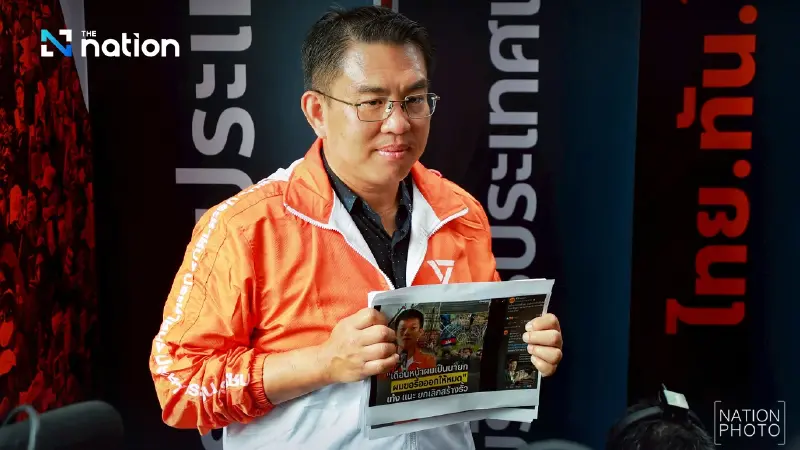


People’s Party deputy leader Wiroj Lakkhanaadisorn says coordinated ‘IO’ accounts, bots and influencer networks are spreading false claims during the campaign, and says the party will submit evidence to the Election Commission and pursue computer-crime charges.
Wiroj Lakkhanaadisorn, deputy leader and party-list MP candidate of the People’s Party (PPLE), said on Monday that the party is preparing to take action against what he described as an organised “IO” operation spreading disinformation to smear the party, and will submit complaints to the Election Commission (EC) under election law.
Wiroj said the problem has continued throughout the campaign and has intensified, involving coordinated smear tactics through IO accounts, fake accounts, bots, and page farms, combined with the use of influencers to reproduce and amplify false messages and information. He said the aim is to repeatedly mislead the public about the People’s Party, and insisted such conduct clearly violates election law.
He said defamatory posts targeting the party typically attract comment patterns featuring repeated, identical wording across multiple stories and posts involving the party. The People’s Party, he said, has collected these repetitive comments from different accounts and is linking them together, with the intention of tracing them back to the political actors behind the operation. The party’s legal team will compile all such comments—along with the content of his statement—before submitting the evidence to the EC for legal proceedings.

Wiroj said the People’s Party accepts criticism when it reflects genuine public opinion—even harsh language—and is prepared to listen. What is happening now, however, he said, is a coordinated operation designed to smear the party using false claims, rather than natural public debate.
He cited several examples. One, he said, is the production of false security-related claims to attack Natthaphong Ruengpanyawut, the party leader, alleging that he would “remove all fences” if he became prime minister—something Wiroj said Natthaphong has never proposed or stated.
He also said Section 112 of Thailand’s Criminal Code has been used as a political weapon, with claims circulated that the People’s Party has a policy to amend the law. Wiroj said the Constitutional Court’s ruling makes clear that Section 112 cannot be used as a political party policy. In another case, he said, when Natthaphong received a letter from a junior soldier affected by war and hardship, disinformation networks alleged it was staged, with linked pages amplifying the accusation through posts and shares.
Wiroj said these tactics have not targeted Natthaphong alone, but also a number of other People’s Party MP candidates. He said the party has already gathered information on pages and user accounts associated with the networks, and will summarise and submit it to the EC. The party also plans to file complaints under the Computer Crime Act 2017.

On controversies involving the party’s candidates—after one People’s Party candidate was arrested and prosecuted, with reports suggesting further cases may follow—Wiroj said the party’s screening process has relied on criminal background checks and credit bureau checks. Candidates were selected only if they had no outstanding arrest warrants and had never been convicted under final judgments in serious criminal cases.
He said the legal action or arrest warrants involving People’s Party candidates occurred after the candidate registration process had already closed, and that those arrested had no prior convictions or court rulings against them.
While some of the candidates now facing legal action had previously been the subject of complaints, Wiroj said the party did not ignore tips or allegations. The party has a review mechanism through its adjudication and disciplinary committees to investigate for evidence or invite the accused to provide explanations. If no concrete evidence emerges, or the person can provide a reasonable explanation, he said the party cannot rely solely on allegations or tips to judge a candidate in advance.
Wiroj said the People’s Party aims to be a mass-based party that is open and encourages broad public participation, which can create vulnerabilities in who joins and works with the party. He said the party has tried to make screening and selection as rigorous as possible, but acknowledged that openness can come with shortcomings. He said good governance requires taking proportionate public responsibility.
“The People’s Party has never claimed it will never make mistakes,” Wiroj said. “But we insist that when wrongdoing occurs, we will not protect it, and we will not apply double standards. That is the difference between the politics people want to see and the old-style politics people no longer want.”
He said cracking down on grey capital, money laundering and corruption must be real, and must apply to everyone—including one’s own side. Even if it costs popularity or political advantage, he said, it must be accepted. “When we receive power from the people, no one will have privileges above the law—not even members of the People’s Party,” he said.
