
Budget Bureau flags THB25trn in campaign pledges, warns of debt ceiling risk


The Budget Bureau says big-spending election pledges could push public debt above the 70% legal cap and weigh on Thailand’s credit outlook, as the EC discloses THB25 trillion in policy costs across 51 parties.
A report by the Budget Bureau says it has completed its assessment of political parties’ spending-related campaign policies and their fiscal implications under Thailand’s medium-term fiscal plan for FY2027–FY2030, submitting its findings to the Election Commission (EC) and the committee overseeing parties’ expenditure-based policy advertising.
The bureau found that most 2026 campaign proposals focus on easing living costs, stimulating the grassroots economy and expanding universal welfare, largely through fiscal measures. While these policies aim to deliver immediate, tangible benefits to the public, the bureau warned they would raise recurrent expenditure and add to public debt.
The bureau noted that welfare measures such as cheaper electricity and subsidies for public transport would be recurring annual costs, increasing fixed budget burdens over time.
It added that Thailand’s recurrent spending framework is already tight, with recurrent expenditure accounting for about 70% of the annual budget. Proposals that further expand recurrent spending, it said, do not align with the medium-term fiscal plan for FY2027–FY2030.
On the expenditure side, the bureau said budget preparation is being geared towards maximising efficiency and effectiveness, with a core aim of not increasing recurrent spending.
It also said stricter scrutiny is being applied to capital expenditure allocations under Section 20(1) of the State Fiscal and Financial Disciplines Act BE 2561 (2018), which requires investment spending of at least 20% of the annual budget and not less than the annual deficit amount.
Areas requiring close discipline include personnel costs, public welfare, medical expenditure obligations, utilities and operating costs of state agencies.
The bureau warned that tax deductions or exemptions aimed at easing household burdens could narrow the tax base, running counter to the FY2027–FY2030 medium-term plan’s emphasis on improving revenue collection efficiency.
It also referenced a phased adjustment to measures equivalent to gradually rolling back a VAT-rate reduction, with an increase from 1.5% to 8.5% in 2028 and a further rise to 10% in 2030.
The bureau said large-budget policies could force the government into sustained deficit financing, directly pushing the public-debt-to-GDP ratio towards — and potentially beyond — the 70% legal ceiling. It projected the ratio at 69.36% in 2027.
It added that policies that could become binding obligations under Section 28 of the fiscal discipline law — including debt reduction, debt moratoria or debt write-offs; consumption and economic stimulus; direct handouts; income guarantees and production subsidies; and targeted welfare schemes — may affect Thailand’s sovereign credit assessment.
Global credit rating agencies, it said, have expressed concerns about long-term fiscal sustainability, reflected in changes to Thailand’s outlook, signalling risks that could lead to a downgrade.
EC disclosure: THB25 trillion across 51 parties
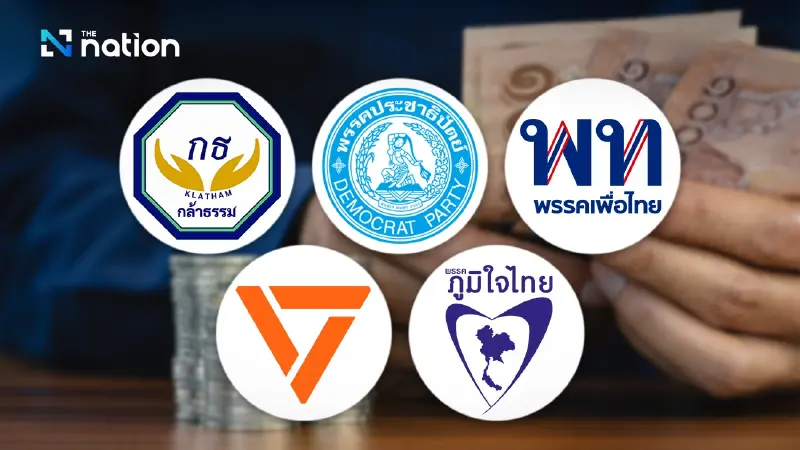
According to the EC’s disclosure of campaign policy details for 51 parties contesting the 2026 election, the combined policy budget totals 25 trillion baht. The three parties with the largest stated policy budgets were:
- Klatham Party: 2.27 trillion baht
- Democrat Party: 2.12 trillion baht
- Thai Kao Mai Party: 1.32 trillion baht
The EC documents for the five major parties include details on policy measures, budget requirements, funding sources, value for money, intended benefits, impacts and risks.
Klatham Party: THB2.27trn a year, including mega projects
Klatham’s total policy budget is 2.27 trillion baht per year, comprising 1.42 trillion baht for four years of programme spending and 850 billion baht in 10-year commitments for mega projects.
Water and irrigation policy: “Where there is farmland, there must be water”
Total investment over 4–5 years is estimated at 400–550 billion baht, broken down into:
- Large-scale irrigation: 250–300 billion baht
- Community water sources and solar: 120–150 billion baht
- Management systems and digital tools: 30–40 billion baht
Funding sources cited include the state’s regular capital budget, environmental and energy funds, and public–private partnerships (PPP). Listed risks include budgetary, management and environmental risks.
Bangkok Shield: East–West Thai Gulf Corridor
Estimated budget varies by project size:
- Small size: 450 billion baht
- Mega size: 850 billion baht
The project could be integrated via PPP. Funding sources cited include the government’s 10-year “giga project” commitments across the Ministry of Transport and other ministries, including Natural Resources and Environment; Agriculture and Cooperatives; Energy; and Interior.
Risks cited include fiscal risks such as cost overruns (from materials, wages or scope changes), and long-term debt and fiscal-discipline risks if borrowing becomes the primary funding source.
Democrat Party: universal welfare and income guarantees
The Democrat Party’s policy budget is 2.12 trillion baht per year. Its flagship proposal is a universal old-age allowance: 1,000 baht per month for all Thais aged 60 and above.
The policy is costed at 168 billion baht per year, based on around 14 million people aged over 60, with a four-year cost of 672 billion baht. Funding is stated as coming from the national budget. Risks cited include fiscal sustainability and concern that cash support may not translate into spending that meaningfully stimulates the economy.
People’s Party: THB741.83bn a year, with ageing-related pressures flagged
The People’s Party’s total policy spending is 741.83 billion baht per year. It proposes an increase in old-age allowances costing 190 billion baht per year.
Funding sources cited include regular budget management, civil service reform, cuts to unnecessary spending and increased state revenue, with an emphasis on complying strictly with public debt management laws.
The party’s document notes high budgetary costs could crowd out other spending. Risks highlighted include future fiscal strain, particularly as the elderly population grows and longevity increases.
Pheu Thai Party: THB243.3bn a year, focused on cost-of-living measures
Pheu Thai’s total policy budget is 243.30 billion baht per year. A key household policy is “Pay on time for one year, get one instalment waived”, budgeted at 30 billion baht.
Funding sources cited include budget management, fiscal measures, revenue collection and tax-system administration. A stated risk is that some debtors may be unaware of the measure and miss out, requiring public communication.
It also proposes a 30% farm profit guarantee for agricultural products, budgeted at 31 billion baht, funded through budget management, quasi-fiscal measures and improved tax collection. Risks cited include possible price distortions, with the state expected to help farmers find markets and manage demand and supply.
Bhumjaithai Party: electricity subsidy and volunteer soldier scheme
Bhumjaithai’s total campaign policy budget is 148.32 billion baht per year.
Its flagship energy proposal is electricity at 3 baht per unit for the first 200 units, budgeted at 63.36 billion baht per year, funded through the annual budget and income from clean energy/solar. The document notes this could affect recurrent expenditure.
Bhumjaithai also proposes 100,000 volunteer soldiers earning 12,000 baht per month, serving four years, with vocational training, education and quotas to sit examinations for non-commissioned officer roles.
The scheme is budgeted at 22.7 billion baht per year (14.4 billion baht in wages and 8.3 billion baht in welfare), totalling 90.8 billion baht over four years. Funding sources cited include the annual budget and reallocations from overlapping or lower-priority spending.
The document notes the need to adjust budgets and manpower structures, expand specialised training and provide vocational certification to support later entry into the labour market.
