
Four parties assert Thailand must remain neutral amid geopolitical conflicts
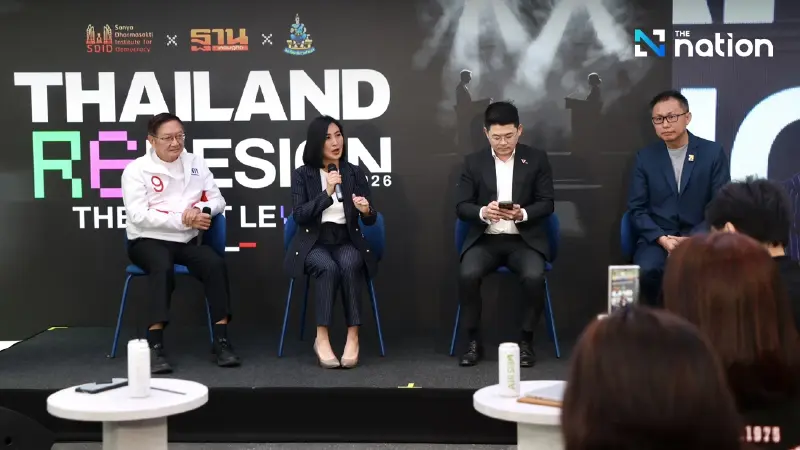


Four political parties agree that Thailand should remain neutral in global geopolitical conflicts, focusing on national interests.
Representatives from four political parties – Pheu Thai, Democrat, People's Party, and Thai Kao Mai – agree that Thailand should not take sides in the ongoing global geopolitical struggles but should instead prioritise national interests.
They advocate for strategic neutrality, diversifying trade risks, and enhancing Thailand’s role within ASEAN during the debate titled "Thailand Redesign 2026: The Next Level," hosted by Thansettakij at AIS Siam in Bangkok.
Aat Pisanwanich, an expert in international economics and ASEAN affairs, posed the question: How should Thailand position itself amid geopolitical conflicts?

People’s Party: "Pro-Thailand" foreign policy focused on national interests
Sittiphol Viboonthanakul, List MP candidate for the People’s Party, stated that the party’s foreign policy is "Pro-Thailand," placing national interests at the forefront.
Diplomatic relations with other countries will be determined by the benefits Thailand gains. If closer ties are beneficial, the government will proceed, but if they harm Thai interests, the country will reassess and maintain appropriate distance.
Sittiphol said that currently, Thailand faces three major external economic pressures: from China, the United States, and the global economic downturn.
The pressure from China concerns low-standard imported goods. While quality products are not an issue, he stated, those that harm Thai businesses and consumers must be addressed by the government with serious measures.
The pressure from the United States arises from tariff and trade measures, which could impact Thai exports, especially in key markets, he explained. He added that the global economic slowdown directly affects Thailand due to its reliance on trade and tourism.
In response to these challenges, the People’s Party has developed an international trade strategy focused on diversifying partnerships, not aligning with any one major power. The party sees opportunities in East and South Asia, as well as in India and the Middle East, which have high growth potential.
The party proposes developing the Ranong port to improve maritime trade connectivity with India, backed by an investment budget of tens of billions of baht to accommodate larger ships and enhance competitiveness.
Additionally, the People’s Party advocates for accelerating Free Trade Agreement (FTA) negotiations with key trading partners, such as Canada and India, which are both high-potential markets. India, in particular, has a strong affinity for Thailand as a wedding and travel destination, generating significant revenue annually.
"All these initiatives align with our 'Pro-Thailand' principle – not choosing sides between global powers but prioritising the country’s interests to strengthen Thailand’s economic security on the global stage," said Sittiphol.

Thai Kao Mai: Strategic neutrality for Thailand’s global positioning
Panurat Damrongthai, Head of Strategy for Energy and Innovation at Thai Kao Mai, emphasised that Thailand should adopt a cautious approach and avoid rushing to take sides.
Given that Thailand is not a global superpower, it should not act too boldly in joining or opposing any major geopolitical faction. Instead, Thailand should assess situations and focus on national interests.
He pointed to the example of US tax measures, which, although impacting global trade, still leave Thailand with many markets that can be expanded.
Regarding relations with major powers, Thailand should adopt a balanced approach, learning from the strengths of both the US and China. The US excels in technology and governance, while China offers flexibility in production costs and a wide range of products.

Pheu Thai: Maintaining balance amid geopolitical rivalries
Prommin Lertsuridej, Chair of the Economic Committee for Pheu Thai, argued that Thailand should maintain a balanced approach and avoid aligning with one side in global conflicts. Choosing to confront or join a conflict would likely bring more harm than good.
Reflecting on history, Prommin noted that Thailand preserved its sovereignty thanks to its strategic geographic position as a regional hub, combined with a cautious foreign policy, particularly during the reign of King Chulalongkorn, who protected Thailand’s independence by making some sacrifices for long-term benefits.
In the current situation, where the US and China are engaged in intense competition, he noted that the two countries remain deeply interconnected through economic relations and investments. Both leaders continue to meet and discuss, demonstrating that the relationship between these powers involves both competition and cooperation.
Thus, Thailand does not need to rush to take sides. The country should observe the situation carefully, “know the other side and know ourselves,” and focus on evaluating what is best for Thailand. Whether engaging with China or the US, or negotiating trade deals, the focus should be on national interests, not political emotions.
"In a volatile world, Thailand must maintain diplomatic flexibility, connect with all sides, and not allow the conflicts between global powers to determine our future. This will ensure Thailand’s economic stability in the long term," said Prommin.

Democrat Party: Strategic neutrality and ASEAN leadership
Karndee Leopairote, Deputy Leader of the Democrat Party and candidate for Prime Minister, proposed three key strategies to ensure Thailand stands firm amid global superpower conflicts.
The first is Strategic Neutrality, where Thailand should avoid making enemies. As a small, open economy, Thailand should use diplomatic flexibility and intelligence to maintain its stance, prioritising national interests without aligning with any particular global power.
The second strategy is to reaffirm ASEAN Centrality, or Thailand’s role as a leader in ASEAN. While Thailand alone may be too small to have a significant impact on the global stage, ASEAN as a region has great potential.
Thailand should take a leading role within ASEAN, particularly as it prepares to assume the ASEAN Chair again. This is a vital opportunity to foster unity among ASEAN members and develop joint strategies, such as strengthening the global supply chain rather than competing within the region.
The third strategy is Diversification, focusing on new forms of security, especially in clean energy, food security, and cybersecurity. In the digital economy, energy has become a fundamental factor, particularly green and clean energy.
Thailand can leverage its geographic strengths as a hub for clean energy in the region, such as facilitating energy trade with neighbouring countries.
Thailand also has potential in food security, a growing global priority. By enhancing food safety standards and boosting cybersecurity in the region, Thailand can strengthen its competitive edge and credibility.
"If Thailand can maintain strategic neutrality, take a leading role in ASEAN, and strengthen new forms of security, the country will be able to thrive amid global volatility and secure sustainable opportunities," said Karndee.
