
WEF 2026 opens in Davos: economy, geopolitics, AI in focus
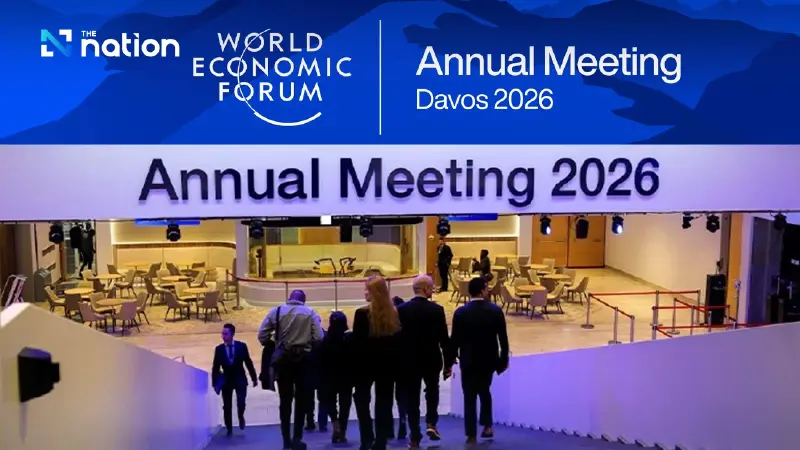


WEF Annual Meeting 2026 runs Jan 19–23 in Davos under “A Spirit of Dialogue”, drawing nearly 3,000 participants from 130+ countries
- The World Economic Forum (WEF) 2026 meeting is being held in Davos, bringing together nearly 3,000 world leaders, CEOs and representatives from over 130 countries.
- Key participants include leaders from the G7, the US President, heads of international organisations, and senior executives from leading AI technology companies.
- The main themes focus on tackling economic challenges, geopolitics, the technology transition (generative AI) and sustainability, to shape the direction of global cooperation.
The 56th Annual Meeting of the World Economic Forum (WEF) officially opens from 19–23 January 2026 in Davos, Switzerland, under the theme “A Spirit of Dialogue”.
It aims to provide a neutral platform for leaders from the public sector, business and civil society to exchange views, seek solutions to shared global challenges, and drive innovations that will shape the future of the global economy and society.
This year, leaders from over 130 countries—nearly 3,000 people—are taking part, marking record-high government participation. Around 400 political leaders are expected, including about 65 heads of state and government, with almost all G7 leaders attending. The meeting also brings together nearly 850 CEOs and chairs of major companies, as well as almost 100 leaders from unicorn start-ups and frontier-technology firms.
Global leaders attending this year include Donald Trump, President of the United States; Mark Carney, Prime Minister of Canada; Ursula von der Leyen, President of the European Commission; Friedrich Merz, Federal Chancellor of Germany; Volodymyr Zelenskyy, President of Ukraine; and Prabowo Subianto, President of Indonesia, alongside leaders from Asia, Europe, the Middle East and Latin America.
At the same time, heads of major international organisations are participating, including António Guterres, Secretary-General of the United Nations; Kristalina Georgieva, Managing Director of the IMF; Ngozi Okonjo-Iweala, Director-General of the WTO; Ajay Banga, President of the World Bank Group; and Mark Rutte, Secretary-General of NATO.
In technology and innovation, many senior executives are attending, including Jensen Huang (NVIDIA), Satya Nadella (Microsoft), Dario Amodei (Anthropic), Demis Hassabis (Google DeepMind), as well as representatives from OpenAI, Palantir and Mistral AI, and leading global AI academics.
This year’s discussions focus on managing geopolitical volatility, economic uncertainty and the technology transition—especially generative AI—alongside energy security, environmental sustainability and workforce skills development in the digital era. The meeting will also examine new forms of cooperation in a world where international trust is weakening and global rules are increasingly being challenged.
WEF said this year’s programme is designed to be solutions-oriented, aimed at delivering inclusive growth, strengthening competitiveness and improving the long-term resilience of the global economy, while recognising the planet’s resource limits.
More than 200 sessions will be livestreamed via digital platforms, allowing audiences worldwide to follow the meeting in real time—reflecting Davos’s role as a global forum that extends beyond on-site participants.
WEF 2026 is therefore being closely watched as a key platform that could help shape directions in the economy, politics, technology and international cooperation at a turning point for the world.
