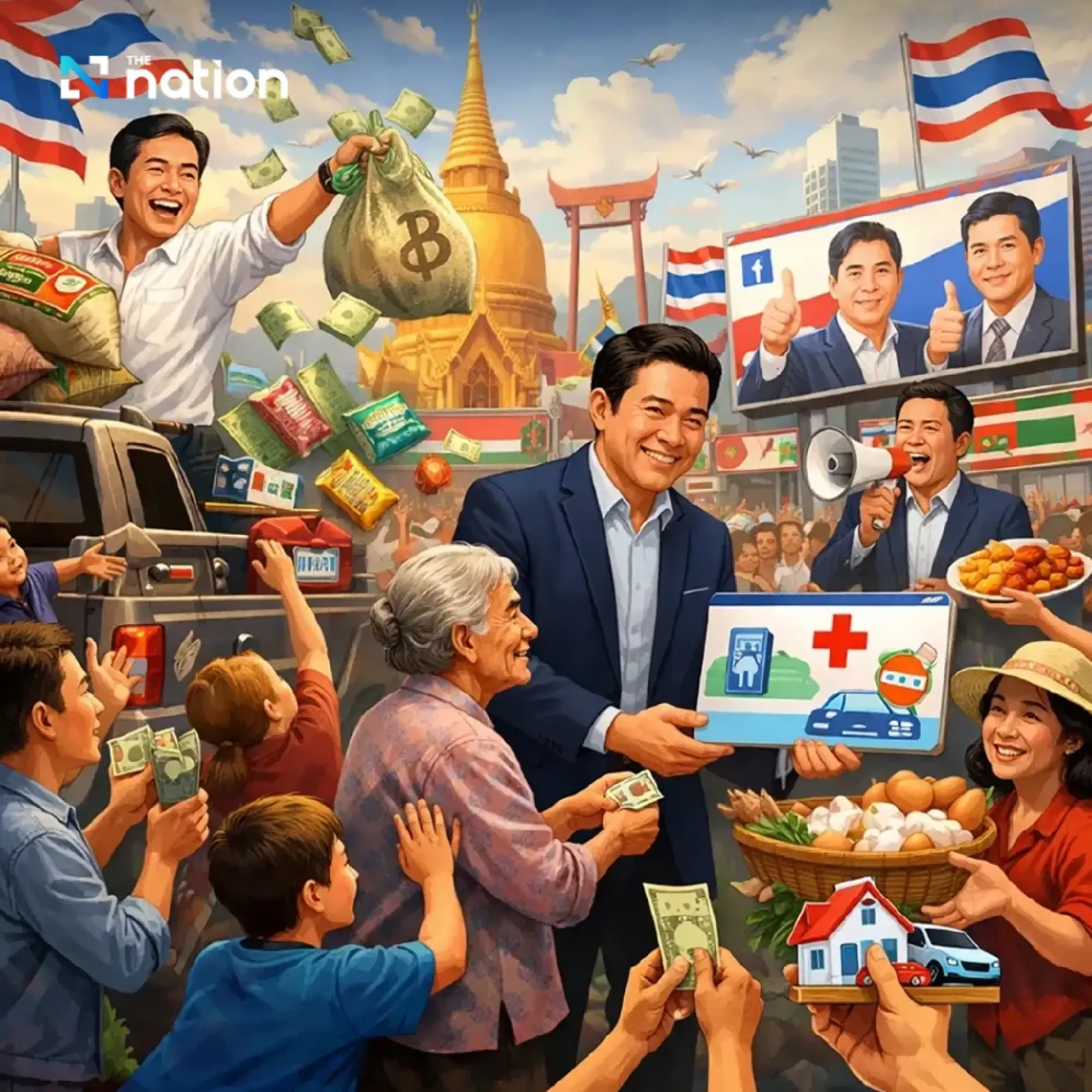
Political parties propose large spending with no clear revenue plans, focusing on short-term solutions rather than long-term economic reforms for Thailand
Most political parties are presenting populist policies that focus on massive spending but lack clear plans for generating revenue to support these policies.
The proposed policies are focused on short-term economic stimulation and solving old problems, without aiming for structural reforms to create long-term stability.
There has been criticism that political parties overlook important income-generating sectors for the country, such as tourism, and fail to understand the deeper issues in various economic sectors.
Amid the policy competition among political parties, it was found that many parties have proposed a large number of policies with a combined budget exceeding 25 trillion baht. However, the question is, with each policy requiring significant spending, where will the money come from? These are all policies focused on spending, but there are very few policies focusing on generating revenue for the country.
Sorathep Rojpotjanaruch, President of the Thai Restaurant Business Association and Honorary Advisor of the Thailand Hostel Association, revealed to "Thansettakij" that after monitoring the political parties' movement in presenting budget proposals to the Election Commission (EC), only a few political parties have reported their campaign budgets to the EC.
Only a few parties were able to clearly outline the source of funds when asked. The most concerning issue is Thailand’s ongoing budget deficit, which has been persistent for several years. It is projected that by 2027, the new government will face a shortfall of approximately 780 billion to 1 trillion baht to compensate for the budget deficit.
Most political parties' policies focus on injecting money to stimulate the economy in the short term but none of the parties have proposed serious measures to reduce recurring expenditures. In comparison, neighboring countries like Vietnam managed to reduce recurring expenses by 18% in the past government through civil service restructuring and early retirement programs. However, in Thailand, most policies still revolve around populist spending.
How Do the Major Parties Spend Their Budgets?
Pheu Thai Party: Focuses on a high economic stimulus budget of 240 billion baht, with key policies including guaranteeing a minimum income of 36,000 baht per person per year and the "Half-Half Pro Max" project where the government supports 70% of the cost and the public pays 30%. They also propose solving informal debt and agricultural debt, expecting to fund these policies through the "Retirement Lottery" scheme.
Bhumjaithai Party: Takes a conservative approach with no increase in borrowing and focuses on reducing the cost of living and continuing the "Half-Half" Phase 2 program. However, there is concern over their funding through government bonds with a 2.5% interest rate, which is another form of public debt, effectively shifting funds around.
Prachachart Party: Proposes creating a welfare state and structural reform of the government with a 741 billion baht budget. A notable policy is the "Receipt Lottery," which mimics Taiwan’s successful model to bring SMEs into the tax system. They also propose replacing price guarantees for agricultural products with subsidies, such as a 20% debt reduction for farmers who switch to planting crops suitable for their land.
Kla Tham Party: Proposes the largest budget of 2.2 trillion baht, focusing on agricultural relief and water management.
Democrat Party: Has the most policies, 91 in total, with a budget of 2.1 trillion baht. Key proposals include income guarantees for farmers, such as 2.50 baht per kilogram for cassava and 60 baht per kilogram for rubber, as well as a newborn subsidy of 65,000 baht.
Thai Sang Thai Party: Proposes a fund using savings from the country’s 17 trillion baht in deposits from the rich, offering loans to small-scale borrowers at an interest rate of 12% per year. This is the only party to clearly outline how to generate funds for its policies.
Disappointments and Concerns
“There is great disappointment that no political party has focused on tourism as a primary strategy, despite it being the second-largest income generator for the country. Based on the policy presentations, most parties lack expertise in this area and are only using data from the internet,” said Sorathep.
He further commented that the structural problems in Thailand’s SME and agricultural sectors have been stuck in the price guarantee system for over 55 years. These policies have never truly helped farmers become wealthier because there has been no permanent integration. Similarly, the SME sector continues to suffer because small businesses often do not have access to the support mechanisms that medium-sized enterprises (MSEs) do, as there is no specific legislation for establishing funds for micro SMEs.
Health and Medical Tourism
Regarding the healthcare sector, particularly the Medical Tourism policy that several parties have focused on, there seems to be a lack of understanding of the deeper issues, such as why the Arab market, which was previously a major source of medical tourists, has been disappearing after COVID-19. There is also the problem of the government’s unpaid social security contributions, which will become a heavy burden for businesses in the future.
Three Proposals for Thailand's Economic Rescue:
Reform Recurring Expenditures: Currently, recurring expenses consume up to 71% of the budget. If the government can reduce this to 60%, GDP will naturally grow. The focus should be on reviewing committed budgets and basic budget allocations.
Revise VAT Structure: If state revenue fails to meet targets, currently about 110 billion baht short, the government may need to increase VAT from 7% to 10%. However, there should be clear distinctions in industries, especially for food and consumer businesses, where VAT should remain at 7% to avoid burdening businesses too much.
Professional Management: The new government should bring in external experts to manage ministries instead of relying on politicians who lack deep understanding of complex issues.
A Final Thought
“If Thailand cannot overcome the populist trap and focus on producing quality products like China is doing now, it will be difficult for the country to develop further. The current economic situation and budget policies will be a critical test for the new government, which must choose between short-term giveaways or long-term structural reforms for the country’s stability,” he concluded.
Industrial Council Warns of Populist Campaigning: Short-Term Cash Handouts Could Harm Thailand's Long-Term Economy
The FTI has expressed concerns over the populist campaign policies of political parties that focus on cash handouts to solve short-term problems, which could negatively impact Thailand’s long-term economy.
The private sector views these policies as temporary fixes that do not address the structural issues of the economy and could create future fiscal burdens for the country.
The reason political parties favor short-term policies is due to the fragile economic situation and political uncertainty, which leads to short-lived governments unable to push long-term policies.
Amidst the election campaigning in a fragile economy, political parties are quickly presenting populist policies aiming for short-term solutions. At the same time, the private sector is concerned about the combined policy budget of over 25 trillion baht, which could exacerbate the long-term economic issues.
Kriengkrai Thiennukul, President of the Federation of Thai Industries (FTI), revealed to "Thansettakij" about the political parties' election campaign policies submitted to the Election Commission (EC), with a combined total of over 25 trillion baht. He stated that the policies reflect the experience of each party and their efforts to please voters. Given the fragile economic situation, high household debt, and limited access to funding, the policies that are popular during election time will be those that respond to short-term needs, seemingly easy to implement immediately.
However, these types of policies have been used for a long time and have been increasing continuously. The private sector has already expressed concerns that these short-term policies have only temporary effectiveness and lack medium- and long-term efficiency. It's akin to taking medicine that temporarily relieves the symptoms, but once the effects wear off, the problem returns. As a result, most political parties’ policies are focused on populist spending, or disguised populism.
From the private sector’s perspective, it is difficult to stop political parties from using stimulus measures to campaign and attract attention in the short term, as this is a typical campaigning strategy. However, once they form the government, these spending issues must be viewed in the long-term and require genuine structural reforms, which are difficult to implement and take a lot of effort.
Spending 25 Trillion Baht Overall Is Concerning
“The overall amount of 25 trillion baht across all political parties is very alarming. However, we must look at the details to see whether most of it is aimed at short-term stimulus or if it will lead to a situation where the public becomes reliant on support and no longer wants to develop themselves,” said Kriengkrai
He further emphasized that populist policies implemented in the past have proven to be ineffective in the long term. If Thailand cannot overcome the populist trap and shift towards producing quality products, similar to what China is doing, the country will struggle to develop further.
A Serious Concern Over Short-Term Populism
Kriengkraiexpressed his concerns over the short-term nature of these policies, saying they are only temporary fixes and fail to address the underlying economic problems, which need long-term solutions. “These policies may appear to address short-term problems, but in reality, they don’t create sustainable growth or reform. It’s like offering promotions that don’t actually resolve the fundamental issues of the economy.”
Challenges in Thailand’s Political System
He also highlighted the challenges within Thailand’s political system, where political parties recognize the weakness of the country’s situation. The majority of the public lacks purchasing power and therefore relies on free support or promotions. Political parties, aware of this, continue to propose such populist policies.
Another important issue is the political instability in Thailand, where governments often face short terms. Historical records show that recent governments have typically lasted only 1-2 years, and after the era of former Prime Minister Prayuth Chan-o-cha, the lifespan of the Prime Minister and the Cabinet is expected to shorten, making it difficult for long-term policies to be implemented.
Summary of Political Party Budgets:
Highest Budget Groups (Above Trillions)
Puangchon Thai Party (No. 23) – 287.58 trillion baht
Economic Party (No. 11) – 5.99 trillion baht
Local Thai Party (No. 14) – 5.43 trillion baht
Other Parties: Prom Party (3.1 trillion), Kla Tham (2.2 trillion), Democrat Party (2.1 trillion)
Lowest Budget Groups
Palung Pheu Thai Party (No. 16) – 100 million baht