

At Chulalongkorn's Animal Cadaver Donation Centre, beloved companions find purpose beyond life
- Pet owners can donate the bodies of their deceased companions to Chulalongkorn University's Animal Cadaver Donation Centre, where they are respectfully referred to as 'silent teachers'.
- These donated bodies provide invaluable hands-on training for veterinary students in anatomy, surgery, and pathology, offering a realistic learning experience that models and textbooks cannot replicate.
- The program teaches students not only technical skills but also compassion, responsibility, and a profound respect for life, with the university holding annual ceremonies to honor the animals and their owners.
- A single donated body can be used for multiple purposes over 1-3 years, benefiting undergraduate students, practicing veterinarians seeking advanced skills, and faculty research projects.
At Chulalongkorn's Animal Cadaver Donation Centre, beloved companions find purpose beyond life.
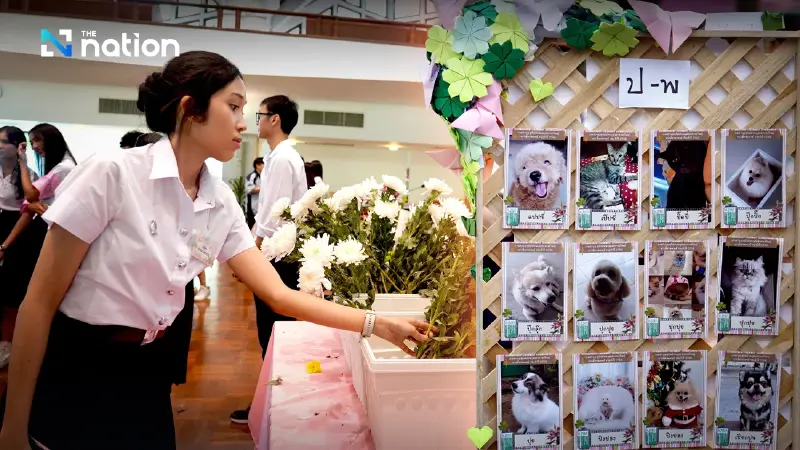
On a humid January morning at Chulalongkorn University, the scent of incense mingles with prayer as veterinary students, professors, and grieving pet owners gather at Sala Phra Kiao.
They've come to honour 1,180 'silent teachers' – the dogs, cats, and exotic animals whose bodies have been donated for veterinary education.
Amongst those present is one owner who donated her beloved companion, alongside students who have spent the past year learning anatomy from these very animals.
As sandalwood flowers are placed in remembrance, the ceremony represents the culmination of an extraordinary cycle of love and learning.
"It must be said that it's a very difficult decision to donate a pet that we love," says Assistant Professor Dr Ekkapol Akaraphutiporn, head of Chulalongkorn University Faculty of Veterinary Science's (CUVET's) Animal Cadaver Donation Centre. "But this sacrifice transforms into knowledge and inspires many veterinarians in the profession."
The 17 January 2026 merit-making ceremony wasn't just a religious observance – it was recognition of the profound contribution these animals and their owners have made to veterinary science.

The Silent Teachers
Dr Ekkapol, an instructor in the Department of Surgery, explains that many people mistakenly believe donated animal bodies are used solely for anatomy classes. The reality is far more extensive.
"The cadavers are used across surgery, pathology, and anatomy," he explains. "Surgery students learn surgical procedures and techniques. Pathology students study abnormalities. Anatomy students learn normal structure."

These 'principals', as they're respectfully called, teach in ways no textbook or 3D model can replicate.
"They teach structure, biological differences, the feel of tissue – its hardness, toughness, and elasticity," says Dr Ekkapol. "Models or other teaching aids can't provide the same experience. That's why we still need principals for education."
Each donated body serves multiple purposes over 1-3 years.
"A single body isn't used just once," Dr Ekkapol emphasises. "It's used repeatedly until we can say it's been used meaningfully, generating maximum benefit."
Beyond undergraduate education, the bodies provide continuing education for practising veterinarians learning advanced surgical skills and contribute to faculty research projects.
"The principals form the foundation for veterinary students, multiply knowledge for veterinarians, and enable new discoveries," Dr Ekkapol explains. "They ultimately help improve the quality of veterinary treatment and education."

More Than Technical Training
The dean's description of animal cadavers as 'teachers without voices' captures their profound role. For students, working with the donated bodies offers lessons that extend far beyond anatomy.
"Beyond anatomical and clinical skills, it teaches students to recognise the value of life and have greater respect for it," says Dr Ekkapol. "It teaches them that their knowledge comes from sacrifice, which ultimately reflects back as teaching them compassion and responsibility towards life, to become veterinarians."

This philosophy permeates every interaction with the cadavers.
"We've cultivated respect for the principals since the very first class," Dr Ekkapol notes. "In the first lesson using cadavers, we have students bring flower garlands and lead prayers asking for forgiveness before use."
Strict protocols reinforce this reverence: photography, video recording, and social media posts about the cadavers are prohibited. Students are taught that "the bodies are teachers providing knowledge, not just learning equipment."

Wipawanee Kaen-in, president of the Social Development and Community Service Division, CUVET student and chair of the merit-making ceremony, recalls her first anatomy lesson as a student.
"It wasn't like looking at a pet," she reflects. "I saw it as a teacher, because it was so different from lecture. Different dogs show different anatomies. It made things much clearer than learning from lectures."
She describes an unspoken understanding amongst students: "We wouldn't joke around. We'd respect the principals and study attentively. The department also has us pray for forgiveness before studying."

A Centre Born of Need
The Animal Cadaver Donation Centre serves as a vital intermediary, receiving donated bodies and distributing them to the Departments of Surgery, Pathology, and Anatomy according to their needs.
The systematic approach includes detailed record-keeping from intake through storage in freezer rooms to final distribution.
"People weren't widely aware there was animal body donation for principals," Dr Ekkapol recalls. "It was limited to a narrow circle. But now, with social media, people are more aware. We receive more bodies for teaching."
The past year saw particularly high interest, resulting in 1,180 donations – roughly 70-80 per cent dogs (660 bodies), with cats (462) and exotic animals (58) comprising the remainder. Yet the centre can accommodate far more.
"Currently, there's no limit," says Dr Ekkapol. "We can accept over 1,000 more because ultimately, body distribution is shared amongst three departments. We can accept quite a lot more."
The centre welcomes all animals regardless of age, breed, or size. Exotic species have included hamsters, dwarf hedgehogs, prairie dogs, exotic snakes, and even an African snakehead – the largest donation received.
"The veterinary circle had never studied or had knowledge about these animals' anatomy before, so the donations were even more beneficial to the public," notes Dr Ekkapol.

Only animals that died from invasive cancer causing severe deformities, or zoonotic diseases like rabies and tuberculosis, cannot be accepted – and even uncertain cases are welcomed for evaluation. The most crucial requirement is vaccination against rabies for dogs.
While large dogs (15-25 kg) and medium cats (3-5 kg) are particularly valuable for their visible organs, all sizes contribute meaningfully to veterinary education.
How to Donate
For pet owners considering donation, the process is straightforward. Immediately after a pet dies, place the body in a plastic bag and freeze it at 4 degrees Celsius. Contact the centre and bring the body to the fifth floor of the Small Animal Hospital Building within 24 hours.
Staff will screen the pet's history, cause of death, vaccination records, and any serious infections. Owners complete a consent form, and the body is preserved in formaldehyde-free embalming fluid before storage at very low temperatures.
Bodies not frozen immediately or kept longer than 24 hours can still be donated, though some organs may have deteriorated. The crucial element is the owner's readiness to make this final gift.

A Community United
The annual merit-making ceremony represents more than religious observance.
"It reflects cooperation, unity, and solidarity," says Dr Ekkapol. "Whether students, staff, or faculty, everyone shares the same purpose: making merit and honouring the principals, and showing gratitude to owners who donated bodies to us."
Wipawanee, organising the ceremony for the first time, was struck by the significance.
"I felt gratitude towards every owner who donated their principal," she says. "I saw it as something truly great that we would donate our pets to be principals. That's why I wanted to make this work good."

The event allows owners to write farewell messages and students to express gratitude. It also raises funds to support students from disadvantaged backgrounds.
Following the ceremony, cremation will take place at Thai Wat That Thong temple, with an ash-scattering ceremony the next day.
For the student organisers – just over ten people managing the entire event – coordinating between various organisations proved challenging yet rewarding.
"Everyone gave their all and tried very hard," Wipawanee reflects. "The work came out quite well."
She hopes the ceremony helps students understand the depth of owners' love for their donated pets. "It'll make us realise we need to try harder to become good veterinarians," she observes.

A Message to Pet Owners
Dr Ekkapol offers heartfelt thanks to all donors.
"On behalf of the Faculty of Veterinary Science and the Animal Cadaver Donation Centre, I want to sincerely thank every owner who donated their pet's body to be a principal," he says. "I must say that it's truly a difficult decision to donate a pet that we love. But this sacrifice transforms into knowledge and creates professional inspiration for many veterinarians. I must thank you for this."
For pet owners contemplating this final act of love, the centre stands ready to honour both pet and owner with dignity and purpose.
Through donation, beloved companions become eternal teachers, their contributions echoing through generations of veterinarians who will care for countless animals in turn.
As Wipawanee notes, while students already possess awareness of this sacrifice, wider participation in ceremonies and activities would strengthen the community.
"If there are events like this, if people could help organise them, that would be good," she suggests.
In the quiet dignity of Sala Phra Kiao, surrounded by incense and flowers, the silent teachers received their final honours – a testament to love that transcends death and serves life itself.
