
Foreign media: Anutin’s nationalist bet delivers landslide
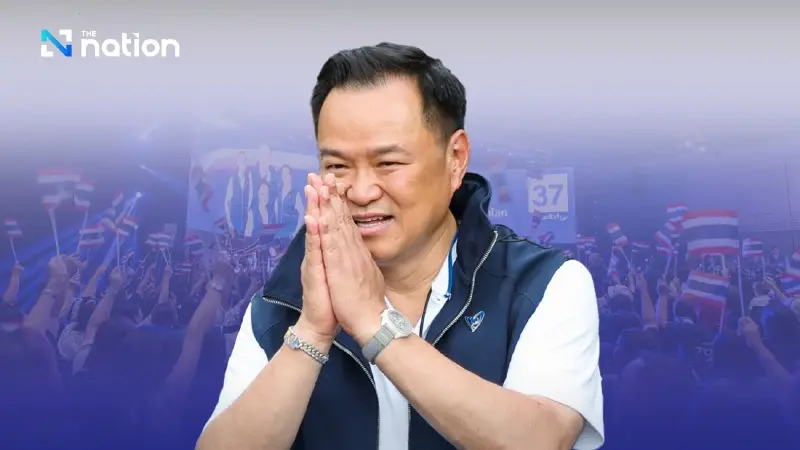


Reuters/Bloomberg: Bhumjaithai leads early count after campaigning on nationalism amid Cambodia tensions; People’s Party spurns coalition; charter referendum passes
Ruling Bhumjaithai leads comfortably in early count; Anutin campaigned on nationalism amid Cambodia tensions; People’s Party led polls before the vote but falls short of a majority
Reuters reported that the Bhumjaithai Party of Prime Minister Anutin Charnvirakul won a decisive victory in the general election on Sunday (February 8, 2026), creating the possibility that a more stable governing alliance could bring an end to a prolonged period of political instability. Voters also approved a referendum to draft a new constitution.

Anutin laid the groundwork for an early election in mid-December amid the Thai–Cambodian border dispute, which political analysts viewed as a conservative leader timing his move to ride a surge in nationalist sentiment.
It was a gamble that paid off for the prime minister, who came to power after Paetongtarn Shinawatra, the populist prime minister from the Pheu Thai Party, was removed over the Cambodia crisis, after which Anutin dissolved parliament within 100 days.
“Bhumjaithai’s victory today is a victory for all Thai people, whether you voted for Bhumjaithai or not,” Anutin said at a press conference. “We must give everything to serve the Thai people to our fullest potential.”
With results reported from nearly 95% of polling stations, preliminary Election Commission figures showed Bhumjaithai had around 192 seats, compared with 117 for the progressive People’s Party, and 74 for Pheu Thai, the former ruling party.
A handful of other parties won a combined 117 seats in the 500-seat House of Representatives, according to Reuters’ calculations based on Election Commission data.
People’s Party rejects offer to join the government
Natthaphong Ruengpanyawut, leader of the People’s Party, acknowledged that while some votes were still being counted, the party did not appear likely to win the election as results continued to come in.
Natthaphong said the party would not join a government led by Bhumjaithai, but would also not form a competing government.
“If Bhumjaithai can form a government, then we have to be the opposition,” he said at a press conference.
With policies focused on structural change and reform of Southeast Asia’s second-largest economy, the People’s Party had led most opinion polls during the campaign.
However, in the final-week campaign survey published on Sunday, the National Institute of Development Administration (NIDA) predicted Bhumjaithai would win 140–150 seats in the 500-seat House, ahead of the People’s Party on 125–135.
Prior support by the progressive party for Anutin as prime minister was likely a major miscalculation that undermined its ideological purity and allowed Bhumjaithai to benefit from its incumbency, Mathis said.
In an interview with Reuters, Natthaphong said he did not see the election outcome as the result of any mistake by his party, but stressed that their political opponents had not been careless.
“I don’t blame any factor. Our duty now is to focus at the grassroots level,” he said. “We’ve done a lot, but we still haven’t been able to break through their strengths. It’s still not good enough.”
Constitutional referendum
Thai voters were also asked whether a new constitution should be drafted to replace the 2017 charter backed by the military. Critics say the current constitution gives too much power to non-democratic institutions, including the Senate, which is chosen through an indirect process with limited public participation.
Preliminary Election Commission results showed voters backed the referendum by a margin of nearly two to one.
Thailand has had 20 constitutions since the end of absolute monarchy in 1932, with most changes coming in the aftermath of coups.
A new government and parliament would be able to begin the amendment process in parliament, but two further referendums would be required before a new constitution could take effect.

Bloomberg sees Anutin win fuelling conservative hopes of ‘stability’
Since the turn of the century, election night has often been a defining moment for reformists demanding democracy, while Thailand’s royalist camp has been left dismayed. Now, the candidate backed by the latter has emerged as the winner, raising hopes that Thailand may regain some stability.
Bloomberg reported preliminary results on Sunday (February 8) showing the Bhumjaithai Party had won 191 seats out of 500, nearly tripling its haul from the 2023 election. Prime Minister Anutin Charnvirakul’s party was said to have leveraged the advantage of incumbency and campaigned on nationalism stemming from border tensions with Cambodia to secure victory.
Bhumjaithai also positioned itself as a defender of the monarchy, including opposing efforts to amend Section 112 of the Criminal Code.
“Sometimes the enemy you know may be someone you can live with. People think about continuity and stability,” said Thitinan Pongsudhirak, a political science academic at Chulalongkorn University who has written about Thai politics for decades.
Bloomberg added that the result represented the best-case scenario for royalists: Bhumjaithai would have the opportunity to lead a coalition with a clear majority in the House of Representatives, after successfully reshaping its image as the only party capable of delivering stability in a country that has had 10 prime ministers in 20 years.
For those tracking Thai politics, the key question is whether Anutin can use the strong election outcome to revive a weak Thai economy weighed down by eroding competitiveness, foreign investors’ reluctance to commit capital, and an ageing society.
Since the Covid period, Thailand’s GDP has grown at around 1% a year, far below neighbours such as Vietnam and Indonesia. The economy has also been buffeted by volatile geopolitical conditions and trade pressure linked to a second Trump administration, Bloomberg reported.
“Investors may view an election outcome that keeps the Bhumjaithai alliance in power as the best short-term scenario for markets, due to policy continuity and ongoing measures supporting consumption and infrastructure,” said Poon Panichpibool, a strategist at Krungthai Bank.

Bloomberg noted that Anutin became prime minister in September, the third premier in two years. He was reported to have capitalised on nationalist sentiment sparked by Thai–Cambodian border tensions, competing for rural support that had previously formed a core base for Pheu Thai.
The shift, Bloomberg said, could have deep implications for Thailand at a time when an export-reliant economy is slowing and policy focus has leaned more towards populist measures than structural reform.
“If Bhumjaithai leads the next government, fiscal policy is likely to be more cautious, even if some stimulus continues. Economic reform would likely proceed gradually under a conservative-led administration,” said Peter Mumford, who oversees Southeast Asia at risk consultancy Eurasia Group.
