
Bhumjaithai seals 295-seat coalition; Kla Tham left out of Anutin Cabinet II
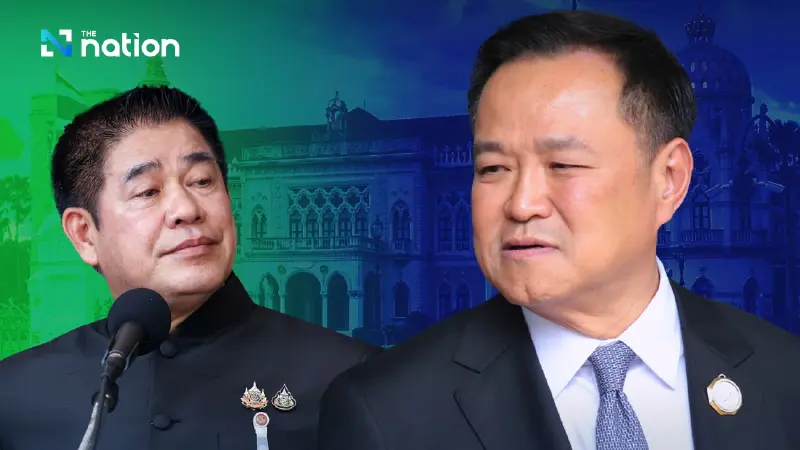


Bhumjaithai clinches 14-party coalition, 295 seats, forming “Anutin Cabinet II”; Kla Tham’s 58-seat bloc excluded over ministerial demands
- The Bhumjaithai Party has successfully formed a government, securing support from 14 political parties for a total of 295 seats.
- The Kla Tham Party, which has 58 seats, will not join the government after making excessive negotiating conditions over ministerial positions.
- The formation of the new government, or “Anutin Cabinet II”, is now considered settled, with the Bhumjaithai Party and the Pheu Thai Party as the core parties.
Developments in Bhumjaithai’s government-formation drive show that, as the leading party with 193 seats, Bhumjaithai has continued negotiations with other parties to assemble enough support to form a government. Party leader and prime ministerial candidate Anutin Charnvirakul, along with party secretary-general Chaichanok Chidchob, were formally assigned by the party’s executive committee to serve as key coordinators in talks with other political parties.
While awaiting the Election Commission (EC)’s official endorsement of the election results, Anutin moved ahead with negotiations by launching an operation to invite small parties to meet at Bhumjaithai headquarters on February 12. These included the Palang Pracharath Party (5 seats), the Economic Party (3 seats), and several one-seat parties, including the New Democracy Party and the New Party.
The following day, February 13, Anutin invited Pheu Thai leaders for talks, led by Pheu Thai’s prime ministerial candidate Yodchanan Wongsawat. This was seen as an official show of clarity in forming an alliance between the No. 1 party with 193 seats and the No. 3 party with 74 seats.
Meanwhile, small parties and various one-seat parties have continued to line up to support a Bhumjaithai-led government. Of note, the Thai Ruam Palang Party (6 seats) is next in line for an official invitation. Also included are the Prachachat Party (5 seats), which has been bundled in alongside Pheu Thai, and the Thai Sang Thai Party (2 seats).
As a result, the latest tally of parties supporting a Bhumjaithai-led government stands at 14 parties with a combined 295 seats, comprising: Bhumjaithai (193), Pheu Thai (74), Thai Ruam Palang (6), Palang Pracharath (5), Prachachat (5), Economic Party (3), Thai Sang Thai (2), and seven one-seat parties: New Democracy Party, New Party, Ruam Jai Thai Party, Thai Sap Thawee Party, Ruam Palang Prachachon Party, New Dimension Party, and New Opportunity Party.
However, reports say Bhumjaithai decided not to bring in the Kla Tham Party’s 58 seats after the stance of Capt Thammanat Prompao, chairman of the party’s advisory board, came with negotiating conditions for joining the government. He reportedly sought major ministries to continue running ongoing work, such as the Ministry of Agriculture and Cooperatives and the Ministry of Tourism and Sports, and also demanded the Ministry of Interior in addition.
Kla Tham cited the combined numbers of its small-party allies—claiming that, together with Kla Tham, they amounted to 80 seats—prompting Bhumjaithai to directly recruit small parties and one-seat parties itself. This was aimed at cutting off Kla Tham’s leverage in negotiations and ultimately leaving the party outside the coalition.
There is also an issue involving the Prachachat Party’s 5 seats, which sought to join the government by attaching itself to Pheu Thai. Bhumjaithai’s key negotiators did not reject this, but imposed one condition: Pol Col Tawee Sodsong, the party leader, would not receive a ministerial position in this government. This is because Pol Col Tawee has had a dispute with Bhumjaithai linked to the alleged Senate vote-collusion case, with lawsuits still pending in the justice process.
Similarly, Bhumjaithai’s key negotiators are said to have imposed a condition on Pheu Thai that Phumtham Wechayachai would not be given a ministerial post either, for the same reason as in Pol Col Tawee’s case.
In any case, the 14-party coalition arrangement is now considered settled, with only negotiations remaining over conditions and the allocation of ministerial quotas among the ministries. Under the Bhumjaithai-led government formula—“Anutin Cabinet II”—the coalition would comprise Bhumjaithai, Pheu Thai, small parties and one-seat parties, totalling 295 seats. The average basis for allocating cabinet positions among coalition parties is reported to be around 8 MPs per one ministerial post.
Within this week, Bhumjaithai leaders are expected to invite the next parties on the list for discussions on the government’s direction and to formally unveil the coalition.
At the same time, the Bhumjaithai-led government under “Anutin Cabinet II” faces a major challenge: tackling economic problems, both domestic and external. The economic team will need to demonstrate professionalism, moving quickly to drive campaign policies and deliver tangible results.
Bhumjaithai has reportedly lined up three “professional” ministerial candidates from the outset:
- Ekniti Nitithanprapas as Deputy Prime Minister and Finance Minister;
- Suphajee Suthumpun as Commerce Minister, with oversight of the Ministry of Agriculture and Cooperatives;
- Sihasak Phuangketkaew as Deputy Prime Minister and Foreign Minister.
Other key figures are also mentioned. Chaichanok Chidchob may become Minister of Digital Economy and Society. Suchart Chomklin may become Minister of Natural Resources and Environment to drive the restoration of national parks along border areas. Akanat Promphan may become Minister of Industry.
As for coalition quotas, reports say preliminary discussions between Bhumjaithai and Pheu Thai on proportionate allocation suggest Pheu Thai would receive five ministerial portfolios: the Ministry of Agriculture and Cooperatives (with the condition that Suphajee would supervise it at another level), the Ministry of Education, the Ministry of Higher Education, Science, Research and Innovation, the Ministry of Labour, and the Ministry of Social Development and Human Security. However, Pheu Thai is negotiating for the Ministry of Public Health as well to push another key policy agenda, which could require trading off another portfolio—either the Ministry of Labour or the Ministry of Social Development and Human Security.
