
Bhumjaithai weighs 355-seat option as Kla Tham seen as ‘last resort’
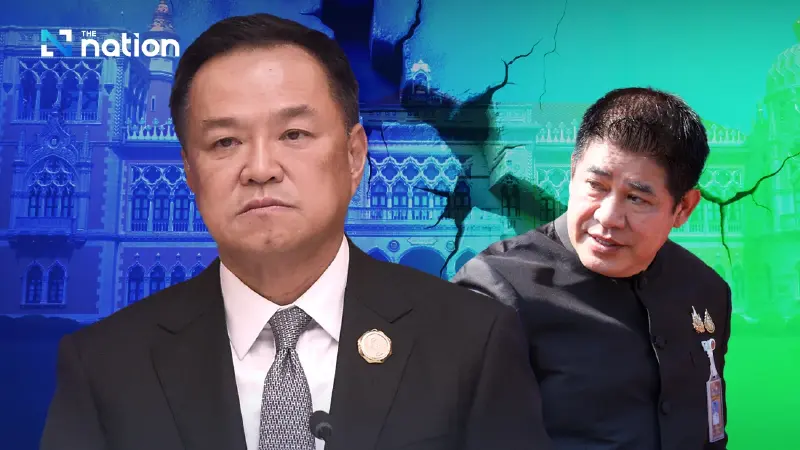


Bhumjaithai’s 297-seat bloc could rise to 355 by adding Kla Tham’s 58 MPs, but talks hinge on control of key economic ministries
- The “Bhumjaithai 355 government” formula is a government-formation equation led by the Bhumjaithai Party. It currently has 297 seats and would rise to 355 seats if the Kla Tham Party (58 seats) is included.
- Bhumjaithai wants to control all economic ministries—especially the Ministry of Agriculture and Cooperatives, which is currently overseen by Capt Thamanat Prompow and the Kla Tham Party. This is seen as a key condition in negotiations.
- Bringing the Kla Tham Party into government is viewed as a “last resort” because Bhumjaithai already has a majority (297 seats). However, having 355 seats would strengthen stability—even if it comes at the cost of higher bargaining over ministerial positions.
- Within the Bhumjaithai Party, there are concerns about joining a government with the Kla Tham Party because of the backgrounds of party figures, which could later lead to petitions seeking the prime minister’s removal.
- The Kla Tham Party is trying to lower its conditions and signal readiness to support Bhumjaithai without bargaining, so it does not miss out on joining the government-formation process—even if that means losing important ministries.
The Bhumjaithai government-formation formula now holds 297 seats from 15 parties: Bhumjaithai Party (193 seats), Pheu Thai Party (74), Thai Ruam Palang Party (6), Palang Pracharath Party (5), Prachachat Party (5), Economic Party (3), Thai Sang Thai Party (2), Puea Chart Thai Party (2), and seven one-seat parties: New Democracy Party, New Party, Ruam Jai Thai Party, Thai Sap Thawee Party, Ruam Phalang Prachachon Party, New Opportunity Party, and Miti Mai Party.
Political movements still need to be closely watched to see whether the Kla Tham Party’s 58 seats and the Democrat Party’s 22 seats will ultimately be added to this government equation.
In particular, attention is on the “green party”, made clearer by the stance of “PM Nu” Anutin Charnvirakul, the prime minister and leader of the Bhumjaithai Party, who said plainly that Bhumjaithai won overwhelmingly to serve as the core party in forming the government. Bhumjaithai, he said, would be responsible for security administration.
This includes the economic agenda to revive Thailand’s economy, with a “Team Thailand” whose main mix comprises Anutin, Ekniti Nitithanprapas, Suphajee Suthumpun, and Sihasak Phuangketkeow.
This reinforces a political strategy in which Bhumjaithai wants to oversee all economic ministries itself—especially the Ministry of Agriculture and Cooperatives, which is currently overseen by Capt Thamanat Prompow and the Kla Tham Party—because Bhumjaithai wants the economic Cabinet to operate as a single team.
Therefore, even the latest stance in which a “blue key figure” delivered a message through Chaichanok Chidchob, the party’s secretary-general, saying Bhumjaithai has not closed the door on talks with any political party in forming a government, is seen as a signal to other parties.
That focus has therefore shifted to the Kla Tham Party, which would have to be the side coordinating with Bhumjaithai to discuss conditions for joining the coalition. This further underscores the full authority the “blue party” is holding as a political advantage, as the “chooser”—and it may not need large numbers from any particular party in this equation.
Behind the scenes, signals that this round of government formation might not include the Kla Tham Party appeared as early as the meeting of 193 prospective Bhumjaithai MPs on February 12, 2026. It was said that at one point Anutin updated the situation on inviting parties to join the government, starting with Pheu Thai, Kla Tham, and the Democrat Party—while leaving out the second-largest party, the People’s Party, which had clearly declared in advance that it wanted to serve as the opposition.
In that meeting, several prospective Bhumjaithai MPs expressed discomfort about joining a government with the Kla Tham Party, fearing that someone could petition the Constitutional Court to remove the prime minister if an individual or party figure from Kla Tham—with a record that remains suspect—were to be submitted for royal appointment. The concerns centre on both legal issues and various behaviours the public still questions.
There is also the case of dissatisfaction from the “blue principal” over political manoeuvres that have targeted Bhumjaithai’s base in many areas, as well as the “green party’s” move to gather support from “small parties” in hopes of signalling bargaining power to “big names of the blue party” in coalition talks.
This has led to a hard-line move by the “blue party” to reclaim both the Ministry of Agriculture and Cooperatives and the Ministry of Tourism and Sports, bringing them back under the core party’s control.
Meanwhile, the Kla Tham Party’s steps—under the “Captain” brand—would naturally not allow it to miss out on the government bandwagon easily. Its manoeuvres are clearly both “underground” and “above ground” at this time, including efforts to strike a deal via “PM Nu” as a middle link, passing messages to the “blue principal”.
Most recently, a message was sent through Pai Leeke, the party’s secretary-general, regarding clarity on supporting the Bhumjaithai Party in forming a government. He said he had already phoned and coordinated with Chaichanok Chidchob, secretary-general of the Bhumjaithai Party and the heir of “Newin”.
“Kla Tham has no bargaining demands or political conditions whatsoever, as reported in the news—such as on the issue of the Ministry of Agriculture and Cooperatives. Kla Tham holds the national interest and the people’s interest as the priority,” Pai said.
Close behind that, Capt Thamanat Prompow, chairman of advisors to the Kla Tham Party, came out himself to clear every issue about forming a Cabinet bloc, insisting that he had not spoken with anyone and there had been no bargaining—because, in principle, government formation must first wait for clarity on whether the Election Commission has certified the election results, and certification to 95% must come before talks can happen.
As for his position, he said: “I’m standing right here, in the same place. Every time you’ll notice I’ve never gone out front or gone to court anyone. Most of the time I let the party leader and the party secretary-general do it. Going out in front beforehand just doesn’t look right.”
On the Agriculture Ministry, which the Kla Tham Party is said to want to continue overseeing, Capt Thamanat explained: “Let me say this directly, and listen clearly. As a politician, you can’t cling to this ministry or that ministry. The allocation or negotiation is up to the leading party. It’s not that I’ll be here forever. That’s very bad manners. I stress that how you speak matters. That’s why I choose not to speak.”
“Kla Tham will not play a game of gathering votes from small parties to bargain with the Bhumjaithai Party, because in the last government we were together. What would I do it for? Even if many parties call me and say that whichever way Capt Thamanat goes, they’ll go too—that’s all.”
However, political observers still need to watch the talks between Capt Thamanat and Prime Minister Anutin, as Bhumjaithai leader, after the Cabinet meeting today (February 17, 2026).
Even though, on the surface, the Kla Tham side has lowered its profile and insisted there are “no conditions”, it still remains to test the resolve of the truly influential figure of the “blue party” in allocating ministerial quotas for “Anutin Cabinet 2”—and whether the coalition number will be boosted to “355 seats” with the “green party” included.
At this hour, the “blue key figure” may have to assess the trade-offs. If Kla Tham is included, there may be an “advantage” in using the “green party” as a counterweight to coalition partners if there is defiance in the future—especially the “red party”, which still has many lingering issues and has previously played hardball and broken with allies.
But the equation may also have a “disadvantage”: the larger the government’s numbers become, the stronger the bargaining power over ministerial seat allocation may rise accordingly.
With only the 297-seat formula without the Kla Tham Party, the number of ministerial seats would average at roughly one ministerial seat per about nine MPs. But if the Klatham Party’s 58 seats are added, the government would have 355 seats in the House, resulting in an average of about one minister per 10 MPs.
Therefore, while a 355-seat formula that includes the “green party” may indeed be more secure in terms of stability, what follows is stronger bargaining over ministerial allocation, with seats being further divided among parties—and that pressure would rise accordingly.
As for economic ministries, it is already clear that Bhumjaithai has locked in an outsider quota with what is described as “three blue superstars”: Ekniti, who would sit as deputy prime minister concurrently serving as finance minister; “Super G” Suphajee Suthumpun, who has a chance to sit as deputy prime minister concurrently serving as commerce minister and overseeing the Ministry of Agriculture and Cooperatives; and Sihasak Phuangketkeow, who may sit as deputy prime minister concurrently serving as foreign minister.
This does not yet include the Grade-A ministries, especially the Ministry of Tourism and Sports, which the “blue party” wants to pull back under its control to continue its “blue flagship”.
Therefore, the shape of “Anutin Cabinet 2”, which is expected to be wrapped up to end the disruptions soon—who will get to continue, and who will not—will be known before long.
