
Ombudsman gives EC 7 days to explain ballot barcodes
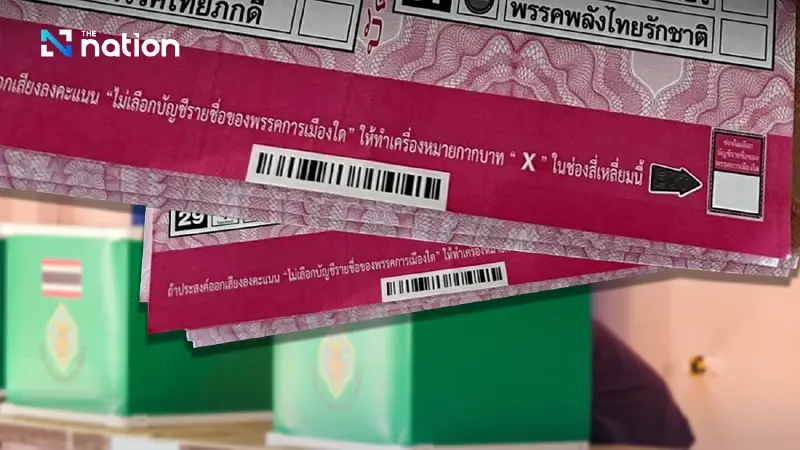


Thailand’s Ombudsman has told the EC to explain within seven days whether ballot QR codes and barcodes could breach constitutional secrecy rules
Thailand’s Office of the Ombudsman has sent a letter to the Election Commission (EC), giving it seven days to explain complaints that QR codes and barcodes printed on ballot papers could breach constitutional requirements for secret voting, ahead of a possible referral to the Constitutional Court.
A report on February 16, 2026 said the Ombudsman asked the EC to clarify petitions seeking a Constitutional Court ruling on whether printing barcodes and QR codes on ballot papers could enable traceability back to eligible voters—revealing which candidate or party they voted for—potentially violating Section 85 of the Constitution and Section 96 of the Organic Act on the Election of MPs. The EC was told to respond within seven days.
Earlier, 12 petitions were filed with the Ombudsman on February 13, 2026 concerning the management of the 2026 election. Among them were requests for the Ombudsman to forward the barcode issue to the Constitutional Court. The Ombudsman’s request for clarification from the EC stems from three petitions: one by Phattharaphong Suphaksorn, also known as “Lawyer Aun Buriram”; one by Thankawin Ratthawatankul, described as a businessman and independent academic; and one by an unnamed citizen representative who asked to withhold their name.
Under the Ombudsman’s process, once the EC’s written explanation is received, the matter will be compiled and submitted to an Ombudsman meeting for consideration. If the meeting finds the petition has grounds indicating a constitutional breach, it will be forwarded to the Constitutional Court. If it finds no grounds, the matter will be closed.
There are currently two Ombudsmen: Songsak Saicheua, Chief Ombudsman, and Pol Gen Sarayoot Sanguanphokai, an Ombudsman. A third position is still in the selection process.
Barcode controversy fuels backlash against EC, spreads to annulment calls, prison risk
- The use of barcodes and QR codes on ballot papers has become a major flashpoint, drawing heavy criticism of the EC over transparency.
- The EC says the codes are intended to prevent fraud and cannot identify voters, while critics fear they could undermine ballot secrecy.
- The controversy has escalated into multiple petitions seeking to have the election declared void and to pursue cases against EC commissioners, which could carry penalties including imprisonment.
Questions over the conduct of the 2026 election continue to be widely discussed, even though a week has passed. Civil society groups, media outlets, and several political parties have described the election as potentially irregular, citing multiple mistakes and issues they consider suspicious.
Although the EC—the organiser of the 2026 election—has used a budget of more than 7.8 billion baht and has held daily press briefings, as well as sending frequent explanations via the Line application, the explanations have done little to calm criticism. Some explanations have instead been seen as statements that further implicate the EC.
The most significant issue is the QR code–barcode controversy, which has become the single spark that has spread widely, with political parties, public figures, and citizens preparing to petition the Constitutional Court to rule that the election should be declared void.
As for the facts around the codes: constituency MP ballots (green) have a QR code; party-list MP ballots (pink) have a barcode; and referendum ballots (yellow) have no QR code or barcode.
Procurement records show the EC used a direct award method in two printing contracts:
Printing 56,100,000 party-list MP ballot papers, via a direct award method. The set reference price was 86,955,000 baht, using price criteria. The total procurement timeline was two days: approval of the purchase/hiring request report on December 29, 2025, and announcement of the winning bidder on December 30, 2025. Chan Wanich Security Printing Co., Ltd. won with a bid of 81,345,000 baht, signed by Sawaeng Boonmee, EC secretary-general.

Printing 56,100,000 constituency MP ballot papers, via a direct award method. The set reference price was 75,735,000 baht, using price criteria. The total procurement timeline was two days: approval on December 29, 2025, and announcement of the winning bidder on December 30, 2025. T.K.S. Technologies Plc won with a bid of 67,320,000 baht, signed by Sawaeng Boonmee, EC secretary-general.
No draft terms of reference (TOR) were publicly released for these procurements. However, when tracing back to the 2023 election, the EC used a selection method. In private-sector price proposals at the time, it was stated that anti-fraud measures had to be implemented under the EC’s TOR, but it did not clearly specify whether QR codes or barcodes were required.
A key point highlighted is that in the 2023 election, there was some discussion about “ballot mismatch" and recounts were ordered in 43 polling stations, but criticism of the EC was not as intense as in 2026, where the controversy stems from QR codes and barcodes.
On February 13, 2026, EC executives—including Acting Sub Lt Phasakorn Siriphokyaporn, deputy secretary-general, and Worapong Anantcharoenkit, director of the Election Support Office —held a press briefing. Their key points were:
- They insisted the barcodes and QR codes on party-list and constituency ballots are an anti-counterfeiting measure to prevent ballot forgery, prevent “ballot mismatch", and deter other forms of fraud. They cited EC regulations on MP elections, Clause 129, which authorises the EC to add codes, symbols, or other text to ballot papers as a special case without prior notice, to prevent forgery.
- The director of the Election Support Office said the barcode/QR code can be scanned to check against the ballot stub, but cannot identify which individual voter cast a vote for which MP candidate or party. Therefore, he said the 2026 election remains direct and secret under the Constitution.
- Beyond barcode/QR code measures, the EC also uses other tracking and anti-counterfeiting measures, which were also used in 2023. However, officials said they could not specify which measures were used, citing the need to prevent information leaks.
Sawaeng Boonmee, the EC secretary-general—described as having been under intense pressure during the advance voting on February 1, 2026—later reduced his public profile and worked behind the scenes. He explained on his personal Facebook account (a post that later became inaccessible) that the barcode was intended to prevent forgery, and insisted voting remained direct and secret with no way to know an individual’s choice. He also said ballot papers, stubs, and voter lists were stored separately in secure locations, and no one could access them without a court order.
In addition to public explanations, the report said the EC is currently collecting factual information and views from multiple sectors to assess whether any parties have disseminated false information about the 2026 election and the QR code/barcode issue. If it finds distorted or provocative content, it could involve breaches of multiple legal provisions and could lead to prosecutions.
For now, the EC has asked to use the timeframe set out under the 2018 Organic Act on the Election of MPs, which allows up to 60 days to officially certify election results. During this period, the EC has been gradually publishing election results by polling unit and by constituency, including in forms such as Sor.Sor.5/18 and Sor.Sor.5/18 (party-list) displayed on the EC’s website, which the public can access.
The report said there are currently four groups taking action on the issue:
- The “annul the election” group, led by some civil society members, some reserve senators, and Mongkolkit Suksintharanon, leader of the Thai Civilised Party. Their actions include petitions to the Ombudsman to forward the matter to the Constitutional Court to rule that the 2026 election is void, alleging the QR code/barcode issue means voting was not direct and secret as intended under Section 85 of the 2017 Constitution. Reserve senators have also filed a case against the EC with the Supreme Administrative Court, seeking interim protection to suspend the election results and order a new election. They also seek imprisonment of EC executives under the law, alleging suspected election fraud.
- The “recount” group, with Pheu Thai Party, the People’s Party (PP), and MP candidates from both parties—along with several other parties—initially aligned in this group. They have petitioned the EC to quickly disclose official vote totals and investigate complaints. Some want recounts at specific polling stations, while others want a nationwide recount.
- The “new election” group, involving some civil society members. Natthaphong Ruengpanyawut, leader of the People’s Party, was quoted in an interview on February 15, 2026 urging the EC to acknowledge election-management mistakes and fix them without waiting for a court order—by quickly ordering the destruction of ballots and organising a new election as soon as possible. Some former PP MP candidates have also filed petitions with the central EC.
- The “defend the EC” group, led by some civil society members and some conservative groups, with Sonthiya Sawatdee, a political activist, openly supporting the EC. He has submitted a letter backing the EC and urging legal action against those spreading “fake news” about QR codes and barcodes, which he said has incited society. He also insisted barcodes/QR codes are necessary on ballots to prevent “ghost ballots”.
These are the movements by civil society and political parties, both supporting and opposing the management of the 2026 election—particularly the single spark of the QR code/barcode issue, which continues to escalate. The ultimate findings will depend on investigations by the relevant agencies.

