
Army rebuts seven fake news claims on Thai-Cambodia border
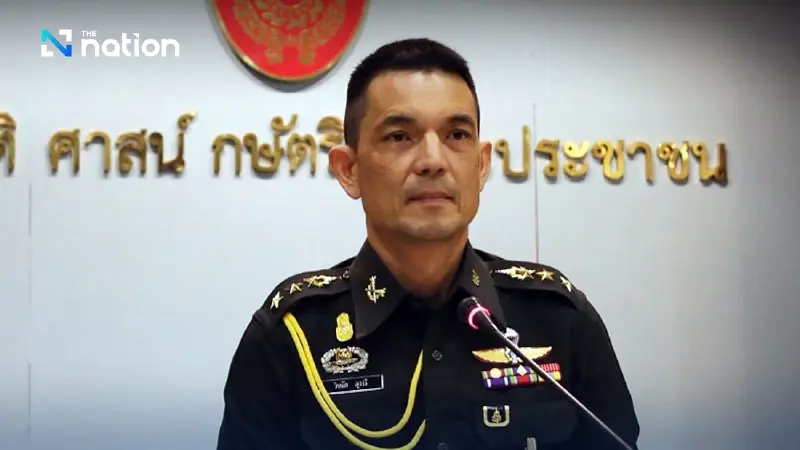


Royal Thai Army rejects seven ‘fake news’ claims on the Thai-Cambodia border, saying a foreign page relied on one-sided information
February 22, 2026 — Maj Gen Winthai Suvaree, spokesperson for the Royal Thai Army, issued a clarification after what he described as “fake news” was circulated as a news report on a foreign social media page on February 20, 2026. The report alleged Thailand violated international law and used excessive force in the Thai-Cambodia situation.
He said the information not only lacked clear references, but also contained distorted content inconsistent with facts on the ground. He said it appeared to reflect only the Cambodian side, which he claimed has repeatedly presented false information to the international community. To ensure the public receives accurate information, the army set out clarifications on the following points:
The army issued clarifications on seven points:
1. Claim: Cambodia started it, but Thailand escalated for Bangkok election gains.
Winthai said the army strictly follows international law, calibrates its actions to the situation, and acts under rules on the use of force. He said Thailand’s actions constitute lawful self-defence under Article 51 of the UN Charter, and are not linked to political campaigning in Bangkok.
2. Claim: Thailand used excessive force after one Thai soldier was injured by a landmine, including deploying F-16s and air strikes.
He said Thailand co-ordinates across all services to defend sovereignty and protect civilians, and that its actions were not merely in response to a single landmine incident. He alleged Cambodian forces opened fire first with heavy weapons against Thai troops and civilian areas, and used civilian areas and buildings as bases. He said Thailand therefore requested F-16 support to reduce Cambodia’s ability to strike, while focusing only on “military targets” and acting proportionately to limit damage to combat zones.
3. Claim: Thailand used illegal weapons, including cluster munitions, causing the death of a 10-year-old boy near Preah Vihear.
Winthai denied claims of chemical weapons or cluster munitions against civilians. He said Thailand used 155mm DPICM (dual-purpose artillery munitions) for military targets, not as anti-personnel mines, and claimed there would be no long-term remnants. He added Thailand is not a party to the convention banning cluster munitions, and said any use would be based on necessity and limited to equipment, vehicles and structures, not people.
On the reported death of the Cambodian boy, he said checks found it was an accident involving old explosive material being dismantled for scrap outside the clash area, and was unrelated to Thai operations.
He also said Cambodia had deliberately used the Preah Vihear monument as a base for heavy weapons, arguing this removed its protected status under the 1954 Hague Convention, and that Cambodia should bear responsibility.
4. Claim: Thailand waged psychological warfare by blasting “crying ghost” sounds and funeral music at 3am into villages to frighten children.
Winthai said this was not a military operation but an expression by Thai civilians protesting alleged sovereignty violations and an assembly he described as aggressive, involving unlawful violence against police in Thai territory. He argued it was not torture because the perpetrators were not state officials, and those who entered Thai territory could leave to avoid the noise. He countered that Cambodia often uses information operations and propaganda to portray itself as a victim internationally.
5. Claim: The Thai government used the border situation and Cambodian lives as an election strategy.
He said protecting sovereignty and public safety is the army’s legal duty as part of the civil service under government oversight, regardless of which administration is in power. He insisted the situation should not be framed as partisan politics but as a matter involving Thai people broadly, and not linked to campaigning.
6. Claim: Nearly 98,000 Cambodians remain displaced.
He called the figure false and far beyond reality. He said the disputed area involved three villages in Sa Kaeo province, with no more than about 1,000 households in total—amounting to only several thousand people, not nearly 100,000.
He said Cambodia has long known the area is Thai territory, and claimed Thailand previously provided shelter to Cambodian refugees during conflict, but that after the war ended, Cambodian civilians and soldiers did not return and continued expanding settlements into Thai sovereign territory. He said Thailand had raised the issue repeatedly through working mechanisms, but Cambodia ignored calls to relocate people back to the Cambodian side. He argued the group should not be labelled “displaced persons” but rather people unlawfully encroaching on Thai territory for a long period.
7. Question: Should the international community hold Thailand responsible?
Winthai said responsibility should lie with Cambodia, alleging Cambodia initiated events—particularly by firing long-range weapons that harmed Thai civilians—and that Thailand has evidence to support this. He said Thailand’s response followed international practice and was proportionate, with a focus on avoiding impacts on civilians in both countries.
