
Thaksin parole timeline fuels debate over Pheu Thai’s future
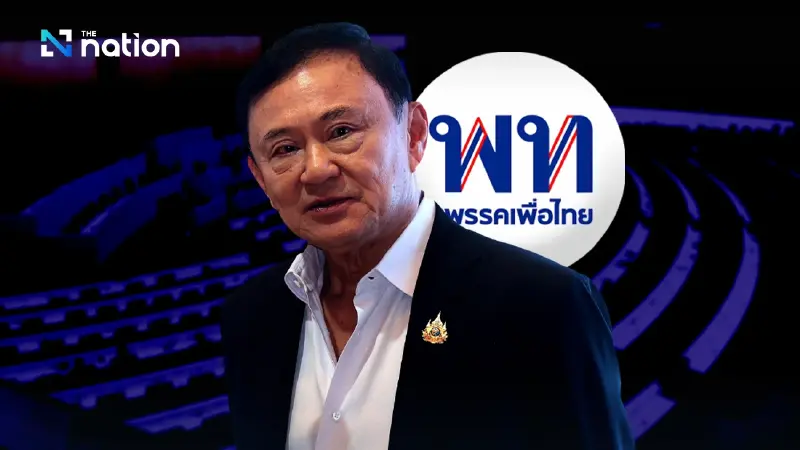


Thaksin is set to qualify for parole on May 10, 2026, with possible release May 11, as Pheu Thai’s defeat intensifies calls for him to step back
- Thaksin Shinawatra’s continued political involvement—both openly and behind the scenes—after being ordered to serve a prison sentence is seen as a key factor in Pheu Thai’s historic defeat, with the party falling below 100 MPs for the first time.
- “Deep state” influence, alongside the 2017 constitution, is viewed as tightening constraints on Pheu Thai and pushing Thai politics away from policy-driven competition towards elections dominated by money and state power.
- The defeat underscores growing pressure for Thaksin to step back from politics, as his bargaining power has weakened and his political room to manoeuvre remains limited by ongoing legal cases, including a Criminal Code Section 112 case.
Former prime minister Thaksin Shinawatra is expected to qualify for parole after serving two-thirds of his sentence under the Corrections Act and related ministerial regulations, following the Supreme Court’s Criminal Division for Holders of Political Positions ordering him to serve a one-year prison term on September 9, 2025.
The Department of Corrections issued a press document titled “Parole of a former prime minister” on February 25, 2026, addressing claims that Thaksin would be eligible on May 9, 2026; it confirmed the eligibility date is May 10, 2026, with possible release on parole on May 11, 2026.
The calculation for two-thirds of a one-year term (365 days) is 244 days (eight months and four days), which falls on May 10, 2026, allowing release the following day, May 11, 2026. Any requirement for an electronic monitoring device would be decided at the discretion of the parole-review subcommittee.
Even if paroled, Thaksin is still seen as facing politically risky conditions, particularly an ongoing Criminal Code Section 112 case linked to a previous interview with a South Korean media outlet; prosecutors’ appeal has been accepted by the Criminal Court, potentially limiting his political room to manoeuvre.
Thaksin’s recent political trajectory is widely framed as a lesson in miscalculated strategy—he did not step back as previously signalled, instead remaining highly visible both publicly and behind the scenes. The episode involving treatment at the Police General Hospital’s 14th floor is viewed as a key moment that unsettled Pheu Thai and later fed into the February 8, 2026 general election, when the party fell below 100 MPs for the first time and suffered a second electoral defeat.
Many within Pheu Thai are seen as agreeing the party’s major misstep was that “the boss” continued to pull strings openly and behind the scenes, without concealing his influence. Had he retreated to a quieter private life—as he had previously indicated—events might not have escalated to a prison sentence being enforced.
Once the party’s “spiritual leader” leaves prison, it is still expected to be difficult if he continues to set strategy and push his daughter, Paetongtarn Shinawatra, to drive politics, with critics arguing this risks repeating the same “armchair warrior” cycle.
Pheu Thai is increasingly portrayed as operating like a “limited company” run by a small circle, making it harder to return to its earlier image as a policy-driven party; the 2026 election is cited as evidence that its “flagship policies” failed to gain traction.
Thai Rak Thai and later Pheu Thai are remembered for winning through policy platforms, but that model is seen as having eroded after Gen Prayut Chan-o-cha seized power in a coup. Elections are viewed as having shifted markedly—especially in 2023 and 2026—towards heavy spending and extensive use of state resources. The 2017 constitution, drafted under Meechai Ruchupan, is described as enabling a conservative order that concentrates power in the bureaucracy, making policy-driven party-building far more difficult.
When the 2017 constitution came into force, Thaksin previously warned former Pheu Thai MPs that Thailand would lose competitive dynamics, become more like “employees”, and end up with independent agencies not connected to the public—outcomes he viewed as harmful consequences of the 2017 constitution.
After parole, a major question hanging over Pheu Thai is the perception that it is now dominated by the “two S’s”—Suriya Juangroongruangkit and Somsak Thepsuthin—who are seen as effectively taking over, while sharing political stakes with Ban Chan Song La.
Those within Pheu Thai who reject the “armchair warrior” approach argue Thaksin should use the parole period to step back, saying he has fought enough battles already.
Although Thaksin’s political strength is often associated with pushing parties to compete through policies aimed at improving livelihoods, the 2017 constitution is seen as dragging politics back towards a pre-1997 style where money, rather than policy, becomes the central weapon. This is linked to public fatigue and the belief that outcomes change little regardless of which party wins, alongside intensified talk of heavy spending in the 2026 election.
Thaksin is also viewed as potentially being forced into a quieter posture due to legal “baggage”, amid the belief that “deep state” forces do not want Pheu Thai—or Thaksin—to regain bargaining power or fight as they once did.
If that holds, it is increasingly argued that the era of Ban Chan Song La may be ending and that Thaksin may finally need to step back. Pheu Thai’s current position—only 74 seats, losing the top spot to the Bhumjaithai Party, and becoming a swing party waiting to join a coalition—is seen as leaving it with limited leverage.
Once treated as the number-one enemy of the “blue party”, Pheu Thai is now viewed as fully predictable to its rivals.
Even if Thaksin is paroled after serving two-thirds of his sentence around May, the political “game” is widely seen as already decided: a Bhumjaithai-led government would return Anutin Charnvirakul as prime minister for a second term, with a new cabinet expected before Songkran 2026.
The broader political environment is expected to remain shaped by the 2017 constitution, which is viewed as difficult to amend, even though a referendum on February 8, 2026 approved constitutional amendments.
Despite that referendum result, “deep state” forces are still seen as holding the advantage and maintaining control of key institutions, relying on the Bhumjaithai Party and “independent agencies” to keep Pheu Thai’s status down—while also containing the People’s Party to prevent further growth—amid the view that available options are limited as other parties weaken and fail to match the rise of the “blue party”.
The central takeaway is that political bargaining is no longer as straightforward as it was before 2017: confidence that compromise with the “deep state” was possible is now seen as having ended in defeat.
