
Anutin: Ending fuel price freeze has ripple effects, government to use Commerce Ministry tools
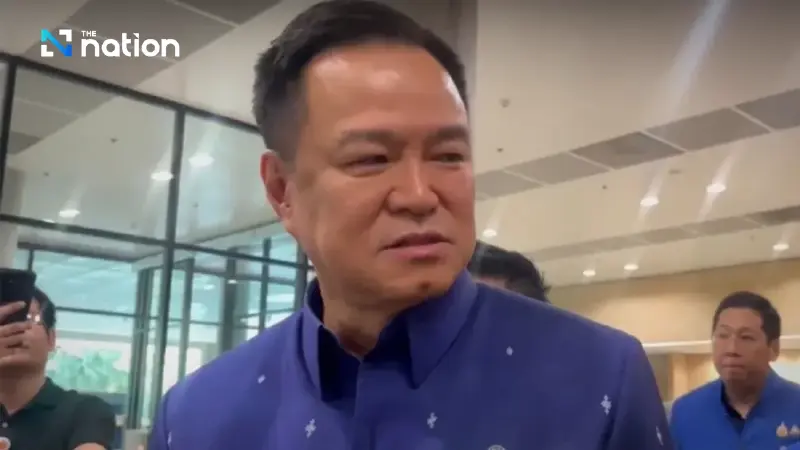


Prime Minister Anutin Charnvirakul said the removal of fuel price controls could trigger ripple effects, adding the government would rely on Commerce Ministry and other agencies’ mechanisms, as motorists queue at stations.
Prime Minister and Interior Minister Anutin Charnvirakul acknowledged on Tuesday that ending the fuel price freeze could have knock-on effects, saying the government would use mechanisms available through the Ministry of Commerce and other agencies to manage the impact.
Asked about reports of motorists queuing to refuel, Anutin said he had already commented on the situation the previous evening and that nothing had changed. He added that he had not yet received any new reports.
When asked whether lifting the fuel price freeze would create a ripple effect, he replied: “It does, to some extent. We have to use the mechanisms we have through the Commerce Ministry and other ministries.”
Asked what measures would be used to address public sentiment, Anutin nodded and said everyone was working.
Deputy Prime Minister and Finance Minister Ekniti Nitithanprapas said on the programme “Inside Thailand” on Wednesday that the government’s policy response to the energy crisis—after ending the 33-baht-per-litre diesel price cap—will focus on targeted subsidies, providing support only to groups that are directly affected.
“Today’s situation is a major global energy crisis. Everyone has to adapt. If we try to go against market prices, it will create distortions. Anything that goes against the pricing mechanism will lead to stockpiling and hoarding, and we will waste resources and budget in unnecessary areas,” he said.
The Finance Ministry and related agencies have prepared assistance measures divided into five main target groups, as follows:
1. Vulnerable groups
Support for low-income people will be delivered through the State Welfare Card programme. The government already has a database of 13.4 million eligible cardholders nationwide. Assistance would be provided by topping up funds on the card, potentially adding to existing sub-wallets such as those for food or electricity costs to help ease living expenses.
However, implementing this measure requires funding from the central budget, so it must wait until the new government formation process is completed before budget approval and rollout can begin.
2. Public transport and logistics sector
The Transport Ministry has compiled data on affected operators, including around 360,000 trucks and nearly 30,000 public buses, as well as vans, taxis and motorcycle taxi services.
“The transport sector is among the first to be hit by energy costs, which then pass through to the prices of consumer goods,” he said.
Support could come in the form of fuel coupons or top-up cards, or direct cash assistance. Payments could be made in two ways: directly to operators, or transferred straight to drivers via PromptPay, to ensure independent drivers who are not affiliated with large operators can access support fairly.
3. Farmers
The energy crisis has also pushed up fertiliser prices, as LNG and oil are key inputs in fertiliser production. The Commerce Ministry has been assigned as the lead agency to secure lower-cost fertiliser and encourage farmers to use organic fertiliser to reduce planting costs.
In addition, many registered farmers are also State Welfare Card holders and would therefore receive support under the vulnerable-group measures as well.
4. Fisherfolk
To reduce fishing costs, the Transport Ministry plans to encourage fishers to switch to B20 diesel (diesel blended with 20% palm oil) instead of “green diesel”. Initial estimates suggest B20 for the fishing sector could be 5 baht per litre cheaper than diesel sold at land-based service stations. The measure is expected to lower costs for fishers while also benefiting domestic oil palm farmers.
“To prevent palm oil prices rising to the point that it affects consumption and industry, the Commerce Ministry will closely manage overall supply, including export controls on palm oil, to prevent opportunistic price gouging,” he said.
5. Government contractors
For contractors working on government projects who face higher construction material costs, the Budget Bureau will provide support by adjusting the “K factor”—the price index used to calculate construction payments—under standard government contract mechanisms.
He added that the government will not introduce special oil price subsidies for the wider industrial and service sectors, because all sectors must adapt to global energy conditions. Instead, the state will help by supporting business liquidity, including preparing low-interest loans (soft loans) to help firms continue operating.
