
MOU 44 reset shifts Thailand-Cambodia seabed talks to UNCLOS arena
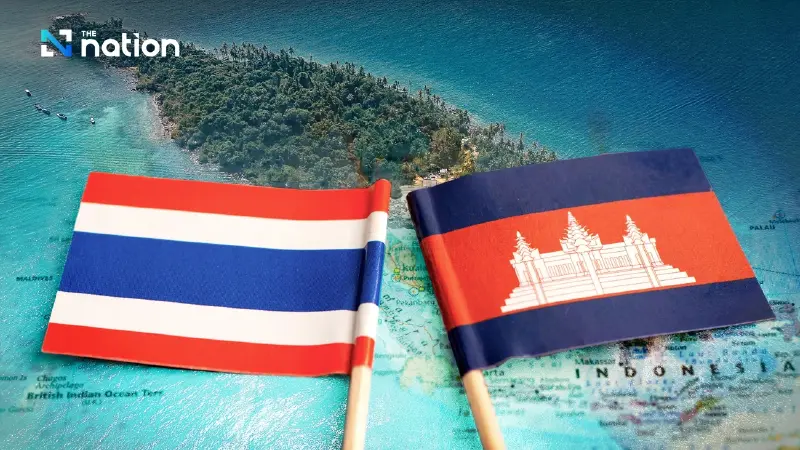


Thailand’s NSC move to cancel MOU 44 shifts the Cambodia maritime dispute towards UNCLOS, raising questions over each side’s legal strategy.
Prime Minister Anutin Charnvirakul convened a meeting of Thailand’s National Security Council (NSC) on Thursday (April 23) to assess key security issues after the government began operating at full capacity.
At the meeting, he instructed Foreign Minister Sihasak Phuangketkeow, who oversees security and international relations, to work closely with Defence Minister Lt Gen Adul Boonthamcharoen on three main issues related to the Thai-Cambodian border and national security.
First, Thai-Cambodian border checkpoints will remain closed.
Second, the government will press ahead with border fence construction. Current pilot areas in Chanthaburi and Trat cover the main border crossing at boundary markers 52–54 in Pong Nam Ron district, Chanthaburi, spanning about 1,310 metres, and boundary markers 72–73 in Trat, covering about 1.5 kilometres. Work began in April, with completion targeted within 45 days.
A separate 10-kilometre border fence project in Sa Kaeo is also under way, starting in areas where there are no disputes. This includes the section around boundary markers 50–51 at Ban Khok Sabaeng in Tha Kham subdistrict, Aranyaprathet district, covering more than five kilometres.
Third, Thailand will continue to pursue negotiations aimed at peace. However, if a third round of clashes becomes unavoidable, the country must be ready to win. The same approach will apply to efforts to resolve problems in the southern border provinces: control the situation, weaken the operational capacity of perpetrators and sharpen intelligence work.
MOU 44 reset brings UNCLOS to the fore
On the Thai-Cambodian maritime dispute, the NSC resolved to cancel MOU 44, one of the policies the government had declared to Parliament, and return to the framework of the 1982 United Nations Convention on the Law of the Sea (UNCLOS).
UNCLOS came into force on November 16, 1994. It is an international legal framework that defines the rights and duties of state parties in relation to the use of the sea and marine resources.
The convention has more than 166 state parties, including Thailand, which ratified it on May 15, 2011. Its key bodies include the International Seabed Authority (ISA), the International Tribunal for the Law of the Sea (ITLOS) and the Commission on the Limits of the Continental Shelf (CLCS).
Cambodia signed UNCLOS in July 1983 but delayed ratification for decades, citing a lack of personnel with the necessary expertise and knowledge. Cambodia’s National Assembly later voted unanimously to ratify the convention, allowing the country to become a state party in March 2026.
“Cambodia became a member of UNCLOS in March 2026. We can now talk within the framework of member states for Thailand’s benefit,” said Adm Thadawut Thatpitakkul, Chief of Staff of the Royal Thai Navy.
He added that the process of cancelling MOU 44 would be handled by the government, while the navy would act as the implementing agency. In principle, he said, the Royal Thai Navy is responsible for protecting Thailand’s maritime sovereignty.
Once the government, through the Foreign Ministry, provides clear direction, the navy is ready to act immediately in line with government policy, he said.
Rachada Dhnadirek, spokesperson for the Office of the Prime Minister, also outlined the key reasons behind the NSC’s decision to cancel MOU 44.
First, MOU 44, signed in 2001, was intended as a framework for negotiations on shared undersea interests between Thailand and Cambodia. However, over more than two decades, only five rounds of talks have been held, with no conclusion that benefited both countries.
Second, Cambodia has instead caused disputes over maritime boundaries, creating conflict between the two countries and offering no workable path towards the joint development and management of undersea resources.
Third, cancelling MOU 44 would end negotiations under the existing framework. If Cambodia still sees benefit in jointly developing and managing undersea resources with Thailand, it should express its intention or formally notify Thailand so that a new and more practical negotiation framework can be established — one that does not lead to maritime boundary disputes as before.
Fourth, it must be acknowledged that, over the past 25 years of conflict between Thailand and Cambodia, MOU 44 has been one of the factors preventing negotiations from moving forward or achieving their goals.
“If the conflict continues in this way, negotiations to jointly develop and manage undersea resources will be difficult, because the key principle is that the maritime boundary must first be agreed. Only then can both sides seek a path towards joint development and management based on sincerity and fair sharing. It is therefore appropriate to cancel it and set a new negotiation framework to reduce conflict and ensure the resources can genuinely be put to use,” Rachada said.
Following the decision to cancel MOU 44 and shift to UNCLOS, the Foreign Ministry will prepare a proposal for Cabinet consideration before notifying relevant agencies and state parties.
Using UNCLOS, a globally recognised framework, may implicitly cut through the issue of Cambodia’s maritime boundary line, which Thailand says runs through Koh Kut. Even so, it raises the question of what information Cambodia may have in hand that prompted it to finally ratify UNCLOS after holding off for so long.
Likewise, Sihasak has not disclosed Thailand’s legal strategy, while both sides appear likely to reserve their arguments for international mechanisms.
