
Thai PM Firm on Sovereignty, Declaring Colonial-Era Maps 'No Longer Exist' for Bangkok
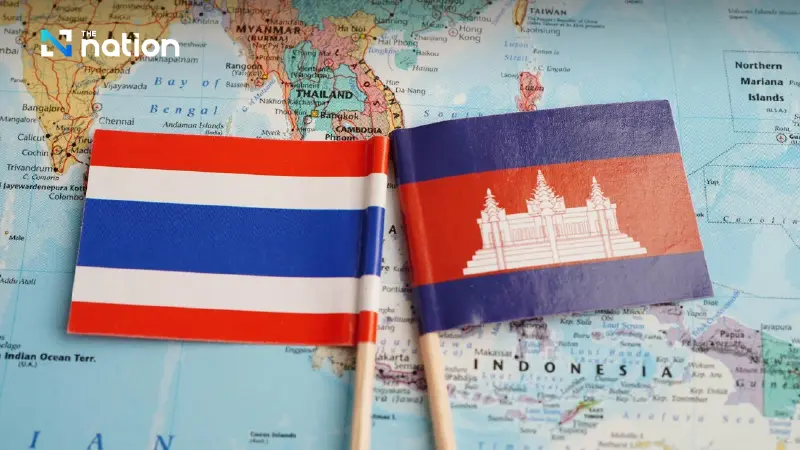


Speaking at Thaifex Anuga Asia 2026, Prime Minister Anutin Charnvirakul confirmed bilateral talks with France and UNESCO over contested boundary frameworks
- Thai Prime Minister Anutin Charnvirakul has asserted national sovereignty by declaring that the French colonial-era maps (1:200,000 scale) used by Cambodia for border claims "no longer exist" for his administration.
- During a diplomatic mission to France, the Prime Minister met with French President Macron and UNESCO officials to clarify Thailand's firm position on the border dispute.
- Thailand insists on using its own technical systems and more precise maps, rejecting external reliance on historical cartography to define its borders.
- The Thai government has demanded that UNESCO remain strictly neutral in the dispute, insisting that Thailand must be heard before any official reports concerning the border are released.
Speaking at Thaifex Anuga Asia 2026, Prime Minister Anutin Charnvirakul confirmed bilateral talks with France and UNESCO over contested boundary frameworks.
Prime Minister Anutin Charnvirakul has firmly reasserted Thailand’s territorial sovereignty, declaring that colonial-era map scales used by Cambodia to justify border claims "no longer exist" for the Thai administration.
Speaking to the media in a sideline interview during his tour of the Thaifex Anuga Asia 2026 exhibition, the prime minister revealed details of his recent high-level diplomatic mission to France, where he held pivotal talks with French President Emmanuel Macron and executive officials at UNESCO headquarters in Paris.
The primary objective of the mission was to clarify international misunderstandings regarding Thailand’s borders and to address the latest friction points along the Thailand-Cambodia demarcation line.

The Map Discrepancy
At the heart of the dispute is the cartographic framework used to define the frontier. Phnom Penh has historically relied on French colonial-era maps drawn at a scale of 1:200,000. Prime Minister Anutin flatly rejected this baseline.
"Thailand adheres strictly to our own established technical systems and existing bilateral conclusions," Anutin stated. "Requests from external parties regarding historical French maps do not hold sway. For Thailand, the 1:200,000 scale no longer exists. If anyone wishes to enforce that scale, they are looking at a completely different country."
The prime minister clarified that Thailand currently utilises a highly precise 1:50,000 scale map for specified border sectors. However, he maintained that the government remains open to transparent technical verifications if lingering doubts persist between the two neighbours.

Demanding UNESCO Neutrality
The border issue has gained renewed urgency following recent reports of alleged structural damage to an ancient World Heritage site situated near the shared boundary.
Cambodia has reportedly raised concerns with UNESCO regarding Thailand's border activities.
In response, Anutin confirmed that Thailand has already submitted comprehensive written clarifications to the international body. To break the deadlock, the Thai government has formally proposed a joint field survey.
"Since the sites in question are located only a few kilometres apart, we have invited international observers to conduct an on-site inspection of both sides of the border," the prime minister said, adding that UNESCO is currently considering the proposal.
However, Anutin issued a stern reminder to the UN cultural agency regarding its geopolitical responsibilities:
"UNESCO is an international organisation that must remain strictly neutral. Even if an investigation or report is formally requested by the opposing country, investigators are duty-bound to listen to both sides. Thailand must be granted the right to clarify its position before any official report is publicised to the world."
A Shift to Results-Oriented Diplomacy
Reflecting on the broader, often stagnant history of Thailand-Cambodia border negotiations, the prime minister signalled a paradigm shift in how his administration intends to handle bilateral talks moving forward.
He emphasised that future dialogue must be "two-way" and outcome-driven.
"The directive I have given to our negotiating teams is clear: talks must yield tangible results for the public. We will not engage in endless, unproductive meetings that serve only to postpone solutions indefinitely," Anutin concluded, stressing that true diplomacy requires reciprocal respect and mutual trust rather than superficial gestures.
