
Uzbekistan Airways steps up push to boost Thailand–Uzbekistan tourism
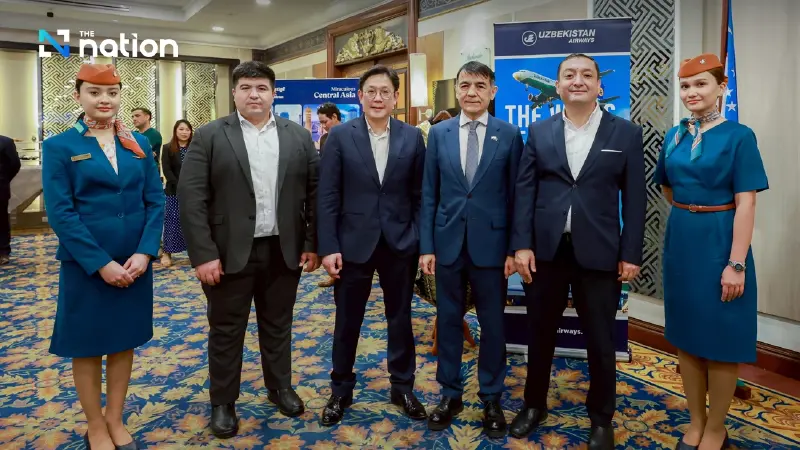


Uzbekistan has a wide range of attractions for Thai travellers — from ski slopes and Silk Road heritage to lively nightlife — says Murod Gulyamov, Uzbekistan Airways’ country manager.
Uzbekistan is a treasure trove of historical and cultural wonders. Home to ancient Silk Road cities that draw visitors from around the world, the Central Asian nation is increasingly being seen as a destination worth watching — and visiting.
Tashkent, Uzbekistan’s capital, is a modern metropolis of more than three million people. From colourful dastarkhans symbolising warmth and hospitality to bustling bazaars scented with oriental spices, the city blends tradition seamlessly with contemporary life. Modern skyscrapers rise above sparkling fountains, offering visitors a surprisingly diverse urban landscape.
Uzbekistan is also widely known for its Islamic heritage, reflected in architectural landmarks such as Registan Square in Samarkand, a historic centre of Islamic learning famed for its grand madrasas, striking symmetry and intricate mosaic tilework.
Beyond Islamic history, Uzbekistan is home to Fayaz Tepe in Termez, one of the country’s most significant ancient Buddhist sites. Most of the complex dates to the 3rd century AD, but its oldest feature — a stupa preserved beneath a modern dome and visible only through a window — is thought to be about 400 years earlier.
Archaeologists have uncovered remarkable sculptures at Fayaz Tepe, including a limestone depiction of the Buddha seated beneath the sacred bodhi tree, accompanied by two monks. Once adorned with gold leaf and framed by Corinthian columns, the sculpture is now regarded as one of the most valuable exhibits at the State Museum of History of Uzbekistan.

The preservation of Buddhist heritage sites in Uzbekistan reflects the government’s recognition of the nation’s diverse spiritual history. Restoration and conservation projects are ongoing, underscoring Uzbekistan’s respect for cultural and religious coexistence — a message that resonates strongly with Thai visitors.
At present, most tourists to Uzbekistan come from neighbouring Central Asian countries and Russia, as well as Turkey, China, India, South Korea and Afghanistan. Interest from Southeast Asia, particularly Thailand, is steadily increasing.
“Nature made a balance,” Gulyamov told The Nation. “We may not have a sea or an ocean, but we are gifted with four true seasons — spring, summer, autumn and winter — each offering its own colours, moods and adventures.
Thai travellers will discover landscapes unlike anything they know, a unique climate and a completely different style of nightlife. In Uzbekistan, there is always something unexpected waiting to be explored — no matter where you go.”
“And, of course, our culture and cuisine are an inseparable part of the experience. Uzbekistan offers travellers ancient traditions, vibrant craftsmanship, music and hospitality that has been preserved for centuries. Food lovers will be amazed by the richness of our gastronomy — from aromatic pilaf and freshly baked bread to delicate soups and flavours shaped by the Silk Road. Every region has its own culinary identity, telling a story through taste.”
“When visitors come to Uzbekistan, they don’t just see the country — they feel it through its flavours, its people and its living history.”

Expanding air links between Thailand and Uzbekistan
Uzbekistan Airways has served as a key bridge between Thailand and Uzbekistan since 1994, facilitating travel and strengthening people-to-people ties between the two countries. In Thailand, the airline works closely with Thai Air Services Co., Ltd, its long-standing partner and sales agent.
After operating just two weekly flights in 2023, the airline has expanded services to six flights per week — four to Bangkok and two to Phuket. In 2025, Uzbekistan Airways carried more than 32,000 passengers on its Thailand routes.
The airline plans to increase frequency to eight flights per week by the end of 2026, aiming to carry more than 35,000 passengers that year.
“For the first time in history, we will have a flight from Tashkent to Thailand almost every day,” Gulyamov said, adding that on some days the airline may even operate two flights.
Uzbekistan Airways is also planning to exploring new destinations in Thailand, including Krabi and Koh Samui, citing strong demand from Uzbek travellers.
“They love the sea, which we do not have. Southern Thailand is especially popular,” he said.
Bangkok services are operated by Airbus A321neo and Boeing 767, while the Phuket route is currently served by the Boeing 787 Dreamliner.
“We use the Dreamliner on the Phuket route because it is one of the most modern and comfortable aircraft available,” Gulyamov said.

Tourism promotion and partnerships in Thailand
Uzbekistan Airways held a partner briefing at the Golden Tulip Sovereign Hotel in Bangkok on January 20, ahead of the Thai International Travel Fair2026 (TITF), to strengthen engagement with travel agents and tour operators
The pre-fair session allowed partners to focus specifically on Uzbekistan and related tour products, prior to the airline’s participation at TITF from January 22–25, where Uzbekistan Airways and Thai Air Services will jointly promote travel between Thailand and Uzbekistan.
The chief commercial officer of Thai Air Services Co., Ltd said the company operates across all major aviation segments, including passenger services, cargo operations and tourism. “For emerging routes such as Uzbekistan, our role is to serve as a bridge between the airline, industry partners and the Thai market,” he said. “We focus on making travel and transportation more accessible, efficient and aligned with international standards.”
The briefing was held ahead of the Thai International Travel Fair, scheduled for January 22–25 at the Queen Sirikit National Convention Centre, where Uzbekistan Airways and Thai Air Services jointly promoted travel opportunities between Thailand and Uzbekistan.

Visa proposal and lower fares
Alongside industry partnerships, Uzbekistan Airways hopes the Uzbek government will consider granting visa-free entry for Thai travellers, noting that Uzbek citizens already enjoy visa-free access to Thailand.
“If we remove the visa requirement, passenger numbers will increase further,” Gulyamov said, adding that flight frequency would be adjusted to meet demand.
Before the Covid-19 pandemic, average return fares to Uzbekistan exceeded US$800. Today, fares range from US$450–480, or around 14,000 baht, making the destination significantly more accessible.
“It is a great opportunity for Thai citizens to experience Uzbekistan,” he said.
The airline has also partnered with Prestige, one of Uzbekistan’s largest tour companies, to help improve service quality and develop attractive travel packages. Uzbekistan Airways continues to monitor passenger satisfaction to ensure travellers feel confident and safe when visiting the country.
Looking ahead, Gulyamov said he expects air connectivity between Uzbekistan and Thailand to expand steadily over the next two to three years, potentially reaching two flights per day. “Thailand has become a key gateway for Southeast Asia, just as Uzbekistan is emerging as a central hub for all of Central Asia,” he noted.
“It may seem ambitious today,” he added, “but I am confident that visa restrictions will eventually fade away. When that happens, cultural dialogue and tourism between our two nations will grow at least twofold — and perhaps even more.”
