
French Energy Interests Drive Macron's Mediation Offer in Thailand-Cambodia Border Row
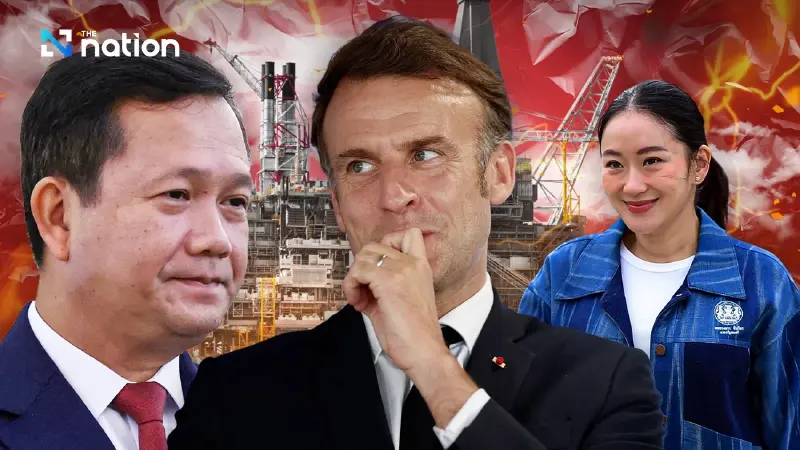


President's diplomatic intervention coincides with TotalEnergies' pursuit of offshore oil concessions worth billions
President Emmanuel Macron's recent offer to mediate the escalating Thailand-Cambodia border dispute appears closely aligned with French energy interests, as the country's oil giant TotalEnergies pursues lucrative offshore concessions in the contested Gulf of Thailand waters.
The French leader's diplomatic intervention comes at a time when thousands of protesters have rallied in Bangkok, demanding Prime Minister Paetongtarn Shinawatra's resignation over her handling of the border crisis, whilst Cambodia has asked the International Court of Justice to resolve its border disputes with Thailand following recent military confrontations.
During a telephone conversation with Prime Minister Paetongtarn on Friday, Macron pledged France's support for negotiations between the two Southeast Asian neighbours and offered access to historical colonial documents that could prove crucial to resolving the territorial dispute.

The French president positioned his country as a "neutral and constructive mediator" committed to promoting regional peace and cooperation.
However, the timing of France's diplomatic offensive raises questions about underlying commercial motivations.
TotalEnergies has maintained a presence in Cambodia's upstream sector since signing a conditional agreement with the Cambodian government in October 2009 for offshore oil and gas exploration in the OCA-III Area, which falls within the disputed maritime zone between the two countries.
The stakes are considerable. Thailand estimates petroleum reserves worth approximately $300 billion in the disputed offshore area, representing one of Southeast Asia's most valuable untapped energy resources.
Thailand and Cambodia are discussing joint Gulf of Thailand oil and gas exploration, but territorial disputes still pose a challenge.

Colonial Legacy Meets Modern Ambitions
France's historical role as Cambodia's colonial power from 1863 to 1953 gives it unique insight into the border demarcation process.
The French-drawn maps and treaties from this period became central evidence in the landmark 1962 ICJ ruling that awarded the disputed Preah Vihear temple area to Cambodia—a decision that continues to strain Thai-Cambodian relations.
Macron's bilateral approach has been notably comprehensive.
Before his conversation with the Thai prime minister, he had already expressed intentions to meet with Cambodian Prime Minister Hun Manet in Nice, promising support for Cambodia's case preparation for the World Court.
This dual engagement demonstrates France's careful balancing act between the two nations.
The French president's social media messaging has emphasised enduring Franco-Thai friendship, whilst Prime Minister Paetongtarn highlighted discussions on expanding cooperation in space technology, defence, and clean energy—areas where France maintains significant commercial interests.
Energy Politics in Focus
The commercial dimension of France's involvement becomes more apparent when considering TotalEnergies' expanded regional presence.
The company operates over 58 service stations across Cambodia and has been actively exploring opportunities in the country's renewable energy sector, with plans to potentially expand successful Singaporean projects to the Cambodian market.
Recent high-level meetings between TotalEnergies executives and Cambodia's energy minister have focused on additional investment opportunities beyond the company's existing retail network.
The discussions coincide with Cambodia's growing energy needs and its position as a key player in the disputed offshore areas.
The overlapping maritime claims between Thailand and Cambodia have effectively frozen development of what could be one of the region's most significant energy discoveries.
ConocoPhillips and TotalEnergies SE were reported by local media to have won concession rights in Cambodia, though the territorial dispute has prevented meaningful exploration progress.

Regional Implications
International mediation seems to be needed as bilateral talks to resolve the dispute have failed, according to regional observers.
However, some analysts suggest that ASEAN, rather than external powers, should take the lead in mediating the conflict to prevent great power interference in Southeast Asian affairs.
The current border tensions have practical consequences beyond energy politics.
Thailand is imposing new border restrictions including blocking tourists from entering Cambodia, whilst both countries had to return their troops to previous border positions after a clash in which a Cambodian soldier was killed.
France's mediation offer, whilst potentially helpful in resolving the immediate crisis, reflects the complex intersection of historical responsibility, diplomatic influence, and commercial interests that characterises modern international relations in Southeast Asia.
Whether this external intervention will prove beneficial or merely serve French energy ambitions remains to be seen.
The resolution of the Thailand-Cambodia border dispute could unlock significant economic opportunities for both nations and their international partners.
However, the success of any mediation effort will ultimately depend on addressing the underlying territorial claims rather than merely facilitating access to disputed energy resources.
