
Xi Jinping’s visit to Tibet reinforces China’s authority over ‘roof of the world’
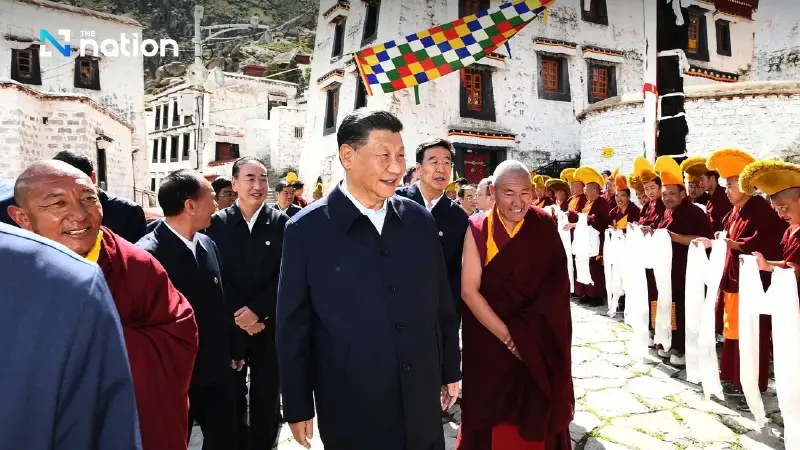


Chinese President Xi Jinping made a surprise visit to Tibet, reinforcing China’s authority over the region, as tensions continue over the search for the next Dalai Lama.
According to the BBC, Xi called for unity during his visit, addressing a crowd of 20,000 to mark the 60th anniversary of China’s establishment of the Tibet Autonomous Region following its annexation.
His trip to Lhasa, which sits at a high altitude that could pose health risks for the 72-year-old leader, appears to underscore his intent to assert his authority over the region.
This marks only Xi’s second presidential visit to the tightly-controlled region. During his address, he praised local authorities for "engaging in a thorough struggle against separatism," referencing the long-standing Tibetan resistance to Beijing’s rule.
"To govern, stabilise and develop Tibet, the first thing is to maintain political stability, social stability, ethnic unity and religious harmony," Xi said, according to an official summary of his speech.

The visit follows shortly after the Dalai Lama, the Tibetan spiritual leader, announced that his office – not China – would choose his successor. Chinese leaders, however, claim that only they hold the power to oversee this decision.
Xi’s remarks on this matter made no reference to the Dalai Lama, who has been in exile in India since fleeing in 1959.
His surprise trip dominated the headlines in China’s state-run media, where his tour of Lhasa was presented as a celebration. Front-page photos showed him being welcomed by Tibetan dancers and cheering crowds.

In his meeting with local authorities, which also included senior members of the Chinese Communist Party (CCP), Xi encouraged greater economic, cultural, and personnel exchanges with Tibet. He also called for the promotion of a national common language and script.
Xi outlined the CCP’s vision for Tibet, emphasising four key tasks for the region: ensuring stability, promoting development, protecting the environment, and strengthening borders, as reported by Chinese state media.
The CCP’s policies now include new laws requiring Tibetan children to attend state-run Chinese schools and learn Mandarin.
Xi also called for stricter regulation of "religious affairs" and emphasised the need to "guide Tibetan Buddhism to adapt to socialist society."
