
Is the new world order shifting to Asia?
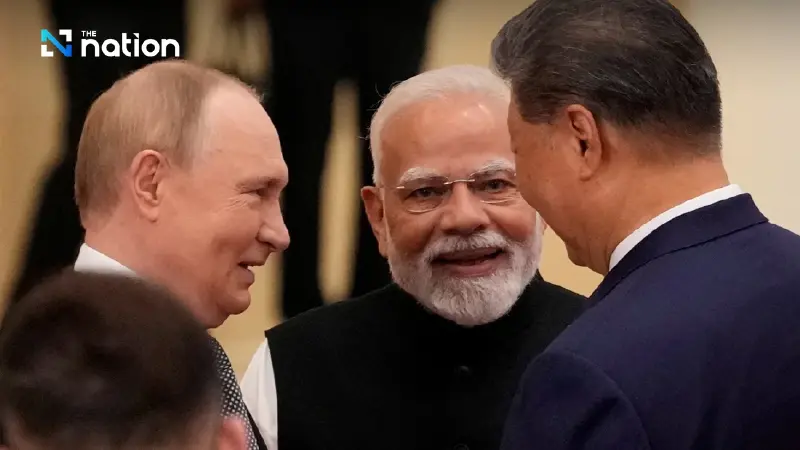


Leaders from China, Russia, North Korea, and Iran gathered in Beijing, marking the emergence of a new "axis of change" to challenge the West. This signals that the global order may be shifting towards Asia.
As reported by Nation TV, the influence of Chinese President Xi Jinping as the host of the Shanghai Cooperation Organisation (SCO) summit in Shanghai was clear.
The leaders of Asia and the Middle East responded to Xi’s invitation to the meeting, which took place from August 31 to September 1. Beyond the carefully curated summit, the event demonstrated Xi’s vision for the new world order.
Among the most watched leaders at the meeting were Russian President Vladimir Putin, North Korean leader Kim Jong Un, Indian Prime Minister Narendra Modi, and Iranian President Masoud Pezeshkian.

In addition to the SCO summit, China is continuing to showcase its power by holding a grand military parade on September 3 to commemorate the 80th anniversary of the "Chinese People's War of Resistance against Japanese Aggression" and the "World Anti-Fascist War."
Beijing's main road, Chang'an Avenue, also known as the Avenue of Eternal Peace, will be adorned with a spectacular military parade featuring advanced hypersonic weapons, nuclear missiles, underwater drones, and thousands of soldiers.
This display serves as both "soft power" and "hard power," demonstrating China's strength in shaping a new global order, unafraid to challenge Western norms. The gathering of leaders from China, Russia, North Korea, and Iran has been termed by strategists in Washington, DC, as the formation of an "axis of upheaval," aiming to oppose the United States.

While Western leaders are making strenuous efforts to pressure Putin into ending the war in Ukraine, observers in the West see Iran and North Korea as key allies of Russia. Iran provides weapons, North Korea supports with military manpower, and China helps with the war-torn economy and industry.
There was also a striking image of the camaraderie between Indian Prime Minister Modi and Putin, who warmly greeted President Xi, sharing hugs, handshakes, and walking side by side—a powerful moment of unity "without Western leaders."
Jonathan Czin, Michael H. Armacost Chair in Foreign Policy Studies at the Brookings Institution, remarked that President Xi’s message was clear: China has solidified its role in international affairs. It sent a distinct signal across the region that China has ascended as a global superpower and is here to stay.
Xi appears to understand the opportunity presented by the United States’ shifting foreign policy towards China.
In his SCO speech, he highlighted that the world is in a state of turbulence, and China is a responsible and stable superpower, ready to lead the world into the future—contrasting with the US, which has imposed high import tariffs on various countries, particularly India, for purchasing oil from Russia and aiding Putin’s war on Ukraine.
Observers also note that even Southeast Asian countries may feel the repercussions of these changing dynamics, particularly with China’s growing military power and increasing confidence in asserting its territorial claims in the South China Sea and Taiwan.
Brian Hart, a researcher at the China Power Project at the Center for Strategic and International Studies (CSIS), commented that the Chinese military parade on September 3 marks the first time leaders from China, Russia, North Korea, and Iran have gathered in one place.
While China is careful not to appear as openly supporting the aggression of certain nations, it is widely understood that China has sent dual-use goods to Russia, and President Xi bringing them together sends a signal that China is shaping the rules of who "should be recognised by the international community," regardless of what the Western democracies or the US think.
