
Immune System Breakthrough Wins Nobel Medicine Prize for US and Japan Scientists
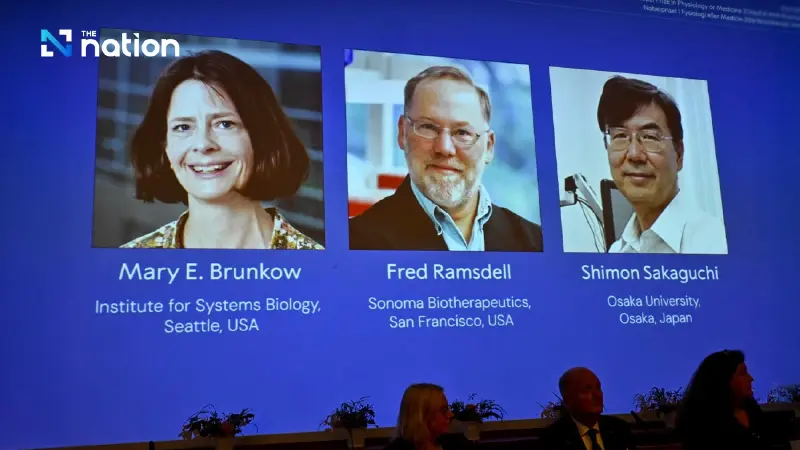


Trio awarded for identifying regulatory T cells, the immune system’s ‘security guards’ crucial for developing new treatments for cancer and autoimmune disease
- Scientists from the U.S. (Mary Brunkow, Fred Ramsdell) and Japan (Shimon Sakaguchi) were jointly awarded the 2025 Nobel Prize in Medicine.
- Their prize-winning breakthrough was the discovery of regulatory T cells and the controlling FOXP3 gene, which prevent the immune system from attacking the body's own healthy cells.
- The research has created new avenues for treating autoimmune diseases and cancer, with over 200 human clinical trials for related therapies now underway.
Scientists from the United States and Japan were jointly awarded the 2025 Nobel Prize in Physiology or Medicine on Monday for their ground-breaking work on how the immune system avoids attacking the body's own healthy cells.
According to Reuters, the laureates are American scientists Mary Brunkow and Fred Ramsdell, and Shimon Sakaguchi from Japan.
Their discoveries have shed light on the mechanisms of peripheral immune tolerance, creating new avenues for treating autoimmune diseases and cancer.
Marie Wahren-Herlenius, a rheumatology professor at Sweden's Karolinska Institute, which awards the prize, explained their findings: "They show how we keep our immune system under control so we can fight all imaginable microbes and still avoid autoimmune disease."
The Institute highlighted the work of all three in bringing attention to regulatory T cells—a class of white blood cells that act as the immune system's security guards, preventing immune cells from launching an attack on the body itself.
The FOXP3 Gene Discovery
Dr Brunkow, who was reportedly woken by her dog barking at a news photographer outside her Seattle home to learn she had won, said she, Ramsdell, and their colleagues had isolated a gene called FOXP3 that serves as a key marker for these regulatory cells.
"They're rare, but powerful, and they're critical for sort of dampening an immune response," she said in an interview.
She described the cells as a crucial "braking system" that stops the body's immune system from tipping over into self-attack.
Dr Ramsdell's extraordinary contribution was finding the FOXP3 gene, initially in mice, which controls the development of regulatory T cells, according to his long-time friend and Sonoma Biotherapeutics co-founder, Jeffrey Bluestone. Their findings were published in 2001.
Dr Brunkow is a senior programme manager at the Institute for Systems Biology in Seattle, while Dr Ramsdell is a scientific adviser at Sonoma Biotherapeutics in San Francisco. Dr Sakaguchi is a professor at Osaka University.
Japanese Scientist Hopes for Cancer Cure
In Osaka, western Japan, Dr Sakaguchi expressed surprise, stating he had felt any major recognition would have required more developmental progress.
“I used to think that some sort of reward may be forthcoming if what we have been doing will advance a little further and it will become more beneficial to people in clinical settings,” he said calmly, smiling occasionally.
During the press conference, Dr Sakaguchi took a congratulatory call from Japanese Prime Minister Shigeru Ishiba, who asked about the future effectiveness of immunotherapy for cancer treatment.
"I believe the time will come when cancer is no longer a scary disease, but a curable one," Dr Sakaguchi replied.
The award winners, selected by the Nobel Assembly of the Karolinska Institute, receive a prize sum of 11 million Swedish crowns and a gold medal presented by the King of Sweden.

Clinical Trials Underway
Thomas Perlmann of the Karolinska Institute confirmed that while specific therapies based on regulatory T cells have yet to receive market approval, more than 200 human trials are currently underway.
Several companies are in the early stages of development. Dr Ramsdell's firm, Sonoma Biotherapeutics, is supported by US drugmaker Regeneron to develop therapies against conditions like inflammatory bowel disease.
Quell Therapeutics has partnered with AstraZeneca to target the same condition, while Bayer’s BlueRock is also exploring the approach.
Medicine traditionally kicks off the annual Nobel Prize season, established by the will of Swedish inventor Alfred Nobel. The awards will culminate with ceremonies and banquets on December 10, the anniversary of Nobel's death.
