
Anutin signals positive outcome in US tax negotiations after second meeting with Trump


Thai PM Anutin shares optimism on US tax talks, backing from President Trump for better conditions for Thailand ahead of APEC summit.
On October 29, 2025, at the Commodore Hotel in Gyeongju, South Korea, Prime Minister and Interior Minister Anutin Charnvirakul spoke to the media after attending a dinner for APEC Economic Leaders, which was part of the 32nd APEC Economic Leaders' Meeting. During the event, he had the opportunity to meet with U.S. President Donald Trump for the second time.
The Prime Minister expressed positive signals on several fronts, including the resolution of the Thai-Cambodian border conflict following the signing of a joint statement. The Cambodian side has already begun implementing the agreement, and Thailand has taken the necessary steps outlined in the statement. Both parties are committed to ensuring swift progress towards achieving their goals.

Anutin also addressed the ongoing negotiations regarding U.S. tax measures, noting that discussions are still ongoing, and the latest draft agreement is awaiting finalisation. He has asked President Trump to support Thailand in securing better terms. The President assured him that he would notify the U.S. Trade Representative to continue discussions, aiming to benefit Thailand. This marks a positive trend, as the Prime Minister has met with President Trump twice—once in Malaysia and again in South Korea, where the President reiterated his support.
Furthermore, the Prime Minister highlighted the significance of participating in international forums, noting that Thailand has gained increased attention from the international community. Following the ASEAN summit, Thailand’s participation in APEC has led to numerous bilateral talks with leaders from various countries, including Canadian Prime Minister, Chinese President Xi Jinping, and South Korean President Yoon Suk-yeol.
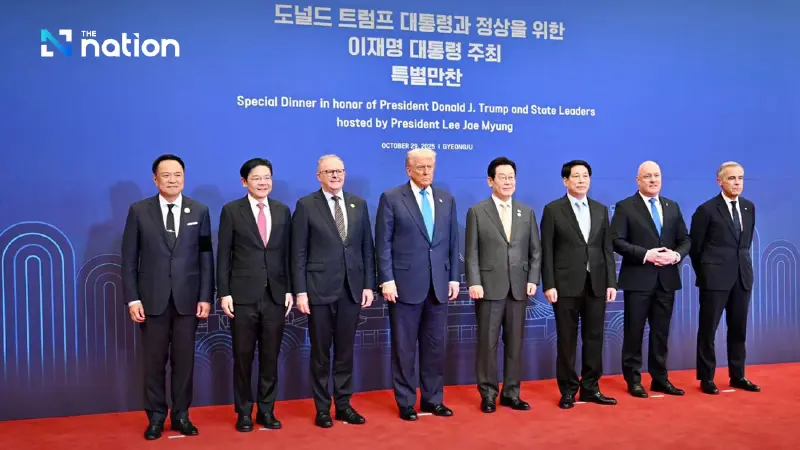
Leaders attending the dinner included U.S. President Donald Trump, South Korean President Yoon Suk-yeol, Australian Prime Minister Anthony Albanese, Canadian Prime Minister Mark Carney, New Zealand Prime Minister Christopher Luxon, Singaporean Prime Minister Lawrence Wong, Vietnamese President Luong Cuong, and Thai Prime Minister Anutin Charnvirakul.
Before the dinner, the eight leaders had informal discussions before sharing a meal and engaging in a discussion on "Indo-Pacific Economic Cooperation."

Anutin’s Remarks at the Event Highlighting Thailand's Commitment to Regional Cooperation
Anutin emphasised Thailand’s dedication to cooperation at all levels, including bilateral, subregional, and regional levels, through various frameworks such as ASEAN, the Mekong Cooperation Framework, and the Regional Comprehensive Economic Partnership (RCEP). He further stated that Thailand and South Korea are strengthening their relations under the ASEAN-South Korea and Mekong-South Korea cooperation frameworks, as well as negotiating the Comprehensive Economic Partnership Agreement (CEPA).
Anutin also mentioned Thailand’s collaboration with the United States and Australia under the "Mekong-U.S. Partnership" and the ACMECS framework to promote sustainable development in the Mekong River Basin.
The Prime Minister expressed his pleasure at President Donald Trump’s participation, calling it a significant signal of the United States’ attention to the Indo-Pacific region. He also thanked the U.S. for supporting the peace process between Thailand and Cambodia, which led to the signing of the Joint Declaration last weekend.
Anutin added that Thailand hopes the U.S. recognises Thailand’s genuine efforts in fostering peace and stability in the region. Thailand is also ready to engage in discussions to negotiate a "balanced and fair" trade agreement with the United States for the mutual benefit of both nations.

The Prime Minister highlighted that the Indo-Pacific region is becoming one of the “engines driving the global economy” due to its highly potential population and advanced technology. He proposed that the U.S. actively engage in three key areas:
1. Digital and Advanced Technology Cooperation, especially in Artificial Intelligence (AI), which Thailand believes will play a crucial role in driving economic growth and combating transnational crime, including online fraud.
2. Improving the Business Environment for Greater Competitiveness, by reducing redundant regulations, fostering fair competition, and promoting equality. Thailand is advancing towards becoming a member of the Organisation for Economic Co-operation and Development (OECD) to enhance its economic standards.
3. Building Resilience in Global Supply Chains, enabling the region to better adapt to changes in the global economic system.
In conclusion, Anutin reiterated that Thailand is ready to cooperate with all economic zones in the region to promote shared values in business, innovation, and creativity, with the aim of "unlocking the economic potential of the Indo-Pacific for the true benefit of the people in the region."
