
Thailand Briefs Diplomatic Corps, Reaffirms Necessity of Utmost Military Action
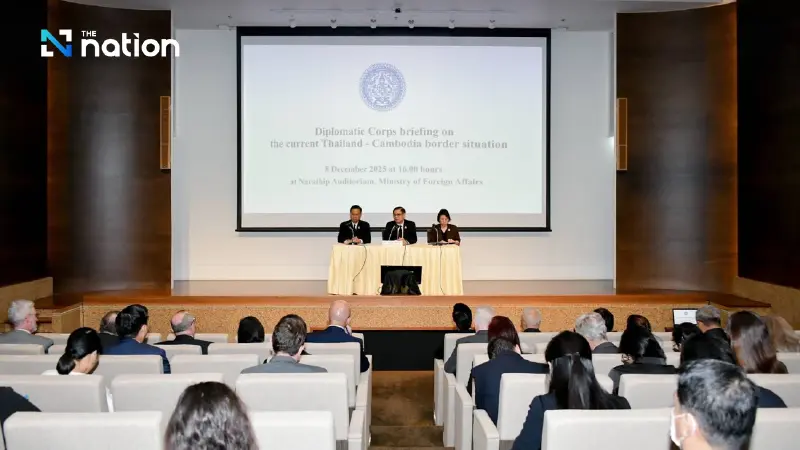


Foreign ministry briefs 70 ambassadors on clashes, presents timeline of 14 incidents allegedly initiated by Cambodian forces
- Thailand's Foreign Ministry formally accused Cambodia of violating a ceasefire and initiating border clashes, presenting a timeline of 14 alleged incidents to 70 foreign ambassadors.
- The recent border violence resulted in the death of one Thai soldier and injuries to eight others.
- Thailand alleges that Cambodian forces initiated the attacks and used heavy weaponry, including BM-21 multiple rocket launchers, against civilian areas.
- Thai officials stated their military response is an act of self-defense to protect national sovereignty and will continue until Cambodia ceases its aggression.
Foreign ministry briefs 70 ambassadors on clashes, presents timeline of 14 incidents allegedly initiated by Cambodian forces.
Thailand's Foreign Affairs Ministry has formally accused Cambodia of violating ceasefire agreements and initiating fresh hostilities along their disputed border, presenting detailed evidence to 70 diplomatic representatives on Monday following weekend clashes that left one Thai soldier dead and eight wounded.
In a comprehensive briefing led by Foreign Affairs Minister Sihasak Phuangketkeow, ministry spokesperson Nikorndej Balankura outlined what Thailand characterises as a systematic pattern of Cambodian aggression, including the alleged use of BM-21 multiple rocket launchers targeting civilian areas on Thai territory.
The briefing came as tensions along the frontier reached their highest point since the October ceasefire agreement brokered by US President Donald Trump and Malaysian Prime Minister Anwar Ibrahim began to unravel in November.

Minister Sihasak emphasised five principal points to the assembled diplomatic corps:
First, the current situation demonstrates Cambodia's recurring tactics of aggressive actions followed by denials, despite publicly calling for peace.
"Cambodia portrays itself as seeking peace and exercising patience, but in reality, they are the side that provokes and attacks first," Nikorndej stated.
Second, Thailand is committed to protecting its sovereignty and territorial integrity, necessitating continued military operations to achieve this objective.
Third, the Thai public has exhausted its patience with Cambodia's repeated disrespect for Thailand's dignity and the security threats faced by Thai citizens.
"We must protect our sovereignty and our people until Thailand's sovereignty and territorial integrity are no longer threatened," he said.
Fourth, Thailand's stance and military operations will continue until Cambodia genuinely changes its position and chooses the path of genuine peace.
Fifth, Cambodia has violated all previous agreements, including the ceasefire agreement and the Joint Declaration signed in Kuala Lumpur last October.

The ministry presented a detailed chronology of approximately 14 incidents clearly demonstrating, from Thailand's perspective, that Cambodia initiated the latest round of fighting.
According to Thai officials, the violence began on Sunday, 7 December, at approximately 2:15pm when Cambodian forces opened fire in the Phu Pha Lek–Phlan Hin Paet Kon area of Kantharalak district, Si Sa Ket province, resulting in two Thai soldiers being wounded.
Thailand lodged a protest with the ASEAN Observer Team (AOT) to clarify the facts surrounding this incident.
The situation escalated in the early hours of Monday morning with clashes erupting across multiple locations.
Thai military officials reported that Cambodian troops deployed firearms against Thai positions continuously, with intelligence indicating Cambodia had moved long-range weapons into border areas.
By Monday morning, casualties had risen to one Thai soldier killed and eight wounded. The ministry expressed its deepest condolences for the loss and extended support to those recovering from injuries.

Most alarmingly, according to Thai officials, Cambodian forces fired rockets from BM-21 multiple launch systems towards civilian populations on the Thai side of the border.
Addressing international media attention on Thailand's deployment of F-16 fighter jets, Nikorndej explained that air operations were necessitated by challenging terrain conditions.
"The reason Thailand needed to use air force attacks was due to terrain that does not facilitate other operations, as the area is filled with landmines," he stated.
He emphasised three key principles governing Thailand's military response:
- First, operations are conducted in self-defence after being attacked first, in accordance with Article 51 of the UN Charter;
- Second, actions comply with international rules on the use of force, particularly principles of necessity and proportionality; and third, all operations exclusively target military objectives.
"Thailand's military operations strictly limit targets to military ones only, with maximum care taken to avoid civilian impact," Nikorndej stressed.
The renewed violence has forced nearly 400,000 civilians across four Thai border provinces—Buri Ram, Surin, Si Sa Ket, and Ubon Ratchathani—to evacuate to temporary shelters for their safety.
"Thailand does not want to see losses such as those that have occurred before from Cambodia's attacks on civilian targets," the spokesperson said.
The displacement has resulted in the temporary closure of more than 600 schools across five border provinces and several hospitals in frontier areas, significantly impacting daily life and fundamental rights whilst disrupting critical services for Thai citizens.
Beyond military violations, Thailand accused Cambodia of systematically disseminating false and distorted information without supporting evidence.
"Cambodia's behaviour this time and previously clearly shows deliberate fabrication of scenarios with political motivations. This is a recurring pattern that Cambodia has consistently employed," Nikorndej stated.
He suggested the timing was significant, noting the clashes erupted just two to three days after Thailand presented evidence to the 22nd Meeting of States Parties to the Anti-Personnel Mine Ban Convention on 5 December, alleging Cambodia had violated its commitments by secretly laying new landmines on Thai territory multiple times.
"Cambodia attempts to portray itself as being threatened or bullied but cannot answer questions from the international community about its own violations whilst provoking Thailand to respond in order to protect lives and maintain our sovereignty," he said.
The ministry cited specific examples of alleged Cambodian disinformation, including the use of old footage claiming Thai defensive actions caused Cambodian schoolchildren to flee in panic, despite Cambodia having previously announced evacuations from those areas.
Additionally, multiple Cambodian agencies simultaneously disseminated what Thailand characterises as false information alleging Thailand initiated attacks, forcing Cambodia to respond in self-defence.
"Documents were published within minutes—less than an hour—after today's briefing," Nikorndej noted, questioning how such rapid responses could be prepared if Cambodia's claims were genuine.
The proximity of the clashes to Thailand's presentation at the Ottawa Convention meeting in Geneva was repeatedly emphasised.

Minister Sihasak had travelled to Switzerland to present evidence of Cambodia's alleged violations through the laying of anti-personnel landmines on Thai territory, resulting in seven Thai citizens losing limbs.
"This is the first time since the Ottawa Convention was established that a member state has activated Article 8," Nikorndej explained, referring to Thailand's unprecedented request for an independent fact-finding mission.
When asked about the timeline for establishing such a mission, the spokesperson acknowledged uncertainty: "I cannot provide a timeline because this has never been done before. There has never been a precedent; there has never been cause to activate Article 8 previously."
However, he expressed confidence in the process: "The conference acknowledged it and agreed to proceed to see how quickly it can be done. We should have faith in the state parties' process to conduct investigations transparently and fairly."
The next meeting of states parties to the convention is scheduled for next year, where Zambian Ambassador Mwaba Kasese-Bota will serve as chair. Minister Sihasak met with the incoming chair during his Geneva visit.
Following the briefing to 70 ambassadors, the ministry undertook several immediate diplomatic actions:
The ministry separately received the Malaysian ambassador and the US chargé d'affaires, both representing witness countries to the signing of the Joint Declaration.

Thailand issued a formal protest note to Cambodia, circulated diplomatic notes to all ASEAN member states explaining the situation, and sent correspondence to both the UN Secretary-General and the president of the UN Security Council.
When questioned about the current status of the Joint Declaration—part of the peace agreement signed in Kuala Lumpur— Nikorndej confirmed the agreement remains in force but has been violated by Cambodia.
He pointed to the Sunday clash and subsequent Monday escalation as clear evidence of these violations.
Emphasising the sensitivity of the situation and what Thailand characterises as Cambodia's systematic disinformation campaign, the ministry urged Thai citizens to follow information only from official channels, including the government, military, and Foreign Affairs Ministry.
"We ask our media colleagues to present facts comprehensively, rather than selecting only certain portions for attention-grabbing headlines that risk inaccurate reporting," Nikorndej stated.
He pledged to provide regular press briefings with verified information to keep the public informed.
Regarding bilateral relations, Nikorndej confirmed Thailand currently maintains a downgraded level of relations with Cambodia, established some time ago.
When pressed on whether further measures might be taken, he declined to speculate: "I cannot answer whether it will go further than that. It depends on the Cambodian side as well."
