
Thailand Invokes UN Charter Self-Defence Clause, Accuses Cambodia of Armed Aggression


Bangkok's UN envoy details escalating attacks across five provinces, demands Cambodia accept responsibility for border violations
- Thailand has formally notified the UN Security Council that it is exercising its right to self-defence under Article 51 of the UN Charter.
- The action is a response to what Thailand describes as unprovoked armed attacks by Cambodia across five Thai border provinces, which it labels as "grave violations" of its sovereignty.
- Thailand alleges that Cambodian forces used heavy weaponry to target both military and civilian areas, resulting in military casualties and the displacement of over 400,000 residents.
- As part of its UN notification, Thailand demands that Cambodia accept full responsibility for the aggression, cease all hostilities, and face pressure from the international community.
Bangkok's UN envoy details escalating attacks across five provinces, demands Cambodia accept responsibility for border violations.
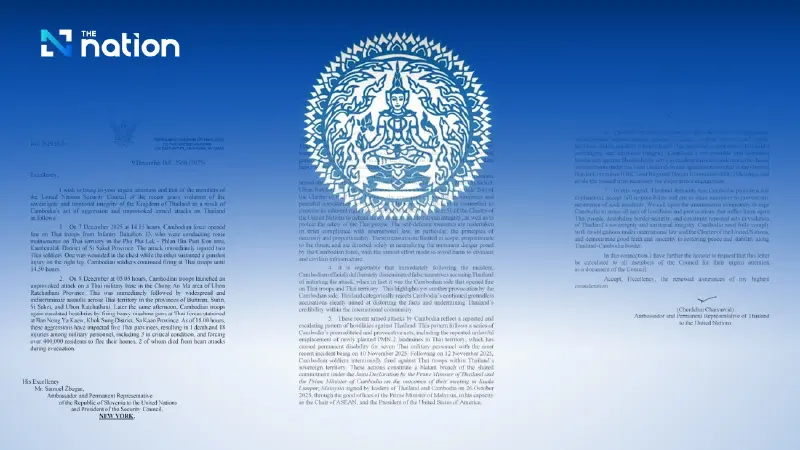
Thailand has formally notified the United Nations Security Council that it is exercising its inherent right of self-defence under Article 51 of the UN Charter following what it describes as Cambodia's unprovoked armed attacks across five border provinces.
In a letter dated 9th December addressed to the Security Council President, Thai Ambassador Cherdchai Chaivaivid detailed a series of incidents that Bangkok characterises as "grave violations" of Thailand's sovereignty and territorial integrity, requesting the letter be circulated to all Council members as an official document.
Timeline of Alleged Attacks
According to Thailand's account, hostilities began on 7th December at 14:15 when Cambodian forces opened fire on Thai troops conducting route maintenance in Si Sa Ket Province's Kantharalak District, immediately injuring two soldiers. The attack continued for 35 minutes.
The situation escalated dramatically the following day.
At 05:05 on 8th December, Cambodian troops launched what Thailand describes as an "unprovoked attack" on a Thai military base in Ubon Ratchathani Province, followed by "widespread and indiscriminate assaults" across Buri Ram, Surin, Si Sa Ket and Ubon Ratchathani. Later that afternoon, hostilities spread to Sa Kaeo Province.
By 18:00 on 8th December, the attacks had resulted in one death and 18 injuries amongst military personnel, including three in critical condition. The conflict forced over 400,000 residents to flee their homes, with two civilians dying from heart attacks during evacuation.
Thailand alleges Cambodia employed heavy weaponry including multiple rocket launchers, mortars and heavy machine guns, "deliberately targeting Thai civilians and civilian infrastructure."

Legal Justification
Thailand asserts Cambodia's actions violate Article 2(4) of the UN Charter, which prohibits the use of force against another state's territorial integrity. In response, Bangkok states it is "compelled" to exercise self-defence rights under Article 51 to protect its sovereignty and people.
The Thai mission emphasised its measures are "undertaken in strict compliance with international law, in particular, the principles of necessity and proportionality," and are "directed solely at neutralising the imminent danger posed by the Cambodian force, with the utmost effort made to avoid harm to civilians."
Pattern of Hostilities
Thailand placed the attacks within what it describes as "a repeated and escalating pattern of hostilities," citing Cambodia's alleged "repeated unlawful emplacement of newly planted PMN-2 landmines in Thai territory," which has caused permanent disability for seven Thai military personnel, with the most recent incident on 10th November.
The letter also accuses Cambodia of breaching the Joint Declaration signed by both countries' Prime Ministers on 26th October in Kuala Lumpur, facilitated by Malaysia's Prime Minister as ASEAN chair and the US President.

Accusations of Disinformation
Thailand has issued a formal complaint accusing Cambodian officials of "deliberately disseminating false narratives" which assert that Thailand initiated the attacks.
Bangkok "categorically rejects" these accusations as groundless, maintaining they are "aimed at distorting the facts and undermining Thailand's credibility within the international community."
The Thai government expressed its strong condemnation of what it described as Cambodia's "acts of aggression, indiscriminate armed attacks against civilians, civilian objects, and public facilities, and its apparent intent to harm Thai personnel."
Demands and International Appeal
Thailand formally demanded that Cambodia furnish a full explanation, accept complete responsibility for its actions, and immediately implement preventative measures.
The communication urges the international community to pressure Cambodia to "cease all acts of hostilities and provocations" and comply with its obligations under international law.
Invoking Article 51, Thailand formally notified the Security Council in adherence to established international legal protocol for reporting self-defence measures.
This action serves as a formal step in international dispute resolution as the conflict progresses into its third day, though it does not mandate automatic Security Council intervention.
