
Bangkok Hospital Launches Advanced 2,800 Sq.m. GI Center.
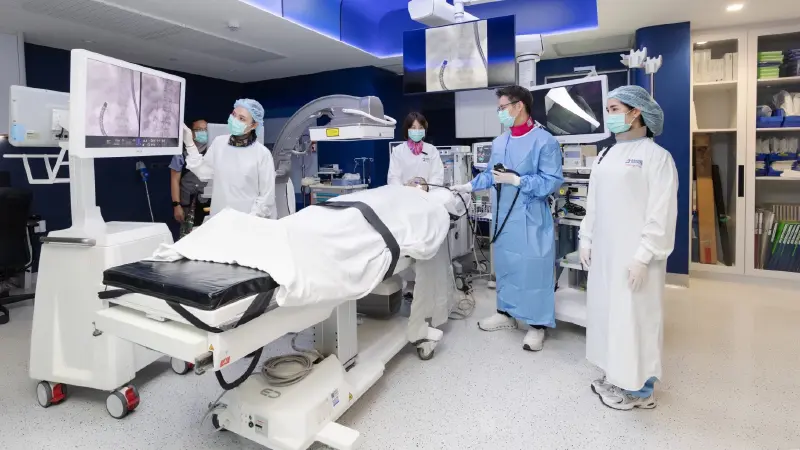


Bangkok Hospital transforms digestive healthcare with its 2,800 sq.m. Advanced GI Center, combining cutting-edge tech and high success rates.
In an era where modern lifestyles and changing dietary habits rapidly accelerate the incidence of gastrointestinal and liver disorders, healthcare institutions must innovate beyond traditional treatment models.
Responding to this evolving health landscape, Bangkok Hospital Headquarters has officially launched its newly transformed Advanced GI and Liver Center under the concept "Beyond Future - Advanced GI Care and Endoscopy."

Spanning over 2,800 square meters, the expanded facility represents a major strategic advancement in value-based healthcare.
Led by Dr. Matinee Maipang, Chief Executive Officer of Bangkok Hospital - Group 1, the transformation reinforces the hospital's commitment to ICHOM-certified outcome measurement, digital healthcare access, and its broader vision to become an Asia-Pacific Medical Robot Hub while steering operations toward Net Zero 2050 goals.

World-Class Clinical Quality and Patient Safety
At the core of the center’s vision is a track record of high-volume clinical excellence.
According to Dr. Boonthida Jaroensawat, Director of Bangkok Hospital, the center delivers holistic care across the entire patient continuum - from screening and early diagnosis to treatment and rehabilitation.
Between 2021 and 2025, the center recorded remarkable performance statistics:
Gastroscopy & Colonoscopy: Over 54,000 procedures completed with an impressive complication rate of less than 1%.
ERCP Procedures: Over 700 high-complexity cases successfully performed.
Endoscopic Ultrasound (EUS): Over 600 procedures executed with exceptional success rates.
Architectural Design Centered on Patient Experience
The newly designed 2,800 sq.m. space harmonizes medical functionality with patient privacy and comfort.
The facility houses 15 modern examination rooms, an Advanced Endoscopy Suite, a GI Motility Lab, Liver Flex Scan, 13C-Urea Breath Testing, and specialized ultrasound suites.
Additionally, nine dedicated recovery rooms and exclusive private spaces ensure smooth clinical workflows while safeguarding patient dignity and confidentiality at every stage of care.

Integrating Medical Expertise with Lifestyle Medicine
Dr. Jaturong Amornrattanakosol, Director of the Bangkok Advanced GI and Liver Center, emphasizes that long-term digestive wellness requires a dual approach: advanced medical interventions alongside conscious everyday choices.

Highlighting this connection between diet and gut health, the center collaborated with lifestyle figures Chris Horwang and Chef In – Narongrit Saekho (Kamlang-In Channel) for a specialized "Food for Gut & Liver" initiative.
Furthermore, in partnership with Imm by BDMS, the center offers nutritionist-curated meals designed specifically to support liver and digestive health.
By pairing clinical mastery with preventative lifestyle care, Bangkok Hospital sets a new benchmark for medical innovation, driving its vision to become Southeast Asia's primary Center of Excellence for gastrointestinal health.
