
US Soy Sector Targets Thailand as China Trade War Freezes Exports
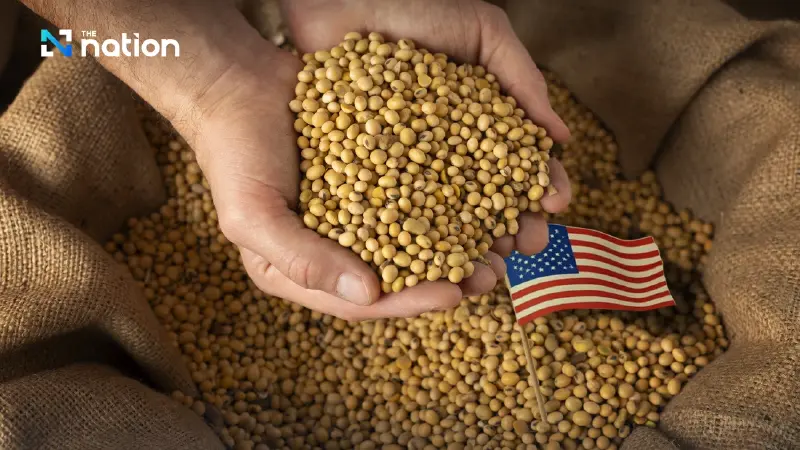


As Trump's reciprocal tariffs shut American farmers out of the Chinese market, Thailand emerges as a key target for US soybean exports
- Due to a trade war with China, US soybean producers are seeking alternative markets like Thailand to sell a massive surplus of their crop.
- Thailand is a promising market for US exports because its own domestic soybean production is declining, making it nearly 100% reliant on imports to meet demand.
- US exporters face challenges in Thailand, including a strict import quota system with high tariffs and competition from Brazilian soybeans, which are often preferred for their higher protein content.
As Trump's reciprocal tariffs shut American farmers out of the Chinese market, Thailand emerges as a key target for US soybean exports.
Thailand has become a primary target for United States soybean exporters as American farmers struggle to find alternative markets following the collapse of trade with China.
According to a report by Pranee Muenphangwaree for Krungthep Turakij, the global soybean market is undergoing a seismic shift.
Reciprocal tariffs imposed by the Trump administration have led China—the world’s largest consumer—to slash imports of US crops in favour of Brazilian supplies.
This has left US producers with a massive surplus, turning their attention toward secondary markets like Thailand to absorb the overflow.
Domestic Production in Decline
The timing of the US export push coincides with a projected downturn in Thailand’s own agricultural output.
For the 2026/27 season, domestic soybean cultivation is expected to shrink to roughly 57,000 rai, a decline of 2.43%.
Total yield is forecast to fall to just 15,627 tonnes, as Thai farmers abandon the labour-intensive crop in favour of more mechanised alternatives.
With domestic demand for 2026 estimated at 4.22 million tonnes—primarily for oil extraction and animal feed—Thailand now relies on imports for a staggering 99.63% of its supply.

The Quota Balancing Act
In response to these global pressures, the Oilseed Crops and Vegetable Oil Committee, chaired by Deputy Prime Minister and Minister of Agriculture Captain Thamanat Prompow, has finalised a three-year management plan (2026–2028).
The committee has approved a WTO in-quota limit of 230,559 tonnes at a 10% tariff rate.
However, any imports exceeding this volume will face a punitive 133% tax, a measure intended to protect the fragile domestic industry and prevent a total market collapse.
Quotas will be allocated on a "first come, first served" basis.

US vs Brazil: A Quality Dilemma
While the US is eager to fill the supply gap, Thai industrial buyers remain cautious. Industry analysis suggests that US soybeans often possess a lower protein content compared to Brazilian varieties.
Despite a potential global price drop led by Brazil’s record-breaking 175-million-tonne harvest, Thai manufacturers must weigh the cheaper US price points against the increased processing costs associated with lower-protein feedstock.
Captain Thamanat emphasised that the 2026 framework aims to "ensure a state of equilibrium," providing enough raw material for the multi-billion-baht animal feed and vegetable oil sectors without further eroding the livelihoods of Thailand's remaining soybean farmers.
