
Trump Year 2 turns up the heat as drive for No. 1 in military, energy and rare earths rattles the world
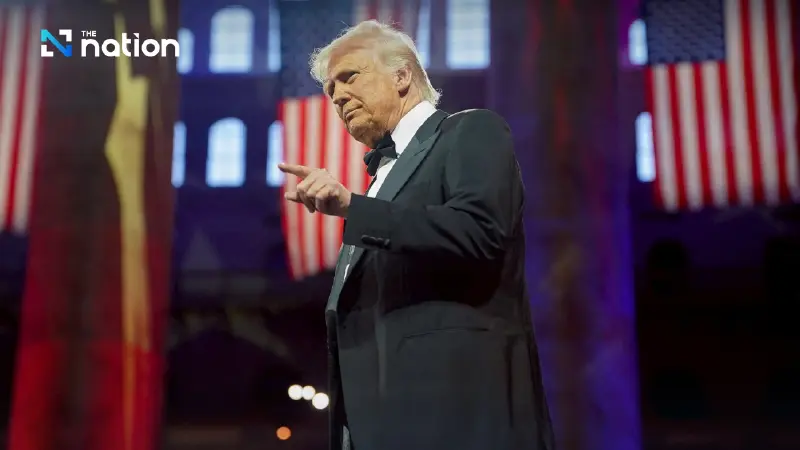


One year after taking office as the 47th US president, Donald Trump’s America First agenda has reshaped trade, security and geopolitics—raising risks for Thailand through a 19% reciprocal tariff, market-opening pressure and intensifying global conflict.
One year after being sworn in as the 47th President of the United States on January 20, 2025, Donald Trump spent just 12 months pushing America First and dismantling the old world order without hesitation—from severing ties and withdrawing from more than 60 international organisations, to launching a reciprocal tariff war that spread from China to trading partners worldwide at steep rates of 10% to 50%. Most recently, he has shaken notions of sovereignty with a proposal to buy Greenland, prompting Denmark and Europe to unite for a tit-for-tat trade battle.
In the security sphere, Trump has torn up the “world’s policeman” playbook and replaced it with the role of “The Dealmaker”—pressuring Ukraine to the negotiating table, striking Iran’s nuclear facilities, and most recently declaring himself chair of a lifelong peace committee, the “Board of Peace”, to monopolise the management of conflict zones worldwide in exchange for enormous “protection fees”.
For Thailand, it is not merely a spectator but a direct casualty—both from the 19% tariff wall affecting exports and the pressure to open its market to US goods, as well as pressure to choose sides on the global “Board of Peace”.
Associate Professor Dr Aat Pisanwanich, an expert in international and ASEAN economics, said the key highlight of “one year of Trump” affecting Thailand is the 19% reciprocal tariff, in place since August 7, 2025. Overall, he said, it has not yet had a major impact on Thai exports to the US—Thailand’s number-one export market—because Thai exports to the US in the first 11 months of 2025 were valued at US$65,318 million, up 30%. That, he said, was due to US importers rushing to bring in goods before tariffs rise further, and the use of transshipment, where foreign goods are routed through Thailand and exported under Thai cover.
He noted that although Thai export figures to the US rose, capacity utilisation among producers manufacturing for export did not increase in line with the numbers, because the unusually high export figures were driven by those two factors. Meanwhile, detailed Thailand–US trade negotiations after learning of the 19% tariff have stalled due to the earlier impact of the Thai-Cambodian fighting.
“In terms of export numbers, Thailand’s overall exports worldwide are expected to expand by 10.5% to 11% (the first 11 months grew 12.5%). But in the real economy, we have gained almost nothing. I see Trump’s tariffs last year as an illusion for Thailand’s GDP, because even though exports grew in double digits, full-year GDP is expected to grow by less than 2%. That shows that not all exports reflect real production taking place in the country,” Aat said.
He added that over the past year, Trump has shaken the world in three main areas:
- Trade war: Trump ordered higher import tariffs on goods from around the world, with the lowest at 10% and the highest at 50% (for example Brazil and India), up from the US’s previous average global tariff of just 3% to 4%.
- Geopolitics: Trump has intervened in conflicts worldwide, including Ukraine–Russia, support for Israel, and attacks on Iran, as well as passing legislation to guarantee Taiwan, which has angered China.
- Withdrawal from international organisations: He has pulled the US out of more than 66 international organisations and agreements important to the world, including the Paris Agreement on cutting global warming and the World Health Organization (WHO). Trump argues these bodies have overlapping missions, are mismanaged, unnecessary, waste budgets and operate inefficiently—affecting international operations and collective efforts to push common goals.
All of this, Aat said, aligns with a new security strategy called NSS25 (National Security Strategy 25). Under it, the US will no longer try to dominate the world as before because that creates economic problems. Instead, it will choose to control only what is necessary—specific points that deliver benefits—focusing on three security pillars: military, energy and rare earths, which are expected to intensify further in Trump’s second year.
Key targets, he said, include Venezuela—or South American countries where the US seeks to assert control in terms of both military presence and resources, extracting oil or rare earths and curbing China’s influence. He noted China had previously been Venezuela’s major oil buyer, purchasing as much as 80%. Iran and the push to control Greenland are next in line, despite opposition from Denmark and European countries.
Aat said Trump wants Greenland for its resources and to use it as a strategic outpost to intercept intercontinental missiles and monitor warships from Russia and China operating in the area. At the same time, Trump is building a “Golden Dome”—beyond Israel’s Iron Dome—to intercept missiles nationwide, while still positioning the US as a major weapons seller. This buildup of weaponry and defence systems, he said, reflects that the US is ready to fight, and that the risk of war this year is very high because policy will shift from rhetoric to real action.
“Trump’s policy is like building the strongest fortress at home (the Golden Dome), while going out to control oil fields and resource sites beyond the home (Venezuela/Greenland), regardless of the existing rules of international organisations—so the US alone can be the greatest again. Everything mentioned will affect the economy, trade, energy prices, exchange rates, gold prices, stock markets and more, which will remain highly volatile this year,” he said.
In summary, he said geopolitical conflict will be the number-one global risk this year across all dimensions—overtaking Trump’s tariffs—with a high chance of wars erupting in multiple locations, potentially dragging global GDP growth below 3%. The most closely watched flashpoint at present is Trump’s desire to control Greenland; if the US uses force to seize it, he warned, it would mark the end of NATO.
Aat said he personally expects Thailand’s GDP in 2026 to expand by only 1.0% to 1.5%. He urged the new Thai government that will take office after the election to set up a war room to urgently assess these risk scenarios and prepare response plans.
He also said Thailand must pursue a strategy of “survivable neutrality”, diversify risk in export markets and energy import sources, and make Thailand attractive as a safe space away from conflict to draw in investors.
Kriengkrai Thiennukul, chairman of the Federation of Thai Industries (FTI), said that based on an assessment of the impact of US President Donald Trump’s policies over the past year, as the world moves into his second year, both the global economy and Thailand are facing heightened volatility driven by a “Make America Great Again” approach that has returned with greater intensity—across the economy, trade and international politics.
He said the core source of the shockwaves is the use of reciprocal tariffs, which Trump believes are necessary because the United States has been disadvantaged by global trade, running chronic trade deficits, carrying heavy debt, and being exploited by trading partners who bring goods into the US market, take American jobs, and force factories to close or relocate production overseas. Tariff hikes have therefore been used as a barrier, directly affecting more than 100 countries, disrupting global supply chains, and triggering chaotic shifts in production bases.
At the same time, the US has been pushing to bring investment and factories back home, alongside a much tougher stance on immigration, education and foreign labour—such as restricting students from rival countries, refusing to renew work permits, and imposing high visa taxes and fees. He said these policies have sent tremors through the wider economic and social system.
Kriengkrai said what is as worrying as the economic impact is Trump’s stance towards international rules. The US has cut funding and withdrawn from many international organisations, undermining the global cooperation framework. Meanwhile, environmental policy has reversed from the Joe Biden era—shifting from leadership on climate mitigation to support for fossil fuels, scrapping targets on carbon reduction and electric vehicles—directly affecting the direction of global industry.
Another issue, he said, is Trump’s heavy reliance on executive orders, bypassing constitutional mechanisms and raising questions about the scope of his authority. This is especially evident in the reciprocal tariff policy, which has been challenged in lawsuits by many US businesses and consumers and is currently under review by the Supreme Court. A ruling expected in the next six to seven months will be decisive: if the court finds the administration exceeded its authority, it could help ease tensions; but if the court allows it, it could further embolden Trump to wield power even more aggressively.
On geopolitics, Kriengkrai said the world is seeing a shift from a trade war towards the risk of a “real war”—including support for military operations in the Middle East, efforts to control strategic areas such as Greenland to counter Russian and Chinese influence, and the use of hard power against countries with key resources such as oil, gold and rare earth minerals. He said this reflects a form of “modern colonialism” that is making the world increasingly unpredictable.
These impacts, he said, have prompted traditional allies in Europe to reassess the US role and strengthen their own military capabilities, while economic pressure through tariff increases has become a bargaining tool, raising the likelihood that the global economy will slow more than previously expected.
For Thailand, Kriengkrai warned that even though it is far from the conflict zones, it cannot escape the fallout—particularly via Europe, one of Thailand’s top export markets. Rising uncertainty will weigh on trade and overall economic growth. Thailand’s way forward in Trump’s second year, he said, is “proactive defence”: it needs an economic team that understands the world and geopolitics, and works closely in an integrated manner across ministries.
“If we lack capable people with experience and integrity, it will be even harder to withstand the shocks from an increasingly volatile world—and Thailand could lose opportunities in a rapidly reshaping global economic game,” Kriengkrai stressed.
