
Iran Maintains Peaceful Nuclear Programme Despite Pressure, Ambassador Tells Bangkok Media
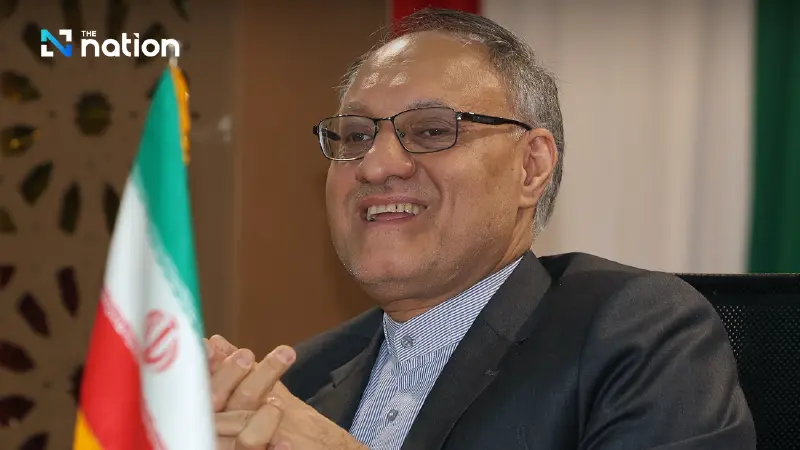


Iranian envoy rejects nuclear weapons whilst defending government response to recent unrest attributed to foreign interference
- Iran's ambassador to Thailand, Nassereddin Heidari, stated that his country's nuclear program is "completely peaceful" and that Iran is not seeking nuclear weapons.
- The ambassador cited a religious decree from Supreme Leader Ayatollah Ali Khamenei prohibiting the production and use of weapons of mass destruction as a key reason for this policy.
- This position is maintained despite what the ambassador described as pressure from "inhumane and illegal US sanctions" and recent domestic unrest attributed to foreign interference.
- Heidari asserted that Iran's deterrence is based on the support of its people and military, rather than on nuclear arms.
Iranian envoy rejects nuclear weapons whilst defending government response to recent unrest attributed to foreign interference.
His Excellency Nassereddin Heidari, ambassador of the Islamic Republic of Iran to Thailand, has reaffirmed Iran's commitment to peaceful nuclear development whilst firmly ruling out the pursuit of nuclear weapons, despite recent escalating tensions and what Tehran characterises as foreign-orchestrated violence within its borders.
Speaking at a press conference with Bangkok media outlets on Wednesday, Ambassador Heidari addressed questions about whether Iran might reconsider its nuclear weapons policy, given what he described as a "law of the jungle" in international relations.
"The nuclear programme of Iran has been completely peaceful," Heidari stated. "Iran is not seeking nuclear weapons. The support of our people and military has provided us with deterrence."
The ambassador cited a religious decree from Supreme Leader Ayatollah Ali Khamenei prohibiting the production and use of weapons of mass destruction, including nuclear, chemical, radiological and biological weapons, on both legal and Islamic grounds.

Unrest attributed to foreign interference
The press conference primarily focused on recent unrest in Iran, which the ambassador claimed evolved from peaceful economic protests into armed violence orchestrated by foreign intelligence services.
According to Heidari, civil and trade protests began on 27 December 2025, centred on economic demands following a rise in foreign exchange rates.
However, he alleged that "after a few days of direct and overt provocation by the United States and intervention by the Zionist regime, these protests were driven toward violence."
The violence peaked on 8 January 2026, the ambassador said, when "trained Mossad agents, organised and equipped with various firearms and cold weapons, committed heinous, ISIS-style murders of law enforcement, security personnel and civilians."
Heidari presented statistics detailing extensive damage: 53 fire trucks attacked, 180 ambulances burned in the capital alone, 26 banks and 53 mosques set ablaze across the country, and more than 1,300 firearms allegedly discovered amongst those detained.
The ambassador screened a documentary purporting to show evidence of foreign direction, including alleged payments of 80 million tomans (approximately four times an average worker's salary) for attacking police centres.

Economic measures and dialogue
Addressing the economic grievances that sparked initial protests, Ambassador Heidari explained that adjusting the exchange rate was "an unavoidable necessity to continue countering the inhumane and illegal US sanctions."
He emphasised that the Iranian government engaged in immediate dialogue with protesters.
"From the very beginning of the protests, the government engaged in dialogue at the highest levels of policymaking," he said. "The President and economic ministers held working sessions with heads of trade unions and the Chamber of Commerce, deciding on executive solutions to address the economic concerns."
The ambassador also stressed that Iranian law enforcement forces were under "strict and explicit instructions to exercise total restraint and avoid using firearms when dealing with protesters," claiming they were equipped only with crowd control gear.

Thai citizens' safety assured
Ambassador Heidari sought to reassure Thai nationals in Iran and the Bangkok media about security conditions.
"The situation is calm. All embassies and nationals of other countries are totally protected," he said.
The ambassador confirmed he had been in contact with the Thai embassy in Tehran and had coordinated with Iran's Ministry of Foreign Affairs to ensure Thai citizens' safety, including students and those preparing for Thailand's upcoming national assembly election polling at the embassy.
"We believe that nothing will happen and Thai citizens will be kept in safety and security," Heidari stated. "Your embassy is doing normal work."

Bilateral relations emphasised
Despite the focus on domestic unrest, the ambassador highlighted the strong cultural and economic ties between Iran and Thailand.
"Between Iran and Thailand, people-to-people, culture-to-culture relations are exemplary, dating back more than 400 years," he said, noting that more than 71,000 Iranians visited Thailand as tourists last year.
However, Heidari acknowledged that trade relations remain below satisfactory levels due to sanctions, whilst expressing optimism about establishing alternative payment mechanisms independent of the dollar system.
"We are continuing our efforts to establish a kind of independent mechanism, differentiated from the dollar system, so we can have better trade with Thailand," he said.
The ambassador particularly emphasised Iran's traditional imports of rice and other products from Thailand whilst seeking to expand trade in goods and services unaffected by sanctions, particularly in food security sectors.

Western media campaign alleged
Throughout the press conference, Ambassador Heidari criticised what he characterised as a Western media campaign of "poisoning by distorting the facts" aimed at projecting a negative image of Iran.
He distributed documentation to media outlets, including reports on attacks against law enforcement, damage to religious sites, and alleged evidence of foreign intervention.
The ambassador encouraged Thai media to verify information independently rather than rely on what he termed Western "disinformation and misinformation."
Heidari concluded by stating that Iran had received support from the Group of Friends of the Charter of the United Nations and the Shanghai Cooperation Organisation, of which Iran is a member.
The ambassador's comments come amid continued regional tensions and international scrutiny of Iran's nuclear programme, with Tehran maintaining that all its nuclear facilities operate under International Atomic Energy Agency supervision for peaceful purposes.
