
Trump threatens 100% tariff on Canada over China trade deal
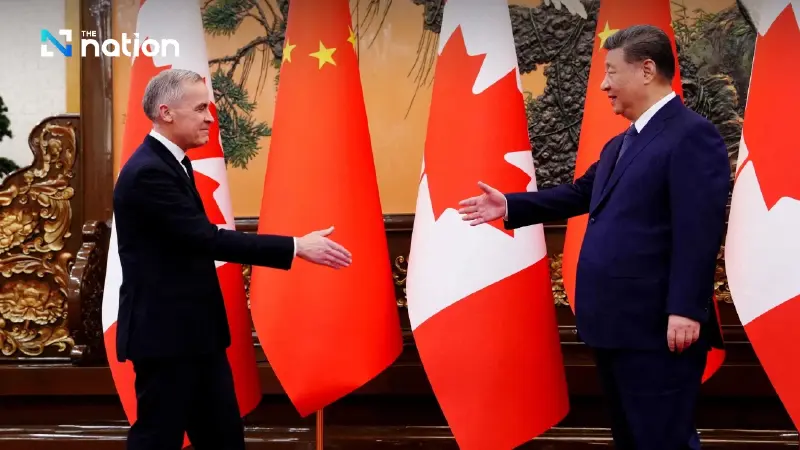


US President Donald Trump warned Prime Minister Mark Carney that any move to deepen trade ties with China would bring an immediate US response, as Ottawa insists it is not pursuing a free trade pact.
- US President Donald Trump threatened to impose a 100% tariff on all Canadian goods if Canada finalises a new trade arrangement with China.
- Trump justified the threat by claiming China would use Canada as a "drop-off port" to circumvent US tariffs and would ultimately undermine the Canadian economy.
- A Canadian minister clarified that the country is not pursuing a full free trade agreement with China, but rather has resolved several specific tariff issues.
- The tariff threat follows a period of rising tensions between Trump and Canadian Prime Minister Mark Carney, particularly after Carney's recent comments criticizing American hegemony.
US President Donald Trump on Saturday (January 24) threatened to hit Canada with a sweeping 100% tariff if it proceeds with a trade arrangement involving China, warning Prime Minister Mark Carney that such a move would put the country at risk.
Writing on Truth Social, Trump claimed China would “eat Canada alive”, saying Beijing would undermine Canadian businesses and damage the country’s social fabric and way of life.
He said that if Canada follows through on a deal with China, the United States would respond by imposing an immediate 100% tariff on all Canadian goods and products entering the US.
Carney, in a video released the same day, did not address Trump’s warning directly. Instead, he urged Canadians to buy domestic products, arguing that when the economy is under threat from abroad, the country should focus on what it can control and be its own best customer.
Carney travelled to China earlier this month in a bid to reset a strained relationship and reached a trade deal with Canada’s second-largest trading partner after the United States.
After the trip, Trump initially sounded supportive, telling reporters at the White House on January 16 that it was “a good thing” for Carney to sign a trade deal and that Canada should do so if it could.
On Saturday, Dominic LeBlanc, the minister responsible for Canada–US trade, said Ottawa was not pursuing a free trade agreement with China, adding that what had been achieved was the resolution of several important tariff issues.
The Chinese embassy in Canada said China was ready to work with Canada to implement the important consensus reached by the two countries’ leaders.
Trump also argued that China would try to use Canada to skirt US tariffs.
In his post, he warned that Carney was “sorely mistaken” if he believed Canada could become a “drop-off port” for Chinese goods destined for the United States, referring to Carney as “Governor”, a title tied to Trump’s past comments about Canada becoming the 51st US state.
In a second post later on Saturday, Trump said the world did not need China “take over Canada”, insisting it would not happen.
If Trump carries out the threat, the new tariff would sharply raise US duties on Canada, piling pressure on industrial sectors such as metal manufacturing, autos and machinery.
Tensions between the two leaders have risen in recent days, particularly after Carney criticised Trump’s pursuit of Greenland.
At the World Economic Forum in Davos, Carney said nations should accept that the rules-based global order was over, pointing to Canada as an example of how “middle powers” could act together to avoid being victimised by American hegemony.
While he did not mention Trump or the United States by name, he warned that “middle powers must act together because if you are not at the table, you are on the menu.”
Many leaders and industry executives at the gathering responded with a standing ovation.
Trump hit back in his own Davos remarks, saying Canada “lives because of the United States”, a statement Carney rejected on Thursday during a visit to Quebec.
Carney said the two countries had built a strong partnership in the economy, security and cultural exchange, but insisted Canada did not live because of the US and instead thrived because it is Canadian.
Since then, Trump has hardened his stance towards Canada, including revoking its invitation to the Board of Peace initiative, which he wants to handle international conflicts and Gaza’s future.
After Carney’s election last year, the two leaders had struck a friendly tone, with Trump saying he believed the relationship would be very strong.
But this month, Trump dismissed the major trade pact between the United States, Canada and Mexico, which is due for renegotiation in July, as “irrelevant”.
Trump has issued numerous tariff threats since returning to the presidency, though in several cases, he has paused them during talks or dropped them entirely.
This week, he stepped back from a recent threat to impose steep tariffs on European allies after the NATO chief and other leaders pledged to strengthen security in the Arctic.
Matthew Holmes of the Canadian Chamber of Commerce said businesses faced immediate consequences from heightened uncertainty and expressed hope that the two governments could quickly reach a better understanding that would ease concerns.
Reuters
