
Davos 2026 opens in turmoil as Canada warns world order is ‘dead’
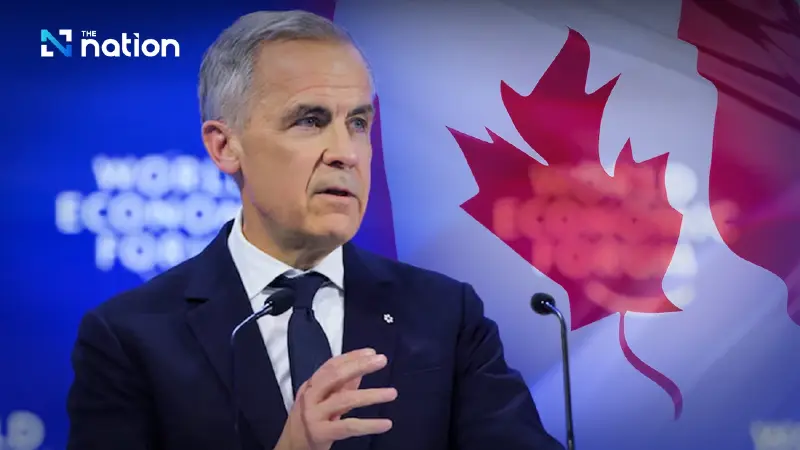


Canada’s PM Mark Carney tells Davos the rules-based order is “dead”, urging mid-sized powers to unite as US–Europe tensions flare over Greenland
The World Economic Forum’s Annual Meeting 2026 in Davos has begun in a notably heated atmosphere, after Canada’s Prime Minister Mark Carney used a major address to declare that the so-called “rules-based order” is effectively “dead” in practice and urged the world’s middle powers to unite against growing coercion by larger states.
Speaking in Davos on Tuesday night, Carney argued that recent events show the old framework no longer functions as advertised and that Canada and other countries have little choice but to build new alliances to confront pressure tactics and intimidation from major powers. His remarks drew a rare standing ovation from the audience, according to reports.
Although Carney did not explicitly name the United States or President Donald Trump, the thrust of his speech was widely interpreted as a direct response to Washington’s increasingly confrontational posture, particularly amid renewed US–Europe tensions linked to Greenland and fresh tariff threats.
Carney, a former central bank governor in both Canada and the United Kingdom, described the current moment as a “rupture” and warned against clinging to nostalgia for a previous era. He called on leaders to “call reality by its name”, arguing that economic integration is being used as leverage for coercion, including through tariffs, financial infrastructure and supply-chain pressure points.
He also said Canada stood firmly behind Greenland amid rising Arctic tensions, while stressing Canada’s commitment to Nato’s collective defence principle under Article 5.
Carney’s speech came only hours after French President Emmanuel Macron criticised Trump’s trade strategy, as disputes intensified over threatened tariffs—reported to include a threat of steep additional duties on French wine—on top of broader tariff warnings aimed at European countries opposing Trump’s Greenland push.
Reports also said Trump posted an image depicting Greenland and Canada covered by the US flag and signalled he had multiple meetings lined up to discuss the territory, while hinting at tools beyond tariffs. Trump is scheduled to deliver a special address at Davos on Wednesday, Jan 21 (local time), according to the official WEF programme.
Carney additionally warned that Canada and Mexico are bracing for difficult negotiations with the White House over the USMCA North American trade agreement, amid public signals from some US officials that the pact could be scrapped in favour of bilateral talks.
To illustrate the danger of leaders refusing to face reality, Carney invoked the ideas of Czech writer and dissident Václav Havel, arguing that systems can persist because people accept convenient fictions—and that world leaders should not repeat that mistake when describing today’s geopolitical landscape.
He said pressure tactics now extend beyond tariffs, describing coercion through financial infrastructure and by exploiting supply-chain vulnerabilities. Carney argued that middle powers must invest jointly in deterrence and develop new forms of cooperation to withstand such pressure.
Carney also said Canada has already shifted its strategic stance, pointing to a major trade agreement he said he signed in Beijing with Chinese President Xi Jinping last week. Under the arrangement described in the report, China would reduce tariffs on Canadian agricultural products, while Canada would lower tariffs on China-made electric vehicles from 100% to 6.1%.
He added that Canada is pursuing new trade and security cooperation with India, Qatar, Thailand and the Philippines, as well as Latin America’s Mercosur bloc and the Association of Southeast Asian Nations (ASEAN). He also pointed to Canada’s decision to significantly increase defence spending and develop new energy and trade infrastructure, while highlighting the country’s strategic advantages, including traditional energy resources and critical minerals.
Carney further argued that Canada has the capital and capacity to act decisively, citing the scale and sophistication of the country’s pension funds and what he described as strong fiscal capability.
The World Economic Forum Annual Meeting 2026 is being held in Davos-Klosters, Switzerland, from Jan 19–23, bringing together global leaders from government, business and civil society under the theme “A Spirit of Dialogue.”
