
Thailand's Foreign Ministry Puts 110,000 Nationals on Alert as Middle East Crisis Deepens


Bangkok activates Middle East "War Room" and prepares evacuation plans as regional tensions spiral following Israeli and US strikes on Iran
- Thailand's Foreign Ministry has placed its 110,000 nationals residing in the Middle East on alert due to escalating military conflict in the region.
- A special emergency operations center, dubbed the "War Room," has been activated to monitor the situation around the clock.
- The government has prepared evacuation plans for its citizens, as a small number of Thais in Iran and Israel have already registered their desire to return home.
- The majority of the Thai nationals affected are approximately 65,000 agricultural workers located in Israel.
- While no Thai nationals have been reported as seriously injured, they have been advised to avoid non-essential travel and remain vigilant.
Bangkok activates Middle East "War Room" and prepares evacuation plans as regional tensions spiral following Israeli and US strikes on Iran.
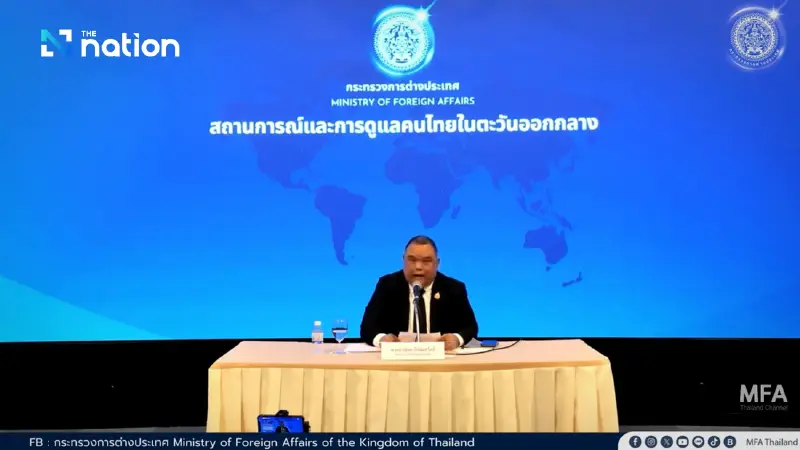
Thailand's Ministry of Foreign Affairs convened an urgent press conference on Sunday evening to address the rapidly deteriorating security situation in the Middle East, following Israeli air strikes on Tehran, retaliatory Iranian missile attacks on American military installations across the Gulf, and the confirmed death of Iran's Supreme Leader.
Panidone Pachimsawat, deputy director-general of the Department of Information and acting spokesman for the Ministry, told reporters that the Thai government is "closely monitoring the situation with grave concern" and has activated a dedicated emergency operations centre — dubbed the "War Room" — to track developments around the clock.
"Overall, the situation remains highly sensitive and continues to be a source of great concern for Thailand," Panidone said.
How the Crisis Unfolded
On the afternoon of Saturday, 28 February, Israel launched air strikes against key targets in Tehran and other Iranian cities. United States forces conducted joint air operations on the same day.
Iran responded swiftly, firing retaliatory missiles at American naval and air bases in Bahrain, Kuwait, Qatar, the United Arab Emirates, Saudi Arabia, and parts of Iraq.
Compounding the geopolitical shock, Iranian state media confirmed that the country's Supreme Leader passed away at his residence on the morning of 28 February while performing his official duties — a development that adds profound uncertainty to an already volatile situation.

Thai Nationals in the Region
Approximately 110,000 Thai nationals currently reside across the Middle East, the largest share of whom — some 65,000 — are agricultural workers in Israel. A further 250 Thais are based in Iran.
Panidone confirmed that there have been no reports of Thai nationals being seriously injured.
"We have been informed that Thai nationals in the various areas are safe at this time," he said.
Nevertheless, the Ministry has noted a small but growing number of requests to return home.
As of Sunday evening, 29 Thais in Iran — primarily students and workers — had registered their desire to evacuate, while fewer than 20 had made the same request from Israel.
"The evacuation plan for Thai nationals has been prepared and may involve coordination with other countries or international organisations that are likewise preparing their own evacuation arrangements," Panidone said.

Government Response
The Ministry of Foreign Affairs established its Middle East Situation Centre — the so-called "War Room" — on 28 February, operating in coordination with relevant agencies on a 24-hour basis. A separate consular coordination hotline has also been activated.
Thai nationals across the region have been advised to avoid non-essential travel and to remain vigilant.
On Monday, 2 March, Prime Minister will chair a high-level meeting of the National Security Council to assess the broader implications of the crisis for Thailand, including its economic, energy, and regional security dimensions. Finalising the evacuation framework is expected to be a key item on the agenda.
Addressing Rumours and Wider Concerns
Panidone also moved to quash reports circulating in Thai media alleging that Thai Airways had transported weapon components to Israel.
He clarified that the incident in question concerned Australia, and that the Thai government had already formally denied any involvement.
"I believe in Thai Airways — our airline is safe and strictly follows international protocols," he said.
Separately, the Ministry acknowledged the plight of Middle Eastern tourists currently stranded in Thailand due to airspace closures across the region.
Officials indicated they are considering flexible immigration measures — similar to those introduced during the Russia-Ukraine conflict — to provide relief. The matter is expected to be addressed at Monday's NSC meeting.
Thailand's Position
The Ministry reiterated a three-point diplomatic stance: that Thailand is monitoring the situation with grave concern; that all parties must avoid actions that could further harm civilians or destabilise regional and international peace; and that an urgent return to negotiation and dialogue remains essential.
"We reiterate the urgency of dialogue and diplomacy," Panidone said.
