
US clashes with China and Russia at UN over Iran nuclear issue
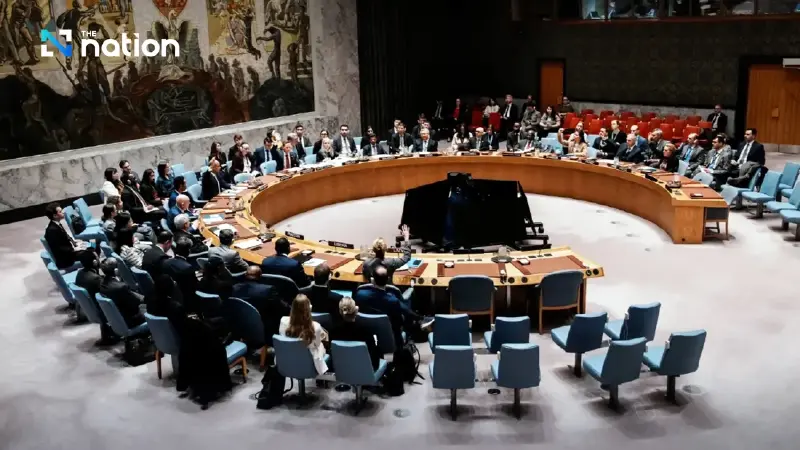


The US and its Western allies clashed with China and Russia at the UN Security Council over Iran’s nuclear programme and renewed sanctions enforcement
The United States and its Western allies clashed with Russia and China at the United Nations Security Council on Thursday over Iran’s nuclear intentions, as Washington sought to bolster support for its position following two weeks of war with Iran.
At the meeting of the 15-member Security Council, which the United States chairs this month, Russia and China tried unsuccessfully to block discussion on establishing oversight for monitoring and enforcing sanctions on Iran. The effort failed after the council voted 11-2 in favour, with two abstentions, to proceed with the matter relating to the so-called 1737 Committee.
US Ambassador to the United Nations Mike Waltz told the council that Moscow and Beijing were trying to shield Tehran by obstructing the work of the sanctions committee. He said all UN member states should enforce an arms embargo on Iran, block transfers and trade involving missile technology, and freeze related financial assets.
Waltz said the UN measures the United States wanted to revive were not arbitrary, but narrowly targeted to address threats stemming from Iran’s nuclear, missile and conventional weapons programmes, as well as what he described as Iran’s continuing support for terrorism.
Waltz also said China and Russia did not want an effective sanctions committee because they wanted to protect Iran, which he described as their ally, and preserve defence cooperation that has once again been suspended.
He added that the International Atomic Energy Agency had reiterated last week that Iran was the only non-nuclear-armed state in the world to have produced and accumulated uranium enriched to 60% purity, while also refusing to allow the IAEA access to that stockpile.
Reuters has separately reported that the IAEA believes Iran still has more than 440 kg of uranium enriched up to 60%, enough in theory for roughly 10 nuclear bombs if enriched further, although the agency says it has no credible evidence of a coordinated nuclear weapons programme.
Russia’s UN Ambassador Vasily Nebenzya accused the United States and its allies of stirring up fear over what he called alleged Iranian plans to obtain nuclear weapons, despite the absence of any IAEA report confirming such an intention. He said the move was designed to justify further military action against Tehran and to intensify the situation in the Middle East and elsewhere.
China’s UN Ambassador Fu Cong also attacked Washington, calling the United States the instigator of Iran’s nuclear crisis. He said the US had openly used force against Iran while negotiations were under way, rendering diplomatic efforts ineffective.
Iran’s UN Ambassador Amir Saeid Iravani later told reporters that Iran’s nuclear programme had always been peaceful and said Tehran would not accept any attempt to reimpose sanctions.
US President Donald Trump has repeatedly cited Iran’s nuclear programme as justification for military action, including his claim earlier this month that Iran could acquire a nuclear weapon within two weeks if the United States did not strike three major nuclear sites last June. Reuters reported, however, that this assertion was not supported by US intelligence assessments.
Britain and France told the Security Council that renewed sanctions on Iran were justified because Tehran had failed to resolve concerns over its nuclear programme. France said the IAEA could no longer guarantee the peaceful nature of Iran’s activities and argued that Tehran’s enriched uranium stockpile was enough, if enriched further, to produce 10 nuclear bombs.
