
Artemis II Crew Return Safely to Earth After Historic Lunar Flyby
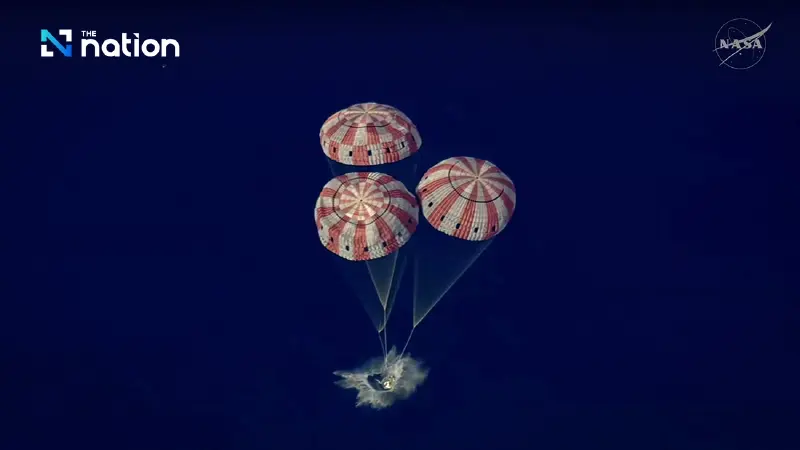


The Orion capsule, Integrity, safely returned four astronauts to Earth on Friday, marking a monumental milestone in the global quest to revisit the Moon
- The four-person crew of the Artemis II mission returned safely to Earth, splashing down in their Orion capsule in the Pacific Ocean.
- This successful return concluded a historic 10-day lunar flyby, the first time humans have journeyed to the Moon's vicinity in over 50 years.
- The mission set a new record for the furthest a crewed spacecraft has traveled from Earth, surpassing the one set by Apollo 13.
- The crew itself was historic, including the first woman, the first Black astronaut, and the first non-American to fly a lunar mission.
The Orion capsule, Integrity, safely returned four astronauts to Earth on Friday, marking a monumental milestone in the global quest to revisit the Moon.
Humanity took a giant leap closer to the lunar surface on Friday evening as the Artemis II Orion spacecraft, Integrity, successfully splashed down in the Pacific Ocean.
The safe return of the four-person crew marks the conclusion of a historic 10-day mission and the first time humans have journeyed to the vicinity of the Moon in over half a century.
At approximately 8:07 P.M. EDT (10 April), the teardrop-shaped capsule bobbed gently on the waves off the coast of Southern California. The descent followed a high-stakes atmospheric re-entry where the vessel reached speeds of 35 times the speed of sound.
Crowds gathered at the San Diego Air and Space Museum erupted in cheers as the capsule’s parachutes deployed, slowing the craft to a steady 25 km/h before impact.

A Record-Breaking Odyssey
The mission, which launched from Cape Canaveral on 1 April, saw the crew travel more than 694,000 miles. At its furthest point, the spacecraft reached a distance of 252,756 miles from Earth—breaking the record previously held by the ill-fated Apollo 13 mission in 1970.
The crew—Americans Reid Wiseman, Victor Glover, and Christina Koch, alongside Canadian Jeremy Hansen—made history even before they left the atmosphere. Victor Glover has become the first Black astronaut to fly a lunar mission, Christina Koch the first woman, and Jeremy Hansen the first non-American.

Braving the Fire
The return was a gruelling test for the Lockheed Martin-built Orion capsule. As it hit the Earth's atmosphere, the heat shield was subjected to blistering temperatures of approximately 2,760°C.
The intense friction created a temporary plasma shroud, causing a brief but expected communications blackout before the crew re-established contact.
Following the splashdown, recovery teams from NASA and the US Navy aboard the USS John P. Murtha arrived within the hour to retrieve the astronauts.
The crew will undergo initial medical evaluations at sea before returning to California and eventually to NASA’s Johnson Space Center in Houston.


The Path to 2028
This successful "dress rehearsal" paves the way for the Artemis III mission, which aims to return humans to the lunar surface by as early as 2028.
Beyond that, the Artemis programme intends to establish a permanent lunar base in the 2030s, serving as a critical stepping stone for future crewed missions to Mars.
As the capsule is towed back to port, the world celebrates a new era of space exploration—one where the Moon is no longer a distant memory but a future home.

