
Ceasefire trembles as US fires and seizes Iranian cargo ship


Washington’s seizure of an Iranian vessel and Tehran’s threat to retaliate have cast fresh doubt over the ceasefire and renewed fears for oil supply
A shaky ceasefire between the United States and Iran came under fresh pressure on Sunday after Washington said it had seized an Iranian cargo ship attempting to breach a US-led maritime blockade, prompting an immediate warning of retaliation from Tehran.
The latest flashpoint has added to doubts over whether the two-day ceasefire can survive even until its scheduled expiry on Tuesday, while also casting a shadow over already fragile diplomatic efforts to prevent a wider regional escalation.
The United States said it had intercepted an Iranian-flagged cargo vessel heading towards Bandar Abbas, while Iran responded by rejecting a planned new round of negotiations and warning that it would answer what it described as US aggression.
According to the US account, American forces fired on the vessel and then took control of it.

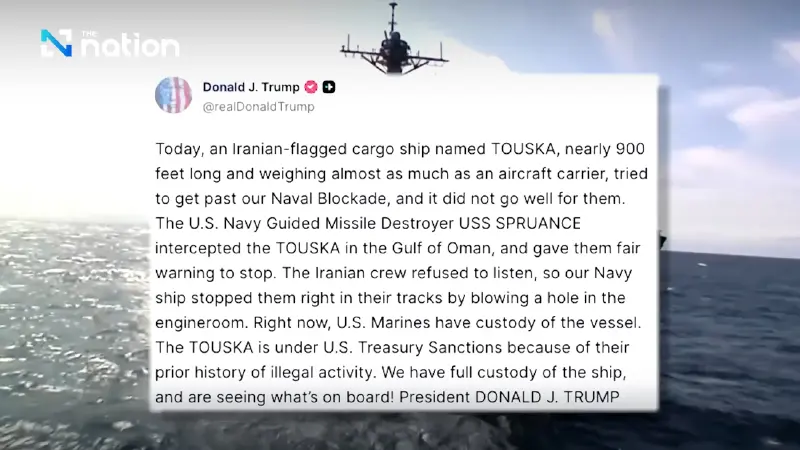
President Donald Trump said on social media that the ship had been fully seized and was being searched.

Trump identified the vessel as the TOUSKA, saying it had tried to break through the naval cordon in the Gulf of Oman before being stopped by the guided-missile destroyer USS Spruance, which allegedly disabled the ship by firing into its engine room.

Iran, however, said the vessel had been sailing from China and warned that its armed forces would respond.
Iranian state media said Tehran viewed the seizure as an act of armed piracy and declared that retaliation would come soon.
The confrontation has landed at a particularly dangerous moment. The current ceasefire was supposed to create space for a second round of talks, reportedly expected in Islamabad before the truce expires.
But that now appears increasingly unlikely after Iran said it would not join further negotiations under present conditions, citing the continuing blockade, hostile rhetoric from Washington and what it called shifting US demands.
Pakistan had nonetheless appeared to prepare for diplomacy, with security tightened in Islamabad ahead of the expected arrival of a US delegation.
Iranian First Vice President Mohammadreza Aref also signalled a harder line, warning that Iran’s oil exports could not be restricted while others expected secure energy flows.
His remarks underlined the broader stakes of the confrontation, with energy security once again at the centre of the crisis.
The United States has kept its blockade on Iranian ports in place, while Iran has lifted and then reimposed restrictions on marine traffic through the Strait of Hormuz, the strategic waterway that normally carries about one-fifth of the world’s oil supply.
The market reaction was swift.
Brent crude futures jumped about 7% to US$96.85 a barrel in early Asian trading, while S&P 500 futures fell about 0.9%, reflecting renewed investor anxiety over both the war and the risk of deeper supply disruption.
The wider maritime crisis has already rattled global trade flows.
The US blockade extends across Iranian coastal waters and into approaches linked to the Strait of Hormuz, with vessels entering or leaving the restricted zone without authorisation subject to interception, diversion or capture.
The blockade, launched after earlier peace efforts collapsed, has effectively tightened pressure on Iranian exports while leaving broader shipping traffic across the region facing growing uncertainty.
That uncertainty has been amplified by fresh incidents involving commercial vessels as Iranian forces turned back two liquefied petroleum gas tankers that attempted to pass through the strait on Saturday, although one of them, the Angola-flagged G Summer, later managed to exit the Gulf on a second attempt.
The war, now in its eighth week, has already delivered the most severe shock to global energy supplies in history, with the de facto closure and repeated disruption of the Strait of Hormuz driving oil prices sharply higher.
Thousands have been killed since the conflict erupted on February 28, with US-Israeli strikes hitting Iran and Israel conducting parallel military operations in Lebanon, while Iran has responded with missile and drone attacks against Arab neighbours hosting US bases.
Even before the latest vessel seizure, the negotiating path looked uncertain.
Iranian parliament speaker Mohammad Baqer Qalibaf, who has led Tehran’s side in the talks, had acknowledged some progress but said the two sides remained far apart on the nuclear issue and on the future of the strait.
European allies, meanwhile, have reportedly grown uneasy that Washington may be pushing for a rushed agreement that would leave the hardest technical issues unresolved.
For now, the seizure of the ship has become more than a maritime incident.
It has exposed just how brittle the ceasefire is, how quickly diplomacy can unravel, and how closely the fate of the region is tied to energy flows through one of the world’s most critical chokepoints.
