
Zelenskiy seeks Trump shift as G7 weighs Ukraine, Iran and Hormuz
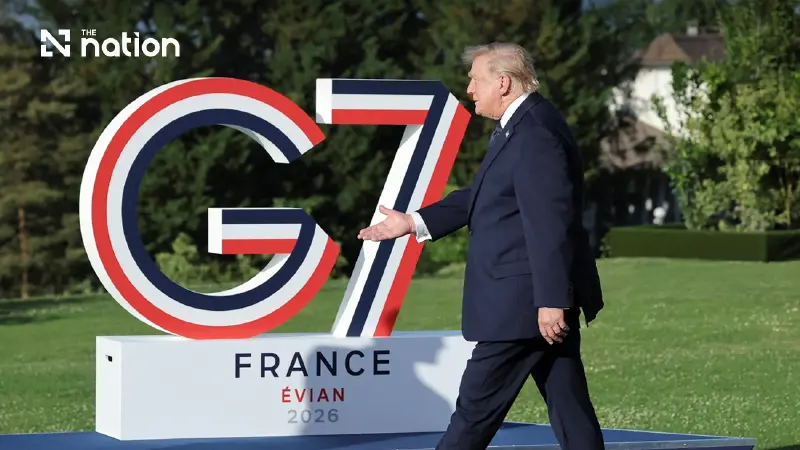


Ukraine’s leader uses the France summit to seek stronger backing, while Europe warns Washington against a weak Iran accord.
- Ukrainian President Volodymyr Zelenskiy is attending the G7 summit to persuade President Trump and allies to provide stronger support for Ukraine, arguing Kyiv's military position has improved.
- European G7 leaders are concerned about a preliminary US-Iran deal, planning to warn Trump that it may be too weak to resolve Tehran's nuclear and ballistic missile programs.
- The G7 is also addressing the reopening of the Strait of Hormuz, largely closed by Iran, by discussing a potential maritime mission and alternative energy routes.
The G7 summit in Evian-les-Bains has become a test of whether Ukraine and Europe can pull Donald Trump closer to their position on two urgent issues: the search for a tougher peace framework for Ukraine and concern over a fragile interim deal with Iran.
President Volodymyr Zelenskiy arrived at the French lakeside resort on Tuesday, June 16, where French President Emmanuel Macron is hosting the June 15-17 gathering.
Zelenskiy’s central message to the US president is that Ukraine’s position in the war with Russia has improved and that Kyiv’s allies should respond with stronger international support.
Trump reached France on Monday after securing a preliminary agreement aimed at ending the conflict with Iran, with a formal signing targeted for Friday.
He said he would now turn his attention to Ukraine, claiming that both Zelenskiy and Russian President Putin had shown an openness to a deal: “We had a very good conversation yesterday with President Zelenskiy and President Putin, and I think maybe we can do something there. I really do. I think they're both open to it.”

European diplomats are trying to challenge what they see as earlier US thinking that leaned too far towards Moscow.
They believe Ukraine’s drone incursions, which have pushed Russia onto the defensive, give them a stronger case.
European Commission President Ursula von der Leyen said on Monday that Ukraine was gaining ground and striking targets deep inside Russia, whose “war economy has never been as weak”.
Zelenskiy joined the first session of the day, “Building peace in Ukraine”, and may also hold a separate meeting with Trump.
He was due to speak individually with other G7 leaders as he tries to restart stalled negotiations and secure a larger European role.
On Monday, he said he had offered to meet Putin at the summit, but that Putin was not ready for peace talks.
Iran is the second major concern for European leaders at the summit.
They are expected to warn Trump that a shallow interim agreement could leave Tehran’s nuclear and ballistic missile programmes entrenched rather than resolved.
Macron said the priority was to secure a “solid, serious agreement that is finalised”.
Tuesday’s working lunch was expected to focus on reopening the Strait of Hormuz safely, including the possibility of a Franco-British-led maritime mission.

G7 leaders were also set to examine alternative energy routes that could bypass the waterway, which Iran has largely closed since shortly after it was attacked by the US and Israel at the end of February.
Trump said the strait would be “completely open” on Friday.
Leaders from the United Arab Emirates, Qatar and Egypt were due to attend Tuesday’s talks.
Diplomats said they were not expected to enter detailed discussions on Iran’s nuclear programme, but would instead set out their expectations for the next stage.
The interim deal is meant to create a 60-day window for complex technical negotiations covering Iran’s stockpile of highly enriched uranium and the lifting of international sanctions.
European allies fear that an inexperienced US negotiating team may fail to secure a robust nuclear accord or deal with Iran’s ballistic missile programme, raising the risk of a prolonged standoff.
France, Britain and Germany want a role in shaping the talks after being sidelined in recent months.
The three countries first engaged Iran on its nuclear programme in 2003 and later worked with then-US president Barack Obama on the 2015 agreement in exchange for sanctions relief.
Trump has long criticised that accord and withdrew the US from it during his first presidency.
Reuters
