
Tokyo sends police officer to Bangkok for global fraud crackdown
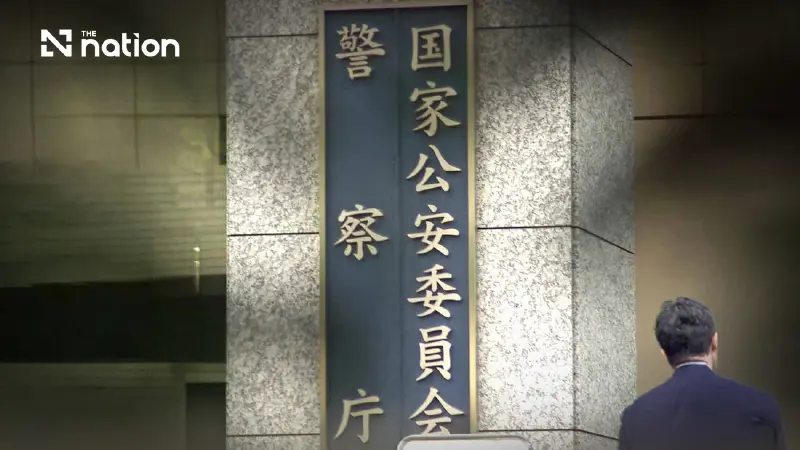


A specialist investigator from Japan will be based in Bangkok to tackle anonymous crime syndicates as global losses from phone scams soar.
- Japan's National Police Agency (NPA) has sent a police officer to be permanently stationed in Bangkok to combat a surge in international phone scams.
- The officer will work to build closer operational ties with law enforcement agencies across Southeast Asia to disrupt "tokuryu" criminal syndicates responsible for the fraud.
- This deployment is a response to record financial losses in Japan, which skyrocketed to 126 billion yen from January to April, with most scam operations based in Southeast Asia.
- A key part of the officer's role is to collaborate with Thai authorities and international counterparts from the US and Europe who are also stationed in the region to counter these networks.
Alarming financial losses from international phone scams have prompted Japan’s National Police Agency (NPA) to deploy a dedicated liaison officer to Thailand.
Announced on Thursday (18 June), the cross-border assignment aims to forge closer operational ties with law enforcement agencies across Southeast Asia to disrupt "tokuryu", loosely structured, anonymous criminal syndicates operating from within the region.
The assigned official, a male investigator in his 30s from the NPA’s Second Organised Crime Division, will be permanently stationed in Bangkok.
His primary responsibilities involve analysing shifting crime patterns and executing early-phase interventions to dismantle fraudulent operations before they fully mature.
Because of Thailand's central role in countering illicit networks across Southeast Asia, personnel from the United States and various European nations are already stationed in the country.
The newly deployed Japanese officer will focus heavily on cultivating deep working dynamics with these international counterparts as well as domestic Thai authorities, whilst gathering and analysing field intelligence.
Should an active fraud hub be identified in a neighbouring territory, the liaison is tasked with orchestrating joint investigations and compiling information on any involved Japanese nationals.
This field-level integration follows an unprecedented escalation in illicit activity.
According to data released by the NPA, losses inside Japan from telephone scams and related offences classified as special fraud skyrocketed by roughly 70 per cent year-on-year, reaching a record 126 billion yen between January and April alone.
The crisis extends far beyond Asia, with annual global damages across Europe and the US now estimated to exceed 400 billion dollars.
A vast majority of these scam operations are believed to be located within Southeast Asia.
The scale of the threat was underscored last year when overseas phone calls accounted for three-quarters of all special fraud cases reported in Japan.
Ongoing regional crackdowns by local authorities led to the apprehension of 54 individuals across four countries last year, including suspects who were subsequently repatriated to Japan.
Enforcement actions have sustained momentum into this year, with a total of 35 individuals detained across Cambodia, Indonesia, and other nations by the end of May.
To match this expanding threat, the NPA has previously hosted international summits and intensified high-level diplomatic exchanges among senior police chiefs.
However, to successfully apprehend the masterminds controlling these syndicates, the agency is now prioritising direct collaboration closer to the field.
Reflecting this strategic pivot, an NPA official commented on the deployment: "We want to establish a system in which [offenders] will definitely be caught even if they escape or stay abroad." The official added, "The liaison is at the forefront of the efforts."

[Copyright The Jiji Press, Ltd.]
