
Iran prepares extensive funeral rites for slain supreme leader


Clerics are mobilising mourners across Tehran, Qom, Mashhad and Iraq as anger over sanctions, repression and unrest shadows the rites.
- Funeral rites for Ayatollah Ali Khamenei are planned as an extensive, multi-day event with processions and ceremonies in Tehran, Qom, Mashhad, and Iraqi shrine cities.
- Iran's leadership is treating the funeral as a political "referendum" on the Islamic Republic, aiming to use a large turnout to demonstrate public devotion and state strength.
- To ensure massive crowds, authorities are providing logistical support for mourners, including transportation, food, and subsidized accommodation in hotels, schools, and mosques.

Iran’s ruling clerics are preparing days of funeral rites for Ayatollah Ali Khamenei, turning mourning for the slain supreme leader into a public demonstration of devotion to the Islamic Republic and its revolutionary cause.
Khamenei was killed in the opening attack of the war by the United States and Israel.
The ceremonies are due to start in Tehran over the weekend, before mass processions are held next week in Qom and Mashhad, with further rites in Iraq.
The leadership is treating the expected turnout as both a political test and a religious farewell.
“The large public turnout at the funeral procession of the martyred leader and the other martyrs will, in effect, be another referendum for the Islamic Republic,” Qom Friday prayer leader Ayatollah Mohammad Saidi told state media.
If the funeral is being framed as a referendum, the authorities are trying to shape the verdict: they hope to bring millions of supporters into Iran’s cities, providing transport, accommodation and food to project the strength of a theocratic state that believes it has survived an existential war.
Khamenei’s death, and the rise of his son Mojtaba as Iran’s third supreme leader, mark a turning point in the Islamic Republic’s 47-year history, coming during a conflict with its greatest foes.
Mojtaba was dangerously wounded in the strike that killed his father and has not appeared in any new image since the war began.
Behind the official display of unity, however, analysts say support for the Islamic Republic has become extremely fragile.
Many Iranians are weary after decades of sanctions that have choked the economy and angry at repression carried out in the name of the 1979 revolution, an event now directly remembered mainly by older people in a mostly young population.
In December and January, inflation-triggered protests brought crowds into the streets, where many demonstrators chanted for Khamenei’s death.
The authorities crushed the unrest by shooting thousands of protesters.
When reports of Khamenei’s killing spread in the first days of the war, Tehran residents said cheers could be heard from behind the windows of homes and apartment blocks in parts of the capital.
Tehran is now tense and quiet, far removed from the last burial of a supreme leader, Ayatollah Ruhollah Khomeini.
Then, millions of grieving mourners overwhelmed Khomeini’s funeral procession; some climbed onto the ambulance, one leg of the dead leader exposed from the shroud, as Revolutionary Guards struggled to push the crowd back.
Samira, 35, whose husband owns a restaurant in Tehran, said her family would not attend any of the funeral events and was leaving the city for the week.
“It is like life has stopped and there are Basijis everywhere,” she said, referring to the voluntary militia organisation affiliated with the Revolutionary Guards.
In Iran’s theocratic system, Khamenei was not only head of state and leader of a revolutionary movement, but also the earthly representative of Shi’ite Islam’s 12th imam, who disappeared in the ninth century.
His death in an enemy attack fits into a powerful Shi’ite tradition of martyrdom and mourning, including processions of black-clad mourners who beat their chests or backs during annual religious commemorations.
That symbolism has been visible in the black funeral flags hanging over city streets since his death, and in mourning ceremonies that refer to the martyrdom of Shi’ism’s third imam, Hossein.
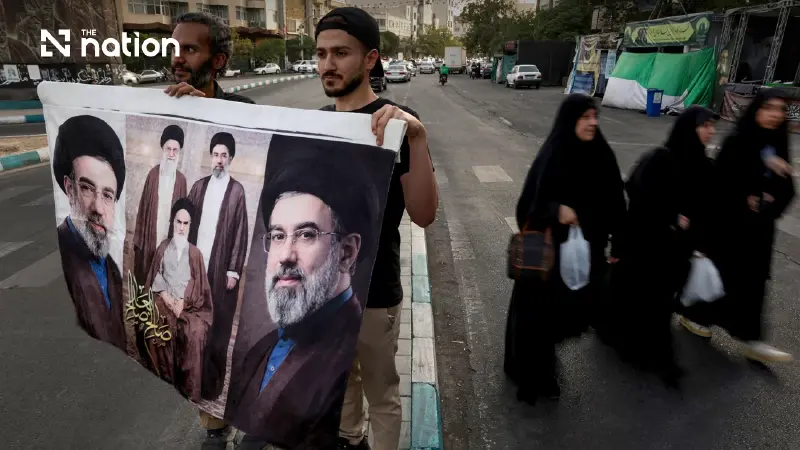
On Thursday, workers in Tehran were putting up new posters in support of Mojtaba, showing the late Khamenei and a raised revolutionary fist behind him.
For supporters of the Islamic Republic, the language of martyrdom is deeply felt.
“These are the hardest days of my life,” said Mohsen, 24, a Basij member in Tehran who asked not to give his family name.
“I do not remember the time when Imam Khomeini passed away, but my father says the entire country was engulfed in grief and mourning. Today, too, people are in mourning, especially because our leader was martyred,” he added.
Officials and foreign dignitaries, including those from Russia and China, are expected to offer condolences at events on Friday.
On Saturday, Khamenei’s remains will be taken to a Tehran mosque for the first stop in a national funerary tour.
The bodies of his daughter, son-in-law and granddaughter, as well as the widow of the new leader, his son Mojtaba, will be carried alongside him; all were killed in the same strike.
Hotels are offering 50% discounts, while schools, mosques and sports halls have been prepared to house mourners.
Bus and rail networks are also being diverted to serve the main events.
After what authorities are billing as a massive procession in central Tehran on Monday, the remains will be taken on Tuesday to Qom, the seminary city at the centre of Iran’s Shi’ite hierarchy.
Ceremonies will then be held on Wednesday in the Iraqi shrine cities of Najaf and Kerbala, with prominent attendees from Iran’s regional network of Shi’ite proxies.
Khamenei is due to be buried on Thursday in Mashhad, after another procession, near the tomb of Imam Reza, a figure of great devotion in Iran.
Security will be tight, with temporary airspace restrictions over Tehran and other cities, and threats of a powerful response if either the United States or Israel resumes attacks.
“We are showing our power to America and others in our own way,” said Hossein Kheiri, 63, a veteran of the 1980-88 war with Iraq, standing under a poster of Khamenei in Tehran.
Source: Reuters
