
US and Iran trade strikes as Hormuz tensions threaten wider war
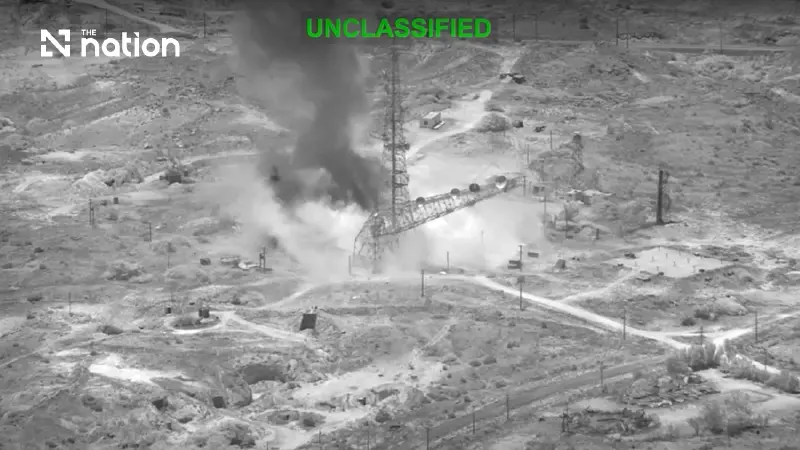


Washington hit coastal defences and missile sites as Tehran attacked regional US bases, while allowing an American to leave in a rare diplomatic gesture.
- The US launched two waves of attacks on Iranian coastal defense and missile sites near the Strait of Hormuz in response to threats against commercial shipping.
- Iran retaliated by striking US military targets in neighboring countries, including Kuwait, Bahrain, and Jordan, using missiles and drones.
- The conflict has escalated around the Strait of Hormuz, a key energy route, which Iran has closed after the US reimposed a naval blockade.
- Fears of a wider war are growing as a fragile truce collapses, with US officials conducting "shaping operations" for potential larger attacks and President Trump threatening further escalation.
Acting at President Donald Trump’s direction, the United States launched two waves of attacks on Iranian coastal defences and missile sites on Wednesday (July 15), after reimposing a naval blockade of Iran’s ports.
Tehran retaliated against US military sites in neighbouring countries as the conflict entered its fifth month and a fragile truce collapsed, reviving fears of a return to full-scale war.
Iran also renewed threats to halt more regional energy exports.
US Central Command (CENTCOM) said a 90-minute first wave began at about 6am EDT (1000 GMT), striking coastal-defence systems and cruise-missile storage and launch sites on Greater Tunb Island.
A second wave followed nine hours later against targets in several cities.
CENTCOM said the strikes hit command centres, air-defence sites, missile and drone capabilities and coastal-surveillance facilities, including targets in Bandar Abbas, home to Iran’s largest port and key naval and Islamic Revolutionary Guard Corps facilities near the Strait of Hormuz.
Washington said the targeted capabilities had been used to threaten commercial shipping.
The Islamic Revolutionary Guard Corps (IRGC) said it had hit US military targets across the region.
It said missiles and drones were used against a gathering of US personnel and a radar system at Ali Al Salem Air Base in Kuwait, while other targets were struck in Bahrain and Jordan.

Iranian media reported explosions in Bandar Abbas, Ahvaz, Konarak, Sirik and Qeshm.
Press TV reported at least two blasts in Khondab, about 250 kilometres south-west of Tehran, while Mehr News Agency said air defences were activated over the capital to counter threats it described as hostile.
The Islamic Republic of Iran Broadcasting (IRIB) said US attacks struck near an Ahvaz hospital housing a paediatric cancer centre, prompting a temporary evacuation and leaving families caring for children outside.
Tasnim, citing a health ministry official, said US attacks had killed at least 35 people in July, while Iranian authorities reported more than 300 people injured in southern provinces.
Iran said late on Saturday that it had closed the Strait of Hormuz, while continuing military operations were also preventing vessels from using the waterway.
Before the war, the strait carried about a fifth of global oil and gas shipments.
Brent crude closed on Wednesday at a one-month high of $84.95 a barrel as concern grew over disruption to one of the world’s most important energy routes.
The US military also said it disabled an unladen oil tanker heading towards Kharg Island after the vessel ignored repeated warnings, firing Hellfire missiles into its smokestack.
Since resuming the blockade on Tuesday, US forces had redirected two ships and disabled another, it said.


Three US officials said the attacks were intended not only to help force open the strait but also to weaken air defences, coastal radar and other military capabilities Washington would want removed before any more complex operation.
One official described them as “shaping operations”.
Possibilities discussed within the US administration have included sending ground forces to seize Kharg Island, the hub for about 90% of Iran’s oil exports, and a possible attack on Pickaxe Mountain, a fortified underground facility linked to Iran’s nuclear programme.
Iran’s parliament speaker and top negotiator, Mohammad Baqer Qalibaf, said the country’s security depended on preserving an Iranian framework for managing the strait.
“We are in an essential and existential war with America,” he said.
An Iranian military spokesperson said the strait would reopen only if Washington complied with the 14-point memorandum of understanding signed in June and accepted “Iranian regulations” governing ship traffic.
Trump remained publicly combative.
At the Pennsylvania Defence and Innovation Summit, he said, “We’ll have Iran defeated soon. They’ll be defeated very soon.”
He also claimed Tehran wanted to “settle so badly”, saying Iran disliked US actions but wanted an agreement and that Washington would either reach one or “finish it off”.
Trump said US negotiators had told their Iranian counterparts, “You better make a deal”.
He later warned Tehran: “They better behave,” and threatened strikes on bridges and power plants the following week if Iran did not return to negotiations.
At the same time, Iran allowed Dena Karari, an American who had been prevented from leaving the country since December 2024 over accusations described by Washington as fabricated, to depart.
Trump said her detention under the Biden administration had been wrongful and wrote on Truth Social: “The United States of America appreciates this gesture of Goodwill by Iran.
” Human rights lawyer Jared Genser said, “Dena is now safe and travelling back to the United States.”
The move provided a rare diplomatic signal but did not soften Trump’s public stance.
The war, which began when the US and Israel launched hostilities on 28 February, has killed thousands and displaced millions, mainly in Iran and Lebanon, where fighting resumed between Israel and the Iran-backed militant group Hezbollah.
Critics in the US Congress have warned that tactical victories against Iran’s conventional military may not produce strategic concessions or a lasting peace agreement, even as the latest attacks expand Trump’s options for further escalation.


Source: Reuters
