
Thailand braces for fuel and trade shock as two Middle East routes face disruption
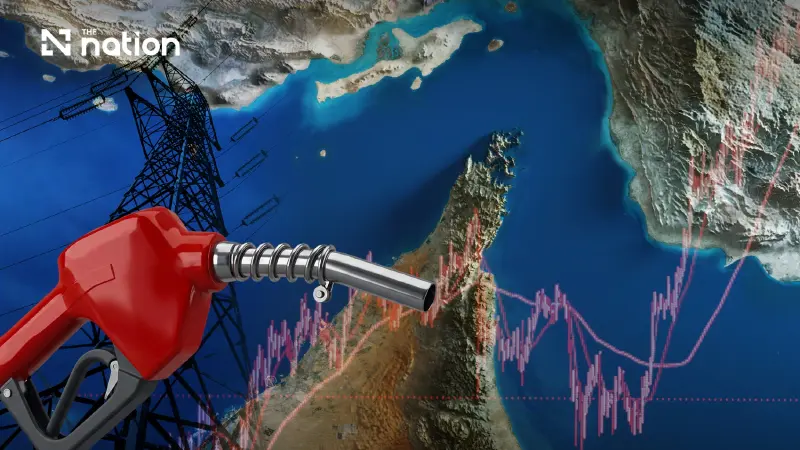


Thailand faces higher oil, electricity and shipping costs if conflict closes Bab el-Mandeb and disrupts trade through the Red Sea and Suez Canal
- Disruption to the Bab el-Mandeb Strait threatens to increase costs for Thailand's imported crude oil and liquefied natural gas (LNG), potentially leading to higher domestic diesel prices and electricity bills.
- A closure of the waterway would force cargo ships to take a longer, more expensive route around Africa, significantly raising freight and insurance costs for Thai trade with Europe and the Middle East.
- Beyond energy, the increased shipping costs and delays would directly impact Thai manufacturers and exporters, potentially causing supply chain issues, higher consumer prices, and weaker economic growth.
- Thailand's vulnerability is heightened by its reliance on Middle Eastern energy, with a simultaneous disruption at both Bab el-Mandeb and the Strait of Hormuz creating a severe "double chokepoint" risk for its supply.
Thailand could face higher fuel, electricity and shipping costs if escalating conflict in the Middle East disrupts the Bab el-Mandeb Strait, a vital gateway linking the Red Sea with the Gulf of Aden and the wider Indian Ocean.
Renewed confrontation between the United States and Iran has increased concern that Tehran’s regional allies, particularly Yemen’s Houthi movement, could intensify attacks on commercial vessels near the strait.
The waterway remains open, but global markets have begun pricing in the risk of further disruption as oil prices move close to their highest level in more than a month.
Any closure would affect far more than energy markets. Ships travelling between Asia and Europe would lose direct access to the Red Sea and Suez Canal, threatening global supply chains, pushing up freight and insurance costs and adding to inflationary pressure.
For Thailand, the potential impact would extend from domestic diesel and electricity prices to manufacturing costs and exports bound for Europe and the Middle East.
‘Gate of Tears’ connects Asia and Europe
Bab el-Mandeb means the “Gate of Tears” in Arabic.
The narrow passage lies between Yemen on the Arabian Peninsula and Djibouti and Eritrea in the Horn of Africa. It connects the Red Sea with the Gulf of Aden and provides access to the Suez Canal, the shortest major shipping route between Asia and Europe.
The area is also strategically important because several major powers, including the United States, China, France, Japan and Italy, maintain military facilities nearby.
The Houthi movement controls parts of Yemen’s Red Sea coast and has demonstrated its ability to attack commercial shipping with missiles and drones.
Bab el-Mandeb is a significant energy route, although traffic has already shifted sharply because of security concerns. About 4.2 million barrels per day of crude oil and petroleum products passed through the strait in the first half of 2025, roughly half the volume recorded in 2023. Flows recovered to about 5.4 million barrels per day in the first quarter of 2026.
Attacks on Red Sea shipping since late 2023 have already prompted many vessels to take the longer and more expensive route around Africa’s Cape of Good Hope.
Closure would immediately raise freight costs
If Bab el-Mandeb were closed, shipping lines would be unable to use the Red Sea and Suez Canal and would instead have to sail around the Cape of Good Hope in South Africa.
The diversion could add about 3,000–3,500 nautical miles, or more than 6,000 kilometres, to some journeys and extend delivery times by another 10–20 days.
Thai shipments to Europe that normally take about 30 days could require between 45 and 60 days, depending on ports, routes and congestion.
The original analysis estimated that freight rates could more than double, with the cost of transporting a 40-foot container potentially rising from about US$3,500 to US$7,000.
War-risk insurance and emergency surcharges could add thousands of dollars more to each shipment.
Those costs would eventually be passed through to manufacturers, retailers and consumers.
Previous Red Sea disruptions have shown that rerouting vessels around the Cape of Good Hope significantly increases both transit times and operating costs. The US Energy Information Administration estimates that bypassing the Suez route can add about 15 days to an oil tanker’s journey between the Arabian Sea and Europe.
Thailand risks higher oil prices and electricity bills
Thailand remains vulnerable because of its reliance on imported energy.
The original assessment said about 58% of Thailand’s crude oil imports came from the Middle East. A simultaneous disruption to the Strait of Hormuz and Bab el-Mandeb would therefore create a “double chokepoint” threatening both the departure of Gulf energy cargoes and their westward passage through the Red Sea.
Under an extreme scenario in which both routes were closed, analysts cited in the report estimated that crude prices could reach US$150–US$200 per barrel.
Such an increase could push retail diesel prices in Thailand above 40 baht per litre unless the government provided substantial subsidies or cut taxes and levies.
The effect would also extend to electricity costs.
Thailand imports liquefied natural gas from Qatar for power generation. The report estimated those purchases at about 2.2 million tonnes annually, equivalent to roughly 24% of the country’s LNG imports.
Qatari LNG must first pass through the Strait of Hormuz. Cargoes bound for Europe traditionally also use Bab el-Mandeb and the Suez Canal, although many have already been rerouted towards Asia or around Africa because of Red Sea security risks.
Delays or higher shipping costs could eventually feed into Thailand’s fuel-adjustment tariff, or Ft, and raise household electricity bills.
The report cited research estimates suggesting that persistently high oil prices, combined with limited government capacity to subsidise energy, could push Thai inflation towards 3–4.5% and weaken economic growth.
These figures represent risk scenarios rather than official forecasts or guaranteed outcomes.
Exporters and manufacturers face disruption
The effects would not be limited to energy.
Longer voyages to Europe and the Middle East could delay Thai exports, substantially raise logistics costs and tie up companies’ working capital for longer periods.
The private-sector estimates cited in the original report suggested that more than 32 billion baht worth of Thai exports could become trapped in the logistics system.
If disruption continued, monthly export losses could average more than 33 billion baht, according to the assessment.
Petrochemicals, plastics, packaging, chemical fertilisers and agriculture would be among the first sectors affected by shortages or higher raw-material prices.
Small and medium-sized businesses could face particularly severe liquidity pressure because delayed deliveries would lengthen payment cycles while freight and production costs rose immediately.
Companies may also need to hold more stock, secure alternative suppliers and pay higher insurance premiums to limit the risk of production interruptions.
Two chokepoints pose wider global threat
The greatest concern is not the disruption of Hormuz or Bab el-Mandeb alone, but the possibility that both waterways could be affected simultaneously.
Hormuz is the world’s most important oil chokepoint. It carried more than one-quarter of global seaborne oil trade and about one-fifth of global oil consumption in 2024 and early 2025. More than one-fifth of global LNG trade also passed through it.
Bab el-Mandeb provides a gateway for energy and goods moving between the Indian Ocean, Red Sea, Suez Canal and Europe.
If Hormuz is the departure point for much of the Gulf’s energy supply, Bab el-Mandeb is the artery carrying part of that supply and a vast volume of other trade towards Europe.
Simultaneous disruption would affect energy prices, freight rates, inflation and industrial supply chains around the world.
Thailand has limited buffer against prolonged crisis
Thailand is reported to have oil reserves sufficient for about 65–95 days of consumption and has sought to diversify imports towards suppliers in the United States, West Africa and Malaysia.
Those measures could offer temporary protection, but they would not fully insulate the country from a prolonged disruption affecting global prices, transport capacity and insurance costs.
The government and business sector would face the combined challenge of controlling energy costs, limiting increases in consumer prices and maintaining sufficient supplies for electricity generation, transport and industry.
For Thailand, the possible closure of the “Gate of Tears” would therefore be more than a distant geopolitical event. It would become a direct test of the country’s energy security, export resilience and ability to manage another global supply-chain shock.
