
Bank Indonesia governor’s resignation revives autonomy concerns
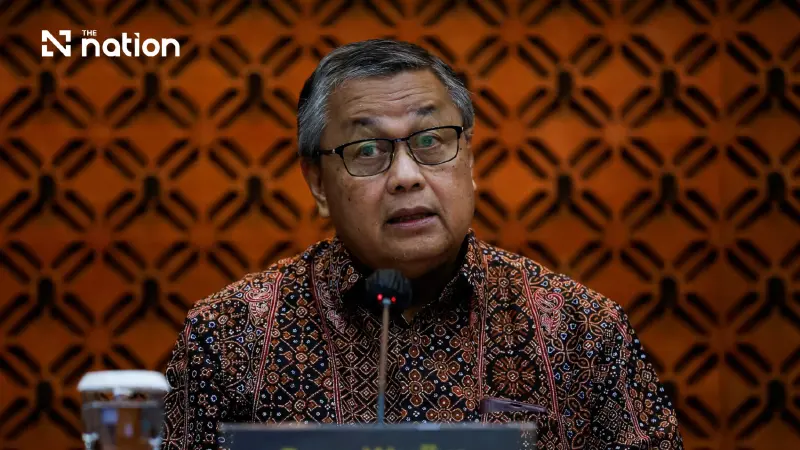


Perry Warjiyo’s unexpected departure leaves Destry Damayanti in temporary charge as investors assess policy continuity and the central bank’s independence.
- The unexpected resignation of Bank Indonesia Governor Perry Warjiyo caused the rupiah to weaken, renewing investor concerns about the central bank's independence.
- Fears over the bank's autonomy have been growing due to recent legislation allowing lawmakers to make binding recommendations and pressure on the bank to support the president's economic agenda.
- Analysts view the choice of a permanent successor as critical, warning that appointing the president's nephew could further undermine market confidence in the bank's independence.
- The resignation follows other recent changes in Indonesia's economic leadership and comes after credit rating agencies had already cited changes to the bank's mandate as a key risk.
The rupiah briefly weakened to 18,000 against the US dollar on Monday after Perry Warjiyo unexpectedly resigned as governor of Bank Indonesia, renewing investor concerns about the central bank’s independence.
The currency fell by as much as 0.36% following the announcement, while Indonesia’s main stock index, the JSE, moved between gains and losses in volatile trading.
The government urged market participants to remain calm during the leadership transition.
Senior Deputy Governor Destry Damayanti was placed temporarily in charge after President Prabowo Subianto accepted Warjiyo’s resignation.
State Secretariat Minister Prasetyo Hadi announced the change before financial markets opened in Jakarta.
Destry reported that Warjiyo had submitted his resignation on Saturday for personal reasons.
Prasetyo confirmed that the governor had sent a letter directly to the president but declined to disclose further details.
Warjiyo did not attend the press conference and could not be reached for comment.
The departure comes at a sensitive time for Bank Indonesia, which has faced pressure to support Prabowo’s economic-growth agenda.
The rupiah had already fallen to a historic low in June as investors questioned Indonesia’s fiscal management and the central bank’s independence.
Those concerns were heightened by legislation approved by parliament last month.
The law strengthens Bank Indonesia’s role in supporting growth and allows lawmakers to make binding recommendations to the central bank and independent financial regulators.
Bhima Yudhistira Adhinegara, executive director of the Centre of Economic and Law Studies, described the immediate risk as “the weakening of Bank Indonesia’s independence”.
He warned that restoring investor confidence would be difficult while markets believed monetary policy was subject to executive control.
Continued political pressure could also prevent any successor appointed from within Bank Indonesia from remaining in office for long, he added.
The choice of a permanent governor will be critical, according to Angus Mackintosh, an ASEAN specialist at Aletheia Capital in Singapore.
Mackintosh suggested that Destry’s temporary appointment could provide initial continuity.
However, he warned that markets could react with suspicion if Deputy Governor Thomas A.M. Djiwandono, Prabowo’s nephew, were elevated to the governorship because the position is a crucial technocratic role that should remain independent.
Under the appointment process, the president will nominate a candidate, who must undergo a parliamentary fit-and-proper test before lawmakers decide whether to approve the appointment.
“The president has not yet proposed the nomination,” Prasetyo stated.
The government pledged that the selection would be conducted transparently and accountably.
It also maintained that the transition would not disrupt monetary policy or economic stability.
Before joining Bank Indonesia’s governing board, Destry served as a commissioner at the Indonesia Deposit Insurance Corporation and as chief economist at Bank Mandiri.
She pledged that Bank Indonesia “will always ensure the continuity of its duties and authorities” as it works to preserve the stability of the rupiah and the financial system and maintain economic conditions supportive of growth.
The leadership change follows Bank Indonesia’s decision last week to leave policy rates unchanged and introduce incentives intended to attract foreign capital and support the rupiah.
The central bank had increased rates by a combined 100 basis points since May in an effort to strengthen the currency.
Credit-rating agencies have offered differing assessments of the risks surrounding the central bank.
Moody’s and Fitch cited changes to Bank Indonesia’s mandate among the main factors behind their decisions to lower Indonesia’s rating outlook to negative earlier this year.
S&P retained a stable outlook this month, noting that the central bank had maintained a level of operational independence broadly comparable with regional counterparts since July 2005.
It did not expect the revised mandate to have a drastic effect on that independence.
All three agencies rate Indonesia’s debt at the second-lowest investment-grade level.
Warjiyo began his career at Bank Indonesia in 1984 and was appointed governor in 2018.
He secured a second five-year term in 2023 after being reappointed by Prabowo’s predecessor.
His resignation follows another abrupt change in Indonesia’s economic leadership.
The removal of finance minister Sri Mulyani Indrawati last year unsettled investors who feared that Prabowo’s costly populist spending plans could weaken the country’s fiscal credibility.
Source: Reuters
