
What do kingdom's historical sites really offer as tourist attractions?


Play
Certainly, that is what all would ask, young or old, when they are told to visit a historical site in Thailand.
That is not surprising. We are told that history shapes the present and the future, but it seems so hard to retrieve information from historical sites.
Twenty years ago, as a university student majoring in history, historical site visits were a must. Then, before our trips, we had to get all information about the sites beforehand. During the tour, we were guided by lecturers. They told us what the remains once were and when they were built.
Sukhothai Historical Park was a must. According to history textbooks, Sukhothai marked the beginning era of Thai history, followed by Srisatchanalai and Kamphaeng Phet historical parks. Civilisation continued southward, to the Ayutthaya and then Rattanakosin eras.
To a student, the visits completed the visualisation of historical civilisation. Information used in the examination, however, came from textbooks, as historical sites had few things to offer – remains of temples and palaces plus some artefacts and brief explanations.
Twenty years later, I returned to Sukhothai Historical Park as a journalist participating in the opening of a development project for the community around the park. With funding from the Thailand Research Fund, the project for the first time circled the historical area, which allows visitors to complete a tour in one loop.
At the event, showcased was the local culture from food, handicrafts to dances preserved by the people. Tourists and people living in other parts of the province enjoyed asking the locals for information.
I came across a dessert that carried a very icky name – “sangkaya kheewua” (cow dung dessert). Made of sticky rice and minced coconut meat topped with Thai-styled custard, it was named that way as villagers usually carried it to paddy fields while watching cows munching on grass.
I met Auntie Bang-oen Tuichan, the owner of the Ruean Noppamas National Museum. Among her artefacts was a Sangkalok plate featuring Nang Noppamas – who was believed to have created the krathong and whose legend started the famous Loy Krathong festival. A chat with her encouraged me to take a look at other pieces at her museum. The auntie along with people living in the neighbourhood have many things to tell, as their families have been living there for a long time.
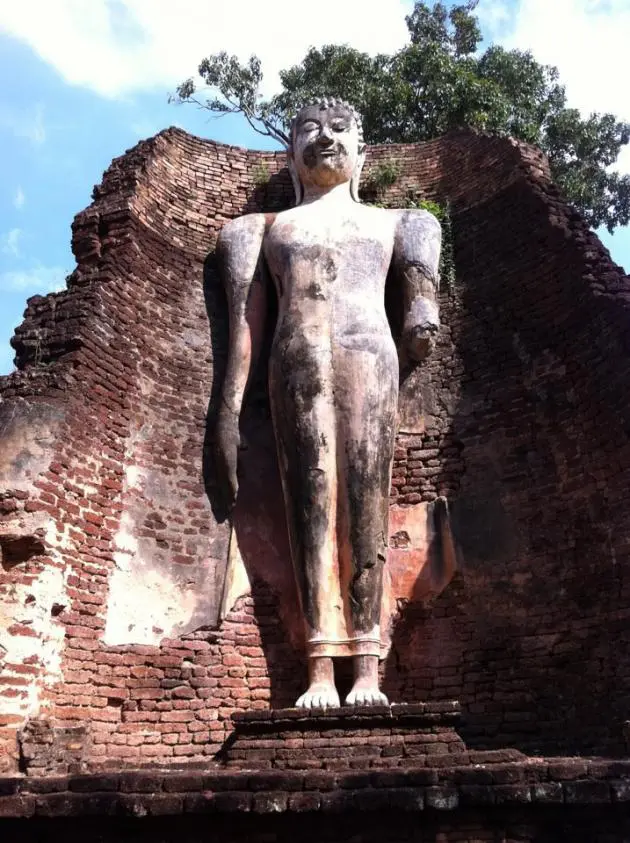
Yes, that visit as a journalist was very informative. However, a visit as a tourist to the nearby park in Kamphaeng Phet was terribly dull. Although it’s part of the World Heritage Site of Sukhothai Historical Park, Kamphaeng Phet had few things to share with tourists.
There was no guide to brief you on the history of this town. A brochure handed out by the tourist information centre was very brief, with a short explanation of the town and a map. Only at highlighted temples could you find a sign relating the history of the temples.
During the tour, questions may have popped up – from where the sandstone came from and how people hundreds of years ago bound the stones together. Sadly, there was no one around to answer those questions. Certainly, aside from the information on the history of the town, more details could have made the tour more interesting. An animated graphic may be too costly and a TV screen could increase the park’s operating cost. But what about a model, telling how the park was constructed?
Like other tourists, that day I completed the tour by taking photos. All questions are not forgotten. If I have time, I will look for the answers.
Indeed, dullness is the character of all historical parks in Thailand. Without that event, Sukhothai Historical Park would also have been that dull. Colour is usually added by beverage carts, bearing logos of famous soft drink brands. What tourists can do is get a brochure and follow the map. Notably, all parks are big, walkways are uneven and not all offer enough shade. They are out of reach for the elderly. And the regular visitors today are students from nearby areas – who enjoy the out-of-school tour more than the history.
Rather than being sources of information and an inspiration for descendants, historical parks are comparable to the sites of ruins and dust. If we really believe that history shapes our present and future, we may need to do something to boost the attractiveness of historical parks.
CHULARAT SAENGPASSA
THE NATION
