
New opportunities lie in Chinese and US regional moves


Play
By remaining impartial, Thailand can benefit from renewed regional interest from China and the US in trade, security and social development
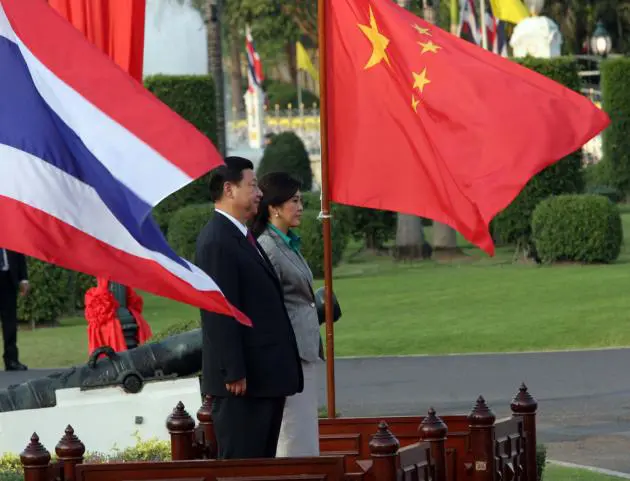
The visit by Chinese Vice President Xi Jinping to Thailand is meant to reaffirm Chinese interest in the region after Washington signalled its intention to ramp up its engagement with recent landmark visits to Burma and Thailand by US Secretary of State Hillary Clinton.
The theme of Xi’s three-day visit, which began yesterday, is timely, as he has come to sign a memorandum of understanding to promote infrastructure and transportation projects – an area in which Thailand needs to improve. China can also benefit from this cooperation, because improved transportation networks will enable it to connect with Indochinese countries to bolster trade links. One of the four planned cooperation projects is a high-speed train project from Bangkok to Chiang Mai, which will also be linked to Laos and thereafter to southern China.
The memorandum of understanding has the potential to produce tangible results. At any rate, the visit’s significance goes beyond the contents of this document. The vice president’s visit affirms Chinese interest in Thailand amid rapidly changing geopolitics, with the US shifting its interest to the region. Until recently, the political situation discouraged Washington from engaging more actively with Thailand, and this was also the case with Burma. Clinton’s recent visits to Thailand and Burma, however, marked the start of a new diplomatic chapter.
The US also plans to shore up its security presence in Asia. Washington has announced a plan to deploy 2,500 Marines in Darwin, northern Australia, marking the first appearance of US troops in that part of the region since the Vietnam War. The move has naturally made China uneasy. During the talks between Prime Minister Yingluck Shinawatra and Clinton, the US also expressed interest in using the Thai Navy’s U-Tapao Airport as a base for humanitarian relief efforts carried out by the US in the region.
Over the past decade, China has strengthened its diplomatic ties with the Southeast Asian region. Regional economic growth, driven by Chinese demand, has provided a market opportunity for Thailand to offset the slower demand in its traditional markets in the West. At the same time, China has been a close ally of Burma during decades of Western sanctions against the military-run state.
The visit of the Chinese vice president is the first official Chinese visit in 11 years, and shows that China hopes to use Thailand as a link in its increasing ties with Asean nations. Prior to the vice president’s visit, Chinese Ambassador to Thailand Guan Mu was quoted as saying that Thailand, as a member of Asean, has played a significant role in pushing for cooperation between China and Asean over the past few years.
Thailand was the first Asean nation to foster strategic cooperation with China – in agreements such as the early-harvest agreement on trade in vegetables and fruit – in the process of creating a free-trade agreement between Asean and China. On the security side, Thailand was the first Asean country to send special forces to participate in training exercises with the Chinese military. The ambassador said he believes that Thailand will play a key role in taking ties between China and Asean to a higher level.
Sino-Thai relations have been characterised by close ties between prominent institutions and individuals. During the flooding crisis, the Chinese government extended help to Thailand by providing water pumps and supplies to help ease the suffering of flood victims. Vice President Xi’s visit this time will also provide an opportunity for Thailand to express its gratitude for the Chinese help.
With the shifting of the US policy towards Asia, it will be interesting to see how future Sino-Thai relations will be shaped by external circumstances. After all, Thailand and China have many opportunities for future cooperation such as in water-resource management and green energy development.
The changing nature of the region’s geopolitics does not have to be a zero-sum game; it can yield mutual benefits for all, if all nations in the region play their cards right. And that’s the goal that Thailand should strive for: to maintain healthy future relations with both China and the US.
