
Charter change: What has real reform got to do with it?


Play
What has the proposed amendment to the Constitution got to do with long-sought-after political reform? How does it reflect the people's real wish for genuine democratisation of the country?
As they say, stupid questions deserve stupid answers.
Who says rewriting the charter is related in any way to the people’s political longing and advancement? You must be really naive to even think the country will embark on major political reform once the charter is amended, no matter how “democratic” the whole process may seem.
First, the Yingluck government said it wouldn’t be involved in the process of amending the Constitution. That, the premier once said, would be the task of the MPs.
On Monday, that position changed dramatically when the Cabinet endorsed a government bill seeking to amend Article 291 of the 2007 charter – paving the way for a controversial proposed rewriting of the Constitution.
Why the about-turn?
Premier Yingluck’s explanation wasn’t all that convincing. But still, it has to be taken into account so that any future debate on the issue can be traced back to the government’s stand on this particularly hot topic.
She said the government doesn’t want to lose the right to propose its own version of the amendment draft, since different groups, including her ruling Pheu Thai Party and the red shirts, have separately submitted their own drafts for parliamentary deliberations.
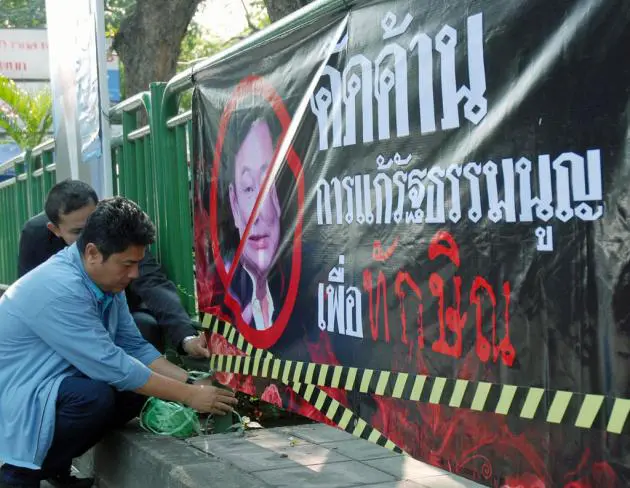
The three groups, of course, are somehow related to Thaksin Shinawatra – and the essence of each of the three drafts isn’t all that different. It’s the overwhelming impact of a joint assault that’s the real purpose of this exercise.
Opposition Democrats immediately fired the first salvo: The whole thing smacks of helping ousted former premier Thaksin to return to power. Premier Yingluck denied that line of argument once again, saying it has nothing to do with her brother.
On the surface, the bill that was approved by the Cabinet was simple enough: form a constitutional drafting assembly of 77 elected representatives (one from each province) and let the House appoint 22 others from among legal and political science experts. The 99-member panel would then be given a “free hand” to amend the entire post-2006 coup charter.
Cynics were quick to point out that a nationwide election to pick members of the Constitution Drafting Assembly (CDA) would inevitably follow the pattern of the last general election. That means despite the provision that CDA members can’t have political affiliations, there is no escaping the fact that the respective political parties would nominate their own men and women to run, with the help of their national and local election machines.
As a result, it is already predicted that the North and Northeast will see CDA members from the ruling Pheu Thai Party, while the South would see Democrat-backed candidates winning their seats.
The CDA members from the central plains would almost certainly be split among the smaller parties – following a similar composition of the current House of Representatives.
If that turns out to be true, there is little doubt what changes will be voted on in the CDA. And those proposed amendments would centre mainly on what the powers-that-be want changed.
That practically means that all the debate about what’s good and what’s bad for democracy in Thailand would come to nought. The whole process of constitutional rewriting would concentrate on who controls how many votes in the CDA rather than what the people really want from the country’s highest law of the land.
It may still not be too late to prevent the national cynicism over this exercise from plunging much deeper into the political abyss.
The CDA should first launch a nationwide survey of opinion of what clauses the people really want amended to fulfil the long-lost hope of seeing real political reform.
A referendum before the draft is drawn up – not after it is rewritten – on the substance of the new charter, would at least ensure that this constitutional amendment isn’t just a farce to ensure the staying power of populist politics where checks and balances are neutralised and moneyed electoral manipulation leads every step of the way to the next national disaster.
