
It's all in the detail


Play
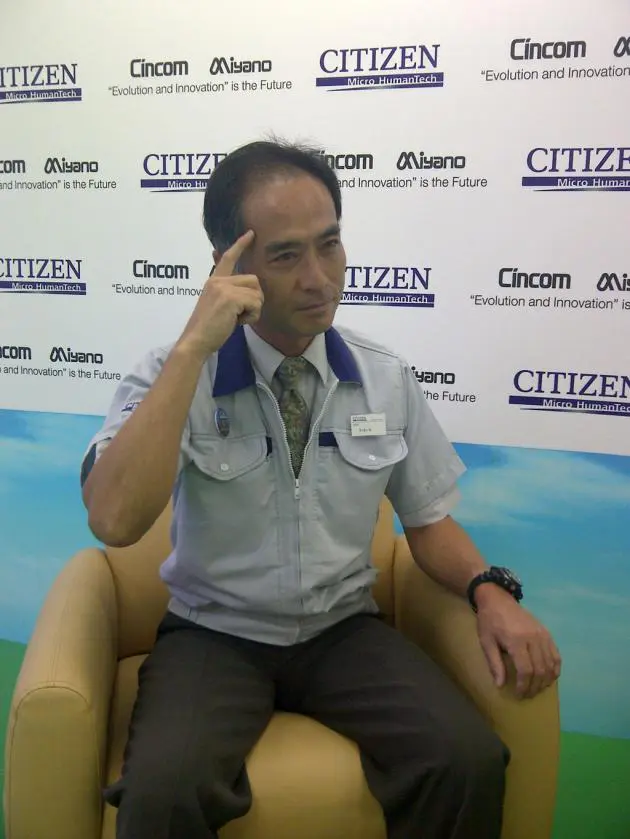
Kenji Aoki, managing director of Citizen Machinery Asia, says that precision parts making will continue in Ayutthaya despite the threat of more flooding
Kenji Aoki, managing director of Citizen Machinery Asia Ltd, held a big party last month to celebrate the opening of the firm’s third factory in Ayutthaya province – an event that shows foreign investors like Citizen Machinery still have confidence in Thailand despite last year’s massive floods.
Citizen Machinery, part of the watch-making Citizen Group of Japan, started its manufacturing activities in Thailand in 2001. Last October, the firm’s first and second factories in Ayutthaya were only slightly affected by the floods, largely because they are located on higher ground near Phahol Yothin Highway.
However, hundreds of other factories in the same province were submerged under water for months due to their low-lying locations. Among those affected were Honda Automobile in the Rojana industrial estate.
For Aoki and Citizen Machinery, a maker of high-precision parts for various high-tech industries, it was fortunate that the company avoided serious flood damage and was able to complete construction of the third factory in February.
“The floods caused a three-month delay to the factory construction plan, but we managed to open the new plant last month. We set up the first factory in 2001 and the second in 2006. In April last year, we started building the third, but construction was inevitably delayed by the disaster. During the massive floods, we also had to shut down production for one week, as many of our employees were severely affected.
“Nevertheless, here in Ayuytthaya, we produced more than 1,000 machines last year, with a combined sales value of more than Bt2 billion,” he said.
Citizen Machinery’s production process starts with the importation of die-cast parts from affiliated companies in the Philippines and Vietnam. Afterwards, the precision milling of these parts is done at the Ayutthaya factory, where there are 12 machining centres to process the imported parts.
“After milling, we send the parts to the assembly area, where other components of the machinery are put together. Our major customers are automobile companies, hard-disk-drive makers, and electronic and medical-device makers who need our machinery to produce high-precision parts and components in their own production process.
“These high-precision parts are used in mobile phones, car electronics and medical equipmment, for example. Our customer requirement is that we have to produce parts and components very accurately, with a margin of errors within five microns.
“In fact, our machine tool technology is derived from Citizen itself, which is well-known for watch-making and producing very small watch parts. This goes back more than 80 years. Last year, we took over Miyano, which also produces high-precision parts, but they are the bigger components. Currently, we produce parts with diameters within 32 milimetres, but Miyano’s parts are bigger, up to 60 milimetres,” he says.
By importing basic parts for Citizen machines from Vietnam and the Philippines for final assembly here in Thailand, the firm benefits from the tax-free movement of raw materials via the Asean regional production network.
According to Aoki, the company also has its own contingency plans to cope with possible floods later this year.
“In addition to the government’s measures, we also have taken action to protect our factories during the upcoming rainy season. A consultant firm has been hired to investigate soil condition around the factories as well as our factories’ positions when compared to sea level, so that we can take preparatory measures.
For all three factories here, we have already invested a total of Bt1.2 billion and have employed 160 workers,” he said.
