
Simply not sustainable


Play
A battle is heating up between the Finance Ministry and the Bank of Thailand.
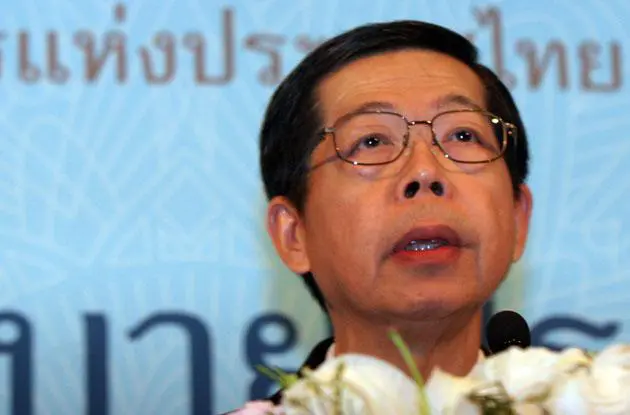
Kittiratt Na Ranong, the deputy prime minister and finance minister, is losing patience with Dr Prasarn Trairatvorakul, the BOT governor. The two are clashing over the country’s fiscal and montary policy.
Yesterday Kittiratt lost his cool. He attacked Prasarn directly, saying, “If the central bank were to listen to me and argue less, things would be better.”
Kittiratt has sent out a repeated signal over the past months that he wants to reflate the economy and wants the BOT to further slash its benchmark rate by another 50 basis points from 3.0 per cent to 2.50 per cent. Moreover, he wants the baht to be devalued further from the current rate of Bt30-Bt31 to the US dollar to Bt32-Bt34 to boost exports.
This attempt to reflate the economy echoes the remark of Dr Virabongsa Ramangkura, who wants the government to stimulate economic recovery through easy money and a weak baht. Virabongsa now heads the government’s massive flood prevention project.
Every time Kittiratt sends out his message of monetary expansion, however, he receives a cautious response from Prasarn. Prasarn argues that the present baht exchange rate, managed through a floating regime, is appropriate to promote macro-economic stability.
As for the interest rate, the central bank has also been pursuing an accommodative monetary stance that supports economic recovery. In fact, the Thai interest rate structure is abnormal, with a negative yield. This means that inflation is running at a higher rate than interest yield.
Moreover, Prasarn has also cautioned the government over its fiscal expansionary programme. Although the government still enjoys a sound credit rating, which enables it to create more debt to finance economic reconstruction, at a certain point it must make a closer self-examination to try to balance its revenue and expenditure, Prasarn said.
Korn Chatikavanija, the Democrat MP and former finance minister, couldn’t stay on the sidelines. He wrote on Facebook that Kittiratt should not interfere in the BOT’s monetary management.
“Thailand pursues open capital account management, using the monetary policy to manage interest rates. The central bank does not have a specific target for the baht exchange rate. We have got the lesson of 1997. If we were to go against the market by trying to fix the baht at a certain level, we would invite speculation in the foreign exchange market,” Korn said.
My view is that Kittiratt is already presiding over the country’s historic fiscal expansionary programme. By putting pressure on the BOT to adopt an ultra-easy monetary stance, he could harm the country’s financial stability in the medium term. The Pheu Thai Party’s economic policy is not sustainable as it focuses on massive public-sector spending without any attempt to match that spending with revenue increases. We have to bear in mind the Greek tragedy here.
Let's take a look at the fiscal expediation of the Yingluck government. While she charms us with her pretty looks, new dresses and hairstyles, her government is mischievously digging into the national coffers for massive spending that is not sustainable in the medium or longer term. Here are some of the big-ticket items: Bt2.2 trillion in public spending over the four-year tenure of the government; budget deficit of Bt300-Bt400 billion a year (which won’t be balanced until 2017 – if ever); Bt800 billion to reconstruct the economy after the foods, of which Bt350 billion is for flood-prevention projects, Bt300 billion for soft loans to SMEs, and Bt50 billion for an insurance fund; a rice subsidy scheme that is now losing money badly and is susceptible to corrupion; Bt10 billion for subsidies on rubber prices; Bt4 billion for school computer tablets; energy subsidies resulting in a Bt20 billion deficit for the Oil Fund (which could hit Bt100 billion soon, as warned by Prasert Boonsamphun, the former chief of PTT Plc); and a sudden, 40-per cent increase in the minimum wage that could deal a shock to the economy, including driving up inflation.
On the revenue collection side, Kittiratt is acting like Santa Claus by handing out benefits to corporations and investors: a corporate tax cut to 23 per cent this year, 20 per cent next year, and eventually down to 17 per cent; tariffs coming down to zero to 5 per cent due to free trade arrangements (AEC, FTAs, WTO); No plan to raise the value added tax of 7 per cent back to its original 10 per cent; no plan to collect property or inheritance taxes, as proposed by the Democrats; no plan to collect capital gains tax for profit made on the stock market; Board of Investment tax privileges for foreign direct investment. (Many of the foreign investments, which might hire some Thai workers, drain our natural resources, consume massive energy and exploit our infrastructure.)
This is a policy mismatch by the Pheu Thai government. To be fair, the Democrat government was not much different from Pheu Thai in this mismatch that will put the country’s macro-economic and political stability in danger.
The debate between Kittiratt, Prasarn and Korn should not be limited to interest and exchange rates alone. It should also cover an economic policy for the country that serves Thailand’s best interests.
