
No to America's use of U-Tapao


Play
Thailand's strategic location in Southeast Asia makes it vital for the United States to secure a hold on the air base and naval base at U-Tapao on the Gulf of Thailand.
As the policy to contain China intensifies, the US desperately needs to strengthen its military ties with Thailand as well as other allies in the region. It appears that the Yingluck government has already consented to this US demand to use the U-Tapao base in return for political support.
We are about to enter into uncharted territory. It could end in a regional conflict of unprecedented magnitude.
In this region, Singapore serves as a military outpost if not a nerve centre for the US forces. The Philippines has undertaken the role of “naughty boy” to annoy China. Vietnam, in spite of the bitter history of the Vietnam War, has fully embraced the US in this strategic alliance against China. Indonesia, conscious of its regional power, is trying to play two cards at once. Australia has markedly increased its military ties with the US. In north Asia, due to the presence of US military bases in their home countries, Japan and South Korea are automatically tied to a position where they have to confront China without any room for flexible diplomacy.
Leon Panetta, the US secretary of defence, has made it clear that the US is shifting the majority of its naval capability to the Asia-Pacific region. US officials use the word “engagement” to reflect this shift in the US military and security policies in Asia and the Pacific, which is emerging as the world’s most dynamic region, with its burgeoning economies and huge natural resources.
But the underlying objective is still to contain China, which is rising to challenge the fiscally bankrupt US as the main global power.
Regarding Thailand’s security ties with the US, there are two major developments. First, Nasa would like to use U-Tapao as an air base from which to conduct surveys of the climate conditions in Southeast Asia. This proposal was only revealed earlier this week. It is said to be Nasa’s most complex and ambitious airborne science campaign of the year, and is known as the Southeast Asia Composition, Cloud, Climate Coupling Regional Study, or SEAC4RS. With support from the National Science Foundation and the Naval Research Laboratory, the campaign will draw together coordinated observations and data from Nasa satellites, several research aircraft and an array of sites on the ground and at sea. This campaign might begin as early as August this year.
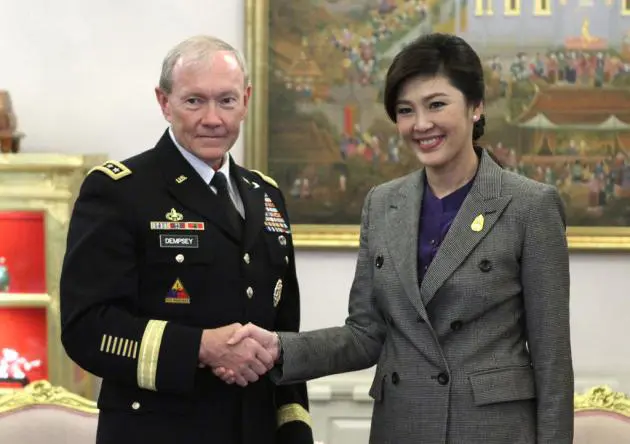
Another US military link with Thailand is a proposal to set up a Humanitarian Relief Operation Centre at U-Tapao. General MartinDempsey, the chairman of the US Joint Chiefs of Staff, paid a visit to Thailand earlier this week following his participation in the regional security forum, the Shangri-la Dialogue in Singapore. He met with Prime Minister Yingluck Shinawatra and other top security policy-makers and officials of Thailand.
General Dempsey asserted that the US would like to cooperate with Thailand on the use of U-Tapao as a Humanitarian Disaster Relief Centre. He denied that the US would like to use U-Tapao as a full-scale military base. But he did not rule out the possibility that, over time, it could be developed in that direction. And General Dempsey also made it clear that the Nasa project and the Humanitarian Disaster Relief Centre are two separate proposals.
Dr Panithan Watanayangkorn, a Thai security affairs expert, warned that the Nasa project to study weather conditions could include spy satellites that support unmanned aerial vehicles (UAVs) or drones. US military forces have increasingly been using drones in South Asia and the Middle East. U-Tapao could thus be used as a ground station to connect with US satellites that help guide drone attacks.
China, according to political sources, has been privately expressing concern over the US’s attempt to use U-Tapao base. If Thailand accedes to American wishes, our relations with China will go sour. In the event of a US-China military conflict, Thailand would certainly become China’s enemy. Pursuing a policy against China is counter-productive to Thailand’s interests.
It boils down to a simple conclusion: Say no to the US’s use of U-Tapao.
