
Cooking on the world stage


Play
Willment Leong, founder of the Thailand Culinary Academy, explains why it is so important for him to groom young Thai talent
The man behind the success of Thailand’s recent culinary Olympics success was once on the Singaporean police’s list of wanted men. Willment Leong has long been off his country’s blacklist but his past problems are today proving of benefit to Thailand’s youth.
Three years ago, as a way of saying thanks to Thailand, which he has called home for the last 13 years, Leong sunk his entire savings into setting up the Thailand Culinary Academy (TCA). The aim, he says, is to groom both young Thai chefs and professional chefs.
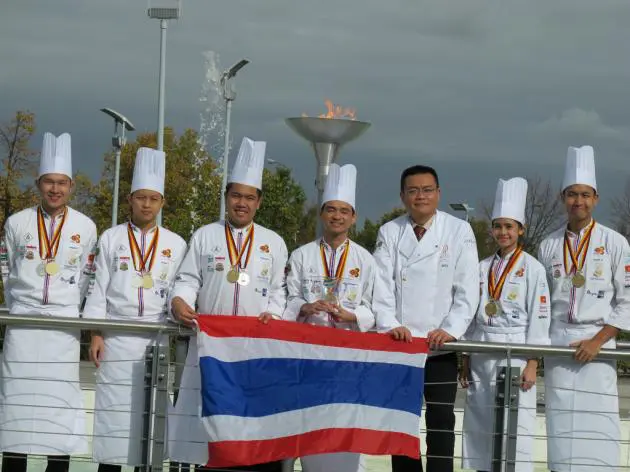
“During my hard times, I earned money working here so I wanted to give something back to Thai society. I can see the forte of Thai chefs so founding the academy makes a lot of sense,” says Leong, who recently led a group of Thai chefs to the IKA World Culinary Olympics 2012 in Germany where they won four gold medals and one silver. For the chairman of the academy, winning at the world’s most prestigious culinary competition is recognition was he’s on the right track.
Born into a poor family, Leong was pushed hard by his father, who borrowed money to pay his tuition fees. Told he would never starve to death if he learned how to cook, Leong reluctantly studied cooking for one year after finishing junior high but failed to graduate. He found two jobs, working two eight-hour shifts to make enough money to survive.
“Being born poor doesn’t mean you will be poor forever. If you are confident, diligent and devote your life to work, you can succeed one day,” says Leong in fluent Thai.
Leong succeeded enough to open his own business but when that failed, he became suicidal. Just 25, he was talked out of killing himself by a respected elder, fleeing the wrath of his creditors - and the police – by heading first to Cambodia then to Thailand where he found work as a chef.
Founding the TCA has been a dream for the past several years.
“I love to create things that are unique and different. If I had said three years ago that I would be ready to send Thai youths to compete in the Culinary Olympics, people would have laughed at me,” he grins.
Leong put some Bt2.5 million into his academy.
“Luckily, my parents supported my idea. They said that even though my rivals at the Olympics included a fellow Singaporean, I needed to win for the Thais.”
The 42-year-old chef quit his permanent job at a five star hotel seven months ago to focus on the academy. “If I’d carried on working, we would not have achieved the biggest awards in Germany,” he says.
“But all the credit must go to the Thais. Without Thai support and the Thai students, the academy would never have happened.”
Founded in 2009, the TCA focuses on sending Thai chefs to compete in international cooking contests. Leong offers free study and training. The academy has so far produced 80 chefs and they’ve bagged 44 trophies, 60 gold medals, 50 silver medals and 60 bronze medals. Leong organises a few cooking contests in Thailand, coaches and also recruits potential Thai chefs for the international contests. The academy, now located at Suan Dusit Rajabhat University, receives most of its funding from businessmen and private sectors. Only a few state agencies have recently offered support.
“Trophies or medals are not what I want. What’s important to me is that Thai youths see the outside world, learn new experiences, get to know strengths and weaknesses of foreigners, and bring back these experiences to transfer to their compatriots,” he says.
Over the last 20 years, expat chefs have all but ignored Thais on the world competition stage. “Today they feel scared of Thai teams because our goal is to sweep as many medals as we can,” he says.
“I want Thai chefs and Thai cuisine to be better known worldwide.”
Leong says his young student chefs are keen to adapt and flexible but tend to lack discipline, so he uses the “boot camp” approach learned both from his dad and his own military training.
“I test them with tough lessons to see if they can stand. For me there is no left or right. You go straight and you will be able to complete your mission,” he says.
He is also very serious about punctuality. Any student arriving late has to walk to the place where the contest is being held.
“When I assign my students a task and they ask me when I will need it, I will say yesterday,” he says.
Producing a talented or medal-winning chef isn’t hard, Leong says. What is far more difficult is managing feelings and characters.
“One of the most serious problem with Thai chefs is that they never truly learn the basics of Thai food. Instead they learn how to cook western dishes and how to use cooking equipment, which is very sad,” he says.
“There’s nothing wrong in learning western food but our chefs need to learn how to cook Thai food and to adapt western food to Thai food. That will give us the advantage in competition,” he says.
“International food is tasteless while Thai food tastes ‘just right’ so Thai chefs will be able to benefit more than other nation when tasting the food.”
With his own money running out, the academy is now facing funding problems but Leong intends to keep it running for as long as he can.
“I was so happy when I saw the smiles on my students’ faces before competition and after they won the prizes from our first win in Dubai. That’s inspirational and something money cannot buy,” says Leong.
Clarification: the mentioning of Mr's Leong legal trouble in thIs article referred to his now-resolved credit card situation. We apologize for any inconvenience caused by the article which followed a dual language Thai-English interview.
