
Dissecting China's past


Play
Academic and TV personality Yi Zhongtian sets out to chart 3,700 years of his country's history in 36 volumes
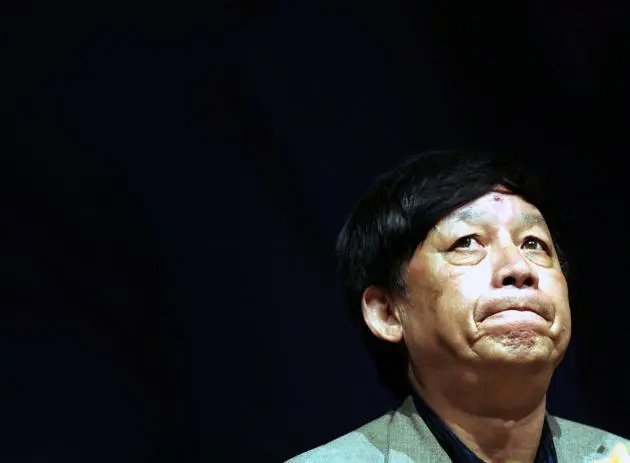
Retired academic Yi Zhongtian shot to fame with his humorous retelling of the history of the Three Kingdoms. Now the 66-year-old TV celebrity is embarking on his most ambitious project to date – a series of books detailing thousands of years of Chinese history.
Lu Jinbo, the president of Guomai Culture and Media, which also publishes such popular authors as Han Han, estimates the books will sell 36 million copies over the next decade and rake in 1.3 billion yuan (Bt6.36 bilion)
Lu says his high hopes for the series are based on the author’s popularity.
Yi, a former professor with the department of Chinese literature at Xiamen University, became a household name after he appeared in the CCTV programme “Lecture Room” in 2005 and performed a unique, humorous retelling of the history of the Three Kingdoms (AD 220-280). The programme was so popular that his book on the topic sold nearly 6 million copies.
His other titles have reached an average of 700,000 copies.
Yi’s new series has the ambitious title "Yi Zhongtian’s Chinese History". The 36-volume series recounts 3,700 years of Chinese history from the primitive era to the end of the 20th century.
Yi plans to establish a “history of his own style”, releasing six volumes a year and making the series a best-seller.
The first two titles: “Ancestry” and “State” hit the shelves in May.
“I have been anticipating a book like this for 10 years,” says Zheng Zhong, president of the series’ co-publisher, Zhejiang Literature and Arts Press.
“It’s rare for a Chinese title to appeal to readers across age groups.”
Yi expects to complete the series over five to eight years. He has based himself in a small town to focus on his work and has retreated from public life.
Yi says he started with a chronology of the comparative history of China and the Western world, produced by history professor Chen Qin.
“History is no singular entertainment with the door closed. It’s only with a global view that you can see it clearly,” Yi says.
His books are littered with references to world history and legends.
“Western audiences will find my writing very acceptable and familiar,” he says. “Anyone who flips through the book would want to finish it.”
In his leisure time, Yi enjoys reading detective novels. He compares writing about Chinese history, especially trying to shatter long-standing misunderstandings and stereotypes, with solving a complex criminal case.
“I walk into the room of a historical period, I slice it into cubes, then I walk from one cube to another in the room to figure out the clues, like a detective,” Yi says.
The book is divided into 1,000-word segments, with every chapter ending on a cliffhanger – a writing style once used in traditional Chinese novels.
Yi begins his tale with the story of the “sexy naked ape” and goes on to compare Venus to Chinese goddess Nyu Wa in the hope of answering the big question: “How has Chinese civilisation evolved?” And, “what determines its fate, and what are the twists and turning points?”
While Yi does not yet claim to have the answers, he says: “I’ll arrive at it as I write”.
Fang Zhaohui, a professor with Tsinghua University, says such books, regardless of their academic value, are a good challenge to mainstream history publications.
“The majority of history books are dry and too purposeful,” Fang says. “They often try to force a rigid pattern on readers.”
Such history books often describe officials of a failing dynasty as corrupt and emperors as incompetent.
“People are looking for books that are easy and fun to read,” Fang says. “They are looking for history told from different perspectives that is more humane.”
Meng Yanhong, a professor of Chinese history with Renmin University of China, has a similar observation.
“Most reading materials on Chinese history, especially schoolbooks, are far from satisfactory. They don’t tell the past naturally or as it is,” Meng says.
A series of history books, “All About the Ming Dynasty”, has proved very popular, selling more than 10 million copies since they were released in 2006.
The series is an example of how history can be told with colour and personality, Fang says.
There are already plans afoot to adapt Yi’s books into animations and comic books, says Guomai’s Lu.
“We are even thinking of a theme park based on Yi’s Chinese history books,” Lu adds.
It’s still too early to toast success, though.
Fang has read Yi’s first two books. He says Yi’s style is simple and fluent, and will attract the public’s attention. But the work is not his best.
He says readers should take Yi’s writings with a grain of salt. “His books are easy to read, but they can easily develop into fiction when there is no historical record.”
Yi says his counselling team collected material and sometimes argued over his viewpoints. But he insists that the research and writing are all his own.
Fang, the history professor, says, “We need reliable history told from more angles, new visions and more competing ideas.”
Yi’s next two books will be released in Hong Kong this month, and another two will be published in October when he plans to present a lecture to 25,000 students in Wuhan, Hubei province.
