
Becoming something authentically Asean


Play
A Chulalongkorn University student opines on how simply making efforts at getting to know the neighbours is crucial to meaningful regional development
One can’t help but wonder when talking to Tipaya Peungcharoenkun about the time she met Hillary Clinton, that the event may be remembered as one in which one world leader was encountering someone who was beginning to take her first steps down a similar path.
“She has such a powerful presence,” Tipaya says in recalling how impressed she was when she briefly met the then-US secretary of state in Bangkok in November 2011. “I feel that everything she says is from the heart.”
A similar profound sense of purpose, accented with classical Thai grace, is apparent when Tipaya talks about the future of the world, and where she sees her place in it. The 19-year-old, a sophomore at Chulalongkorn University, is already gathering momentum in a career in international relations, having visited around 30 countries and hoping to someday to hit 100. But first is helping raise understanding among her neighbours, which she sees as all the more crucial since the creation of the Asean Economic Community (AEC) in 2015 is set to unleash all kinds of trade and travel liberatisations – and a need for better understanding among peoples of the region.
“Asean is the first step for me,” she says. “But even today, Thai people do not really know what Asean is. While we are being bombarded with information about Asean, it’s still not in our hearts and minds yet. There need to be many more real activities and foreign exchange student programmes, youth councils and online exchanges. We shouldn’t just point to a map and say, ‘This is Myanmar, this is Laos, this is Cambodia.’ There needs to be more personal exchanges.”
While region-wide fears that Asean countries were not ready for the expected tsunami of travellers and workers once the AEC comes into effect delayed its start from the beginning of 2015 to the end of that year, Tipaya and many young people from Asean countries are getting excited about the opportunities it presents. In outlining where she has gone and where she wants to go, Tipaya puts a human face to the rarified language found in the Master Plan on Asean Connectivity, which calls for “a well-connected Asean that will contribute towards a more competitive and resilient Asean, as it will bring peoples, goods, services and capital closer together”. On a practical level she is one of a growing number of people reflecting the Thai government’s goal to encourage people-to-people contacts with foreign countries – particularly Asean neighbours.
More than doing her part in this regard, Tipaya is a frequent flier to Asean states, on a quest to help bridge barriers and meet like-minded peers in the region. She boasts more than 100 Facebook friends from around the Asean + 3 region (Asean, China, Japan and South Korea). She aspires for a leadership role in an agency with the Thai government or UN.
While recognising the need for the increasingly efficient running of business, she sees a more holistic approach to regional neighbourliness. “I don’t want an MBA. If you really want to know who people are and what they want to buy, you should study their culture. Then it is more possible to think and act globally. First you have to change yourself. I don’t know exactly what I will be in the future, but I know that first it is important to get to know people.”
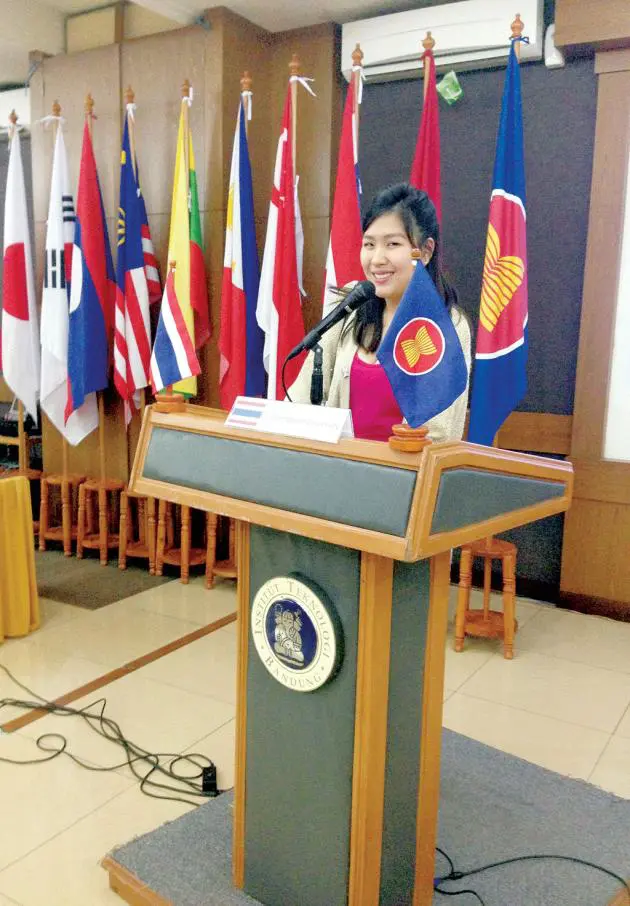
With the maturity of someone much older, Tipaya explains how her view of the region has been evolving as she gets to know neighbouring states, by taking part in events such as the ASEAN + 3 Educational Forum and Young Speakers Contest, held in June this year at the Bandung Institute of Technology, Indonesia, where she placed fourth out of more than 20 contestants.
There, she met a Lao delegate who she already calls a good friend, Maniphet. Tipaya says that getting to know Maniphet has helped her better understand Thailand’s northeastern neighbour. “She’s smart. She speaks English fluently. She speaks Thai fluently. She represents how Lao people know a lot about Thailand. But Thais don’t know a lot about Laos. The Lao speak better English than us. In many ways they are more international than Thais, and yet in Thai, ‘Lao’ can be used as a swearword.”
At previous events focusing on getting young people from around Asean to get together and produce mission statements on issues such as how to take better care of the environment, she has seen fellow savvy youngsters from other Asean nations give presentations. “Singaporeans are very impressive in the way they present their ideas in depth, and are quite charismatic and speak good English. I had this idea of them speaking ‘Singlish’, not English, but what I heard changed my mind. No matter what topic you debate, they will give a very detailed response.
“We must build our cultural awareness and knowledge of our neighbours. We can’t be narrow-minded. It is only by working together and building awareness and acceptance that we can progress. Cultural awareness can be raised by talking to each other.”
In one of the several international events she attended, young delegates discussed issues and produced statements to be dispersed to governments. “What we agreed is that we need to get to know people from other countries. It’s these connections that are most important.”
One year after Tipaya met Hillary Clinton, she had a brief encounter with the top diplomat’s boss in a similar setting when US President Barack Obama was in Bangkok as part of a tour of the region based around the annual Asean leaders’ summit last November. After patiently waiting for three hours to shake his hand, she came away with deep impressions of how leaders operate and can try to make positive change. “Through the power of negotiation, we in Asean can compete in the world. I want to help develop the human resources of Asean. This will give us the ability to build a better society.
“I want people in my generation to wake up. Look at the world and see what you can do for the world. In the future, the world will be in our hands.”
Carleton Cole is a freelance writer and former Nation staffer.
