
Thailand's coloured conflicts always have the same outline - feudalism


Play
Talk to most foreigners about Thai politics and you'll quickly notice they understand little about the multicoloured conflict.
International media report the protests, but usually fail to expose the underlying restlessness that erupts every few years in mass rallies, pointing up the country’s unsuccessful record in using parliamentary channels to solve conflicts.
Over the past few weeks, Thailand has made international headlines again, as demonstrators hit Bangkok’s streets to protest a blanket-amnesty bill they feared would allow former Prime Minister Thaksin Shinawatra to return after five years in exile. Some oppose the bill as a matter of principle, saying all should be held responsible for crimes they commit.
The anti-Thaksin group says it cannot allow such a “massively corrupt criminal” back onto Thai soil. On the other hand, radical red shirts who lost family members during the 2010 protests feel betrayed by legislation that would let those they hold responsible – former prime minister Abhisit and his inner circle – off the hook. A large number of graft cases and criminal charges related to protests would also be swept under the amnesty carpet.
In short, the amnesty bill has accidentally become the mother of all grievances in a polity struggling to become a democracy but still helplessly bound by its feudal past.
But how different is this protest from the last time around?
In 2010, protests against then-prime minister Abhisit Vejjajiva were clearly instigated by red-shirt leaders under the exiled Thaksin, who often appeared by video link to stoke feelings at rallies. The protests were centred on encampments fortified by sharpened bamboo staves at Silom and Ratchaprasong intersections. Former military strategists mobilised forces in guerrilla-type warfare that utilised rifles and M79 grenades, Molotov cocktails, firecracker-loaded slingshots, and burning tyres as deadly weapons. Although 91 red-shirts were allegedly killed by the Army, the military also suffered many deaths and casualties but these were often not mentioned. Bangkok, in April to May 2010, became a war zone, with arson attacks, vandalism, looting, barricades, and armed “men in black” fighting to unseat the Democrat government. At one point, the red shirts stormed into Chulalongkorn Hospital, and grenades were thrown at “multicolour” or “no-colour” demonstrators who came out to protest against the violence. The Abhisit government, facing armed riots and acts of terrorism and civil disobedience, was forced to react with a military crackdown. The result is that Abhisit and his deputy, Suthep Thaugsuban, are now facing murder charges.
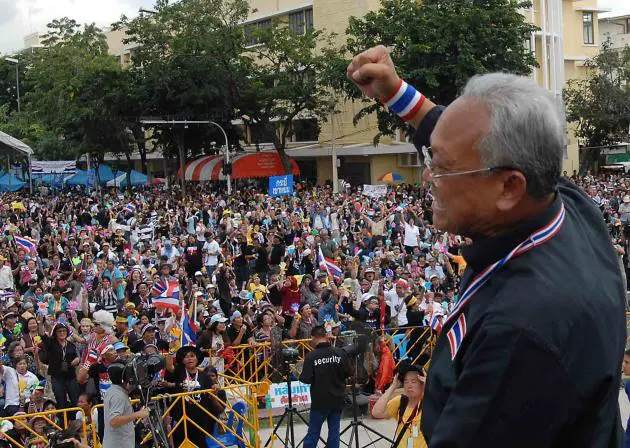
This time round, the protest has been more spontaneous. Although food and facilities at anti-amnesty rallies are being provided by the Democrats, the movement is less organised and consists of people from all walks of life – university professors and students, doctors and nurses, office workers, housewives and businessmen, and ordinary Thais who are not dependent on anybody’s hand-outs.
While the Democrat Party is opportunistically riding the wave, many of those out on the streets protesting are not partisan but merely want to rid the country of a culture of impunity and injustice. The fact that this whistle-blowing movement is peaceful and unarmed (and will remain so unless radical yellow-shirts enter the fray with weapons), means the Yingluck government has not had to call in the Army or use force to control the situation.
To be fair to the Thaksin camp, they do have a clear mandate to govern. They won the election and enjoy the support of the majority of Thais, many of whom remain poor and uneducated. Thailand’s welfare system still lags behind its international peers’ and many poor Thais still feel oppressed by, or jealous of, the well-heeled elite. However, the culture of worshipping the rich and the powerful is intrinsic to Thai society, regardless of which government is in power. The wealthy often enjoy impunity from the law as the country’s institutions are weak and hampered by corruption and red-tape – again, regardless of which political party governs.
As His Majesty has retreated from public life due to old age and the sensitive nature of his role, Thaksin has become a figure of salvation for many, earning their faith and unquestioned allegiance.
On the other hand, the Democrats have failed to win the hearts and minds of poor people in both urban and rural Thailand, who see them as out-of-touch “hi-so” people who do not understand them. The Democrats also have a record of being rather indecisive on big issues, preferring a strategy of play safe and self-preservation. Police and many bureaucrats also see them as stingy, failing to sufficiently oil the administrative wheels with kickbacks and rewards needed for the smooth-running of Thailand’s money politics. Perhaps to counter that image, the Democrat leadership has recently taken a more grassroots approach, using simpler language and trying to get “down and dirty” with the poor in an obvious attempt to expand its popularity.
It is impossible to identify which side is the demon and which the angel. As in all things, nothing is black-and-white and there is always more than one perspective.
Both the red and yellow camps, plus the “multicolour” or “no colour” groups, all have their share of wrongs and prejudices. After all, Thailand is a relatively new democracy and has not yet been able to shed completely the inequality of its old hierarchical, feudal structure. When the culture of patronage hampers the growth of individualism and liberalism, democratic aspirations – no matter how innocent or good-willed – become self-conflicting and unable to fully develop.
The silver lining to the thundercloud of our malfunctioning parliamentary democracy is the growing consensus that military intervention is no longer acceptable as a way to break political impasses. Whether the generals have been forced to accept this or have become genuinely enlightened, the most important thing now is for Thais to educate themselves politically on how to make their democratically elected representatives accountable. Most crucially, Thais must learn to let go of their excessive attachment to any single, mortal individual, and instead respect the rules, regulations and institutions of society. By aspiring to the moral high ground, they may eventually lift the country out of this restless sea of ever-changing coloured conflict.
Galumplee Seemuang is a freelance writer.
