
India's fallen WWI soldiers ignored at home 100 years on


Play
As Britain and her allies commemorate the end of World War I today, former colony India will largely ignore the occasion despite losing tens of thousands of soldiers in the conflict.
Everyone from world leaders to school children are taking part in ceremonies today, November 11, to remember the armistice for the Great War, whose centenary this year gives the occasion extra significance.
But the commemoration will be largely overlooked in India where, for many, the war is an embarrassing reminder of the bloody sacrifices made for its formal colonial master.
“You can’t call it sacrifice, it was surely not patriotism that made them fight,” war expert Mridula Mukherjee says of the 70,000 Indian soldiers who died on the battlefields of Europe.
“It was mostly them looking for employment,” adds Mukherjee, chief historian at Delhi’s Jawaharlal Nehru University.
Mukherjee says 1.2 million Indian soldiers were also motivated to sign up for the war because of Britain’s promises at the time of a greater role in the running of their own country if they fought.
Leading political figures in India, including independence hero Mahatma Gandhi, then backed the effort, believing it would bolster the colony’s claims for self-government.
Indian soldiers arrived on the Western Front in late September of 1914, equipped with just two machine guns per battalion and dressed in thin cotton uniforms that offered no protection against the bitter European winter.
Volunteer army
At a ceremony in New Delhi recently, British defence minister Michael Fallon, flanked by top military brass and politicians from both countries, paid tribute to India’s soldiers.
“We must not and we will not ever forget the enormous service rendered by India’s heroes,” Fallon said after laying a wreath at the India Gate memorial.
“Their courage is all the more remarkable for being entirely voluntary. Not a single Indian was conscripted.”
Far from acknowledging their contribution, however, many in India, a British colony for 200 years, have chosen to ignore the past. Some are ashamed its soldiers volunteered to fight for a country that had long kept them in servitude, experts say.
“In those days, it was not considered heroic to be fighting for your ‘masters’,” says Vedica Kant who has written a book called “The Indian Heroes of WWI”.
“Hence, many of those soldiers’ voices went unheard, their stories unwritten.”
Indian soldiers became the largest volunteer force in history when 2.5 million also fought for Britain during World War II, according to official figures, before the country finally gained independence in 1947.
Few reminders
Today, India’s army is not planning anything special to commemorate the occasion, preferring to hold fire for Republic Day and Armed Forces Day. “There may be some ceremonies here or there, but nothing that I know of,” spokesman Rohan Anand says.
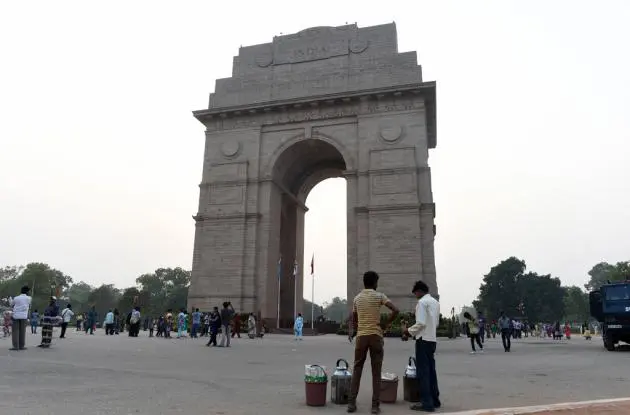
The giant India Gate memorial in the capital is one of the few stark reminders of the country’s world war past. The British-built sandstone arch is a notable landmark, drawing thousands of visitors every year.
But few snapping selfies at the monument recently could accurately describe its significance.
“Gandhi made it when we got independence from the British in 1947?” suggests 19-year-old Saksham Jain. Hawker Babu Ahmed, 35, who has been selling tea at the monument for 12 years, shrugs and says “who cares as long as you get visitors”.
During the recent ceremony in Delhi, relatives of fallen soldiers beamed with pride as British embassy officials gifted them digitised war diaries of Indian troops who fought in France and Belgium’s Flanders.
But some wondered why the soldiers had never been honoured in such a way by their own governments.
“Finally after 100 years a foreign country has recognised my grandfather’s contribution to WWI, something the Indian government could never do,” said 75-year-old Baljit Singh, a retired colonel.
“My grandfather and his fellow men sacrificed their lives in the hope of early independence from the British, but nobody saw that.
“No recognition, no books, nothing – only the families who sent their own know what they went through and for what.”
